
← All sectors / The AI transformation
173 · Distributed energy resources & microgrids
Generation where the load is
Curve position
Binding constraint
Interconnection rules that were written assuming one way power flow.

When the grid cannot deliver more power to a site and cannot guarantee reliability, generating on site stops being an environmental choice and becomes an operational requirement. Data centres, hospitals, factories, and campuses are all reaching that point.
Historically on site generation meant a diesel generator for emergencies, sized for outages measured in hours and used a few times a year.
The structural driver is interconnection scarcity plus reliability. Facilities that cannot get grid capacity on their timeline build their own, and facilities that cannot tolerate outages stop relying on a grid under increasing stress.
The technology layer spans on site generation from gas turbines to fuel cells, storage, microgrid controllers that island a site from the grid seamlessly, demand response participation, and the software that optimises across all of it.
Adoption economics work through avoided outage cost and through demand charge management, with the option to sell services back to the grid adding a second revenue stream.
The beneficiaries include microgrid developers, generation equipment makers, controller and switchgear manufacturers, energy as a service providers financing installations, and the software firms optimising dispatch.
The value chain runs from equipment through integration and controls to operation. Controls are what turn assembled equipment into a microgrid rather than a collection of generators.
The overlooked layer includes microgrid controller makers, switchgear and protection equipment suppliers, energy as a service financiers, and the engineering firms designing systems.
Competitive dynamics favour developers who can finance projects off the customer's balance sheet, since capital availability rather than technology usually decides whether a project proceeds.
Risks: interconnection rules for exporting power vary and can be restrictive, gas price volatility affects economics, utility opposition to customer generation is real in some jurisdictions, and equipment lead times are long.
What to watch: microgrid installations at large facilities, interconnection rule changes for distributed generation, energy as a service contract volumes, and demand response programme participation.
Coverage / Daily Disruptor issues in this sector

August 26, 2026
Daily Disruptor: $NRGV, The $2 Billion Backlog The Market Forgot
Energy Vault just signed the largest contract in its history, a 1.25 GW deal worth up to $600 million, and most Wall Street analysts have not…
Read the issue →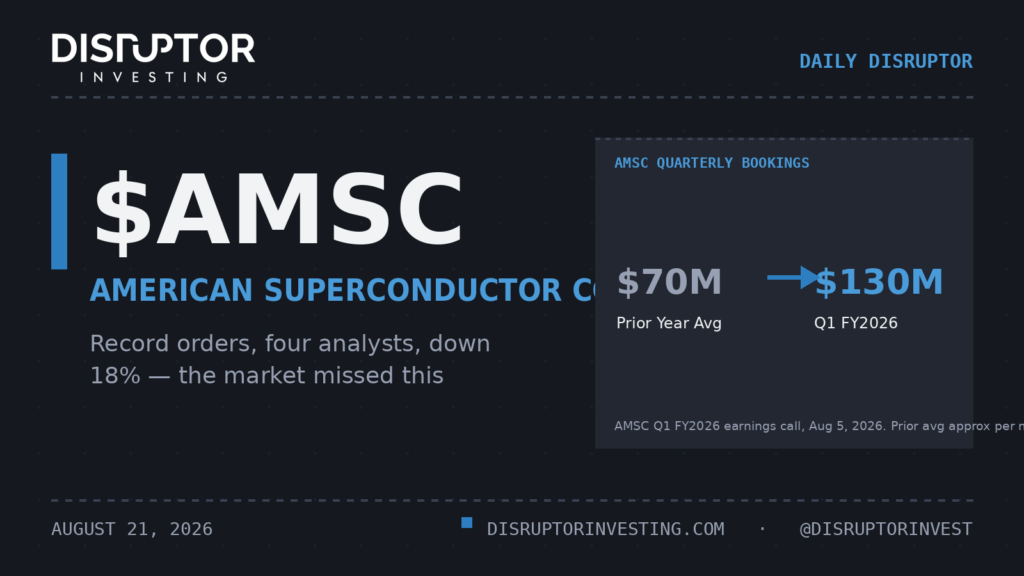
August 21, 2026
Daily Disruptor: $AMSC, Grid Hardware Nobody Is Watching
AMSC booked over $130 million in new grid orders in a single quarter while the stock traded near a twelve month low with only four analysts…
Read the issue →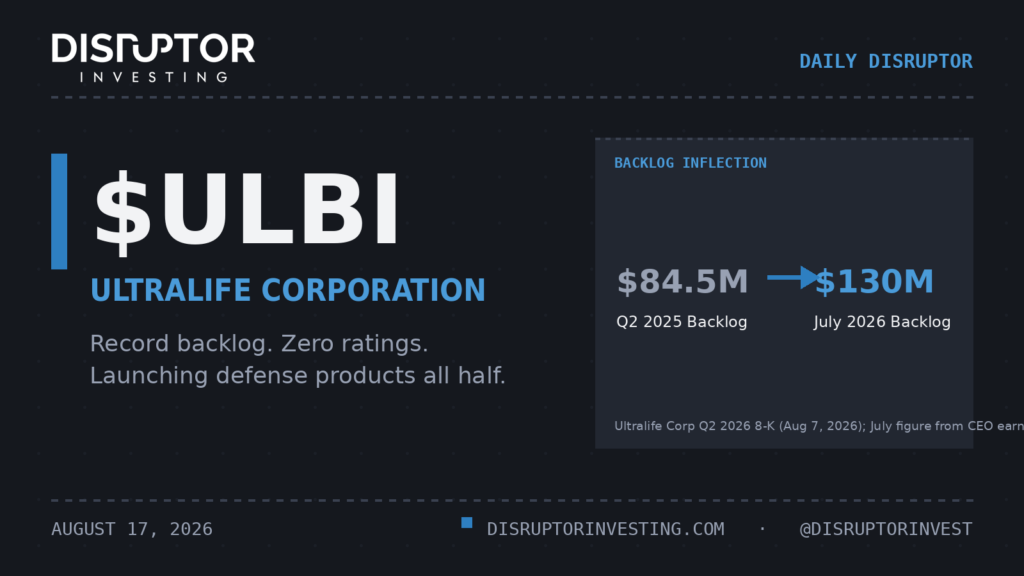
August 17, 2026
Daily Disruptor: $ULBI, The Defense Battery With a $130M Backlog and Nobody Watching
Ultralife just reported its highest backlog in company history, a 500-basis point gross margin expansion, and a 39% jump in its higher margin communications segment, yet…
Read the issue →