
The 30 second version
- What it does: American Superconductor (AMSC) makes power quality and voltage stabilization hardware for electric utilities, data centers, LNG terminals, mines, and wind farms across the U.S., Europe, and Latin America.
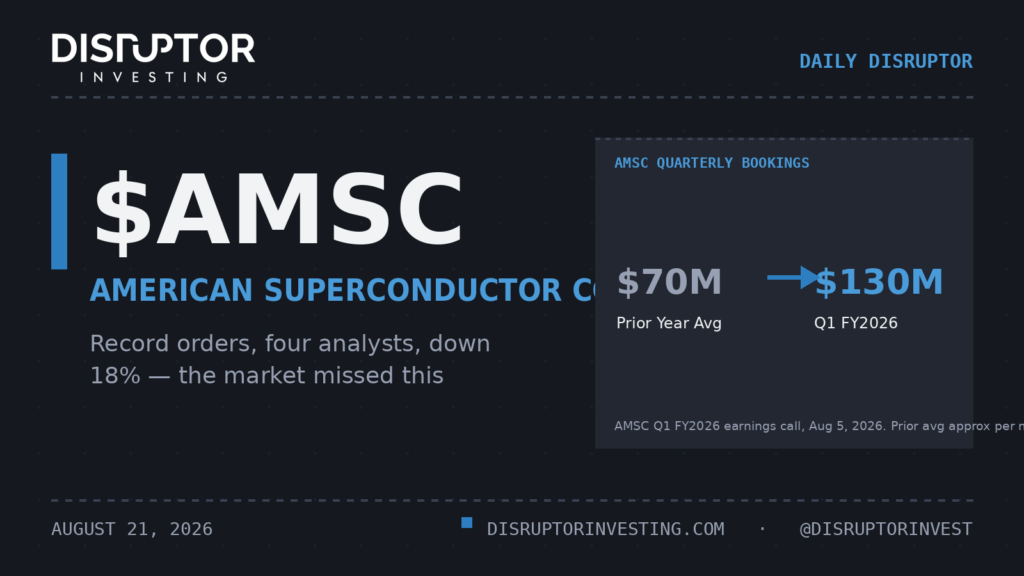
- The number: Bookings exceeded $130 million in Q1 FY2026 (quarter ended June 30, 2026), nearly double the prior year quarterly average, lifting total backlog above $400 million.
- The catalyst: Q2 FY2026 earnings print, expected around November 4, 2026, when management guidance of revenue above $85 million runs up against a $0.23 analyst consensus EPS estimate.
- The main risk: A disclosed material weakness in acquisition accounting controls, which has not yet been remediated, could force a restatement and cloud the story regardless of operational progress.
- Market cap: Approximately $1.58 billion. Four analysts cover the name. Stock is down roughly 18% over the past twelve months.
American Superconductor booked over $130 million in new orders in the quarter ended June 30, 2026, the highest single quarter total in the company’s history, while revenue reached a record $94.1 million, up 30% year over year. The stock closed last week at roughly $32.77, down about 18% from a year ago. Those two facts do not belong in the same sentence, and that tension is where the thesis lives.
The reason the market has not responded is partly mechanical. A one time $118 million tax benefit in fiscal 2025 (the year ended March 31, 2026) inflated reported earnings to a point that made the underlying business difficult to read, and a Q2 guidance number slightly below analyst consensus gave cautious investors an exit. Four analysts cover the name. That is a feature, not a flaw.
What just happened
On August 5, management reported that orders in Q1 FY2026 exceeded $130 million, “led by utility sector mining developments and traditional energy markets,” and that the 12-month backlog now exceeds $300 million, with total backlog above $400 million. The company generated $16 million in operating cash flow during the quarter. That is a company with real project momentum, not a story stock.
The standout booking was a $25 million turnkey order for a North American mine expansion, described as the largest individual mining order in AMSC’s history. The scope runs from STATCOM voltage stabilizers and capacitor banks to shunt reactors, a 138-kilovolt transformer, switchgear, and protection and control equipment. A single mine order touching six product lines is not a commodity sale. It is the kind of bundled contract that only lands when a customer trusts the supplier across the full stack. Delivery runs into fiscal 2027, which locks in forward revenue.
Even stripping out that contract, AMSC booked more than $100 million in orders during the quarter, roughly 40% above its prior quarterly average. That pace of new business, sustained for two or three more quarters, would push total backlog well above $500 million against a company with roughly $380 million in trailing twelve month revenue.
The business
American Superconductor provides power resiliency and voltage control hardware for electric utilities, industrial facilities, renewable energy developers, and naval customers through two segments: Grid and Wind. Grid is the story and accounted for 81% of Q1 FY2026 revenue, rising 27% year over year. The products sit at the point where variable renewable generation meets the transmission system: reactive power compensation, voltage regulation, harmonic filtering, and increasingly, full turnkey substation solutions. These are not commodities. Lead times on competing equipment from ABB and Siemens Energy now stretch two to four years, and AMSC’s domestic manufacturing gives it a positioning advantage in the current tariff environment.
In December 2025, AMSC acquired Comtrafo, a Brazilian maker of utility scale power and distribution transformers. The deal cost roughly $84 million in cash and 2.4 million shares. Comtrafo serves utilities, industrials, and telecom operators in a $1.5 billion annual Brazilian transformer market, with more than $20 billion in planned national grid investment in the pipeline. AMSC is now the only U.S.-listed grid hardware company with a manufacturing base in Latin America. The detail that stands out in the filings: Comtrafo’s Q1 contribution accounted for a meaningful share of Grid revenue, yet order intake in Brazil is still in its early ramp. The acquisition adds capacity, not just revenue.
End market breakdown in Q1 tells you something about resilience. Renewable energy projects contributed roughly 30% of revenue. Traditional energy, semiconductor adjacent utility work, and grid utility projects each contributed about 20%. Military roughly 10%. No single sector can kill the quarter. That breadth is unusual for a company under $2 billion in market cap.
The numbers
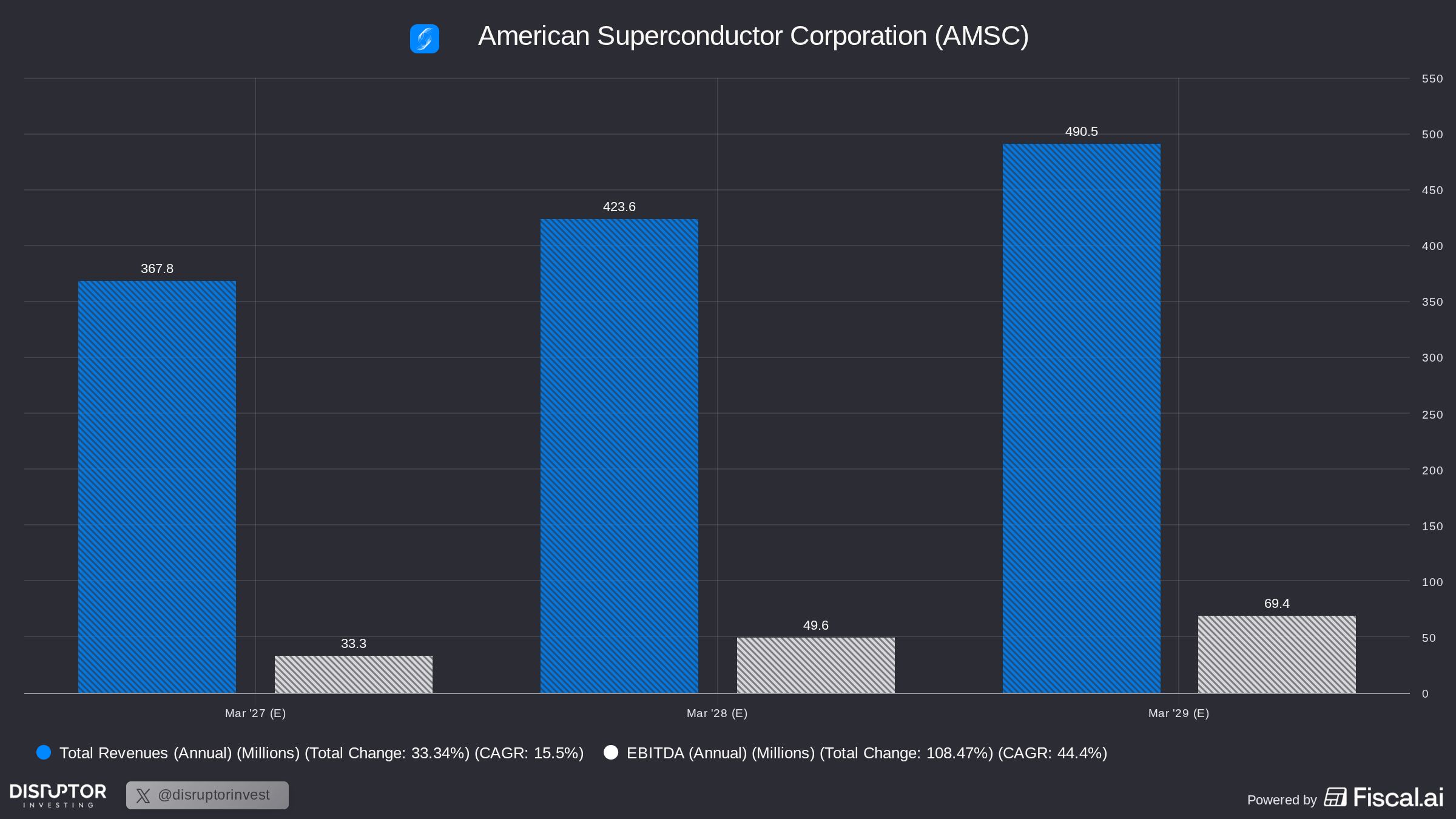
Full year FY2025 revenue (ended March 31, 2026) came in at $299 million, up 34% year over year, with approximately 25% of that growth organic and the rest from acquisitions. The 12-month backlog ended the year up nearly 40% at about $280 million. Since then, Q1 FY2026 added to both figures: revenue of $94.1 million (another record) and a booking quarter that pushed the 12-month backlog above $300 million and total backlog past $400 million. Cash as of June 30 was $153.1 million. There is no meaningful debt. No dilution risk inside two quarters.
For Q2 FY2026 (ending September 30, 2026), management guided revenue above $85 million and non GAAP net income above $8 million, or $0.17 per share. The analyst consensus for Q2 EPS sat at $0.23 before the call. That $0.06 gap is the surface reason the stock sold off after Q1 results. We read the conservative guide differently: management has beaten its own revenue guidance in every quarter for the past year, the 12-month backlog now covers roughly 80% of the guided quarter at entry, and the $130 million booking wave has not yet had time to convert. The gap between $0.17 guidance and $0.23 consensus is often where upside lives. Only four analysts sit on either side of that trade.
The trailing PE is listed at roughly 10.6x, which looks misleadingly cheap because it includes the $118.4 million tax benefit release. Normalized forward earnings put the multiple closer to 32x. That is not inexpensive, but a 30% revenue grower with $400 million in backlog and a net cash position, selling at 1.5x trailing revenue, is not the valuation profile of a company the market has already figured out. The consensus twelve month price target across four analysts is $62.50, against a current price of roughly $32.77.
Why the market has not caught up
Four analysts. That is the whole positioning story in two words. The Comtrafo acquisition came with a disclosed material weakness in acquisition accounting controls, which spooked the handful of institutions that look at this name, and the one time tax benefit created a reported earnings number that was essentially unanalyzable. The result was a stock that went sideways for twelve months while the underlying revenue base grew 30% and the backlog nearly doubled. Short interest sits at about 6.9% of shares, moderate and not reflecting a crowded thesis in either direction.
The specific gap: the market appears to be pricing AMSC as though the Comtrafo acquisition was dilutive overhead rather than an entry into a $1.5 billion transformer market with $20 billion of planned national grid capex behind it. The price implies near zero credit for the Brazilian book of business, zero credit for the record order pipeline, and a multiple that would be appropriate for a company growing at mid single digits. That is the argument. The price has not moved to reflect what the filings show.
What breaks it
The material weakness in acquisition accounting is the single most important near term risk. If the weakness requires a restatement covering Comtrafo’s first two quarters of contribution, the timeline disruption and the credibility hit would weigh on the stock regardless of operational results. AMSC has not disclosed a restatement as of today, and management said on the August 5 call that remediation is underway. But we cannot size that risk from the outside, and anyone owning this name should treat it as a live threat until the next 10-Q is filed clean.
The second risk is order lumpiness. The $130 million Q1 booking total was exceptional. Management’s own prior year quarterly average was approximately $70 million. If Q2 orders revert toward that level, the thesis around accelerating backlog growth weakens materially. Shares outstanding also rose about 16% in the past year, partly from the Comtrafo share issuance, which is a dilution rate worth monitoring even if the balance sheet is currently clean.
What we are watching
- November 4, 2026 (approx): Q2 FY2026 earnings print. The key test is whether revenue beats the $85 million floor and whether orders for the July September quarter show the $100 million plus run rate held for a second consecutive period. If both conditions are met, the guidance consensus gap closes, and the next round of estimate revisions forces coverage expansion.
- Next 10-Q filing (due ~November 2026): Material weakness status. Any disclosure of remediation completion removes the single largest overhang. Any disclosure of scope expansion or a restatement changes the thesis materially.
- FY2027 mining order delivery (referenced on the August 5 call): Management confirmed the $25 million North American mining turnkey project is set for delivery in fiscal 2027. If the November call references it as on track, the backlog conversion timeline becomes visible and reduces execution risk for the largest single order in the book.
Not financial advice.
References
- American Superconductor Corporation. Form 8-K (Exhibit 99.1): Q1 Fiscal 2026 Financial Results and Business Outlook. US Securities and Exchange Commission. Published August 5, 2026. Accessed August 21, 2026. https://www.sec.gov/Archives/