
← All sectors / The AI transformation
116 · Digital identity & verifiable credentials
Proving who you are without oversharing
Curve position
Binding constraint
Issuer adoption, since a credential is worthless until institutions issue it.
Why this sector sits at Liftoff
Verifiable credentials moved from standards work to mandated deployment in several jurisdictions with compliance dates attached.
This is Liftoff: the constraint was the absence of a mandate, that has changed, and rollout has barely begun.
Reviewed on a two month cycle. The position moves only when a dated, verifiable change in the binding constraint justifies it.

Every online interaction that needs proof of something currently works by handing over a document containing far more than the thing being proved. Verifiable credentials let someone prove a single fact without disclosing the rest, and regulation is starting to require exactly that.
Historically identity online meant a username and a password, then a photograph of a passport uploaded to whoever asked. Both approaches are poor, and the second creates enormous liability for whoever stores the image.
The structural driver is regulation. Age verification requirements, digital identity frameworks in several jurisdictions, and rules limiting how long identity documents may be retained all push toward credentials rather than document copies.
The technology layer spans issuance by governments and institutions, digital wallets holding credentials, selective disclosure and zero knowledge proofs, verification services, and the trust registries establishing which issuers count.
Adoption economics face a genuine chicken and egg problem. A credential is useless until issuers issue it and verifiers accept it, and neither moves first without regulation or a very large platform pushing.
The beneficiaries include identity verification firms, wallet providers, credential infrastructure vendors, and the government contractors building national schemes.
The value chain runs from issuer through wallet to verifier. Issuance is the bottleneck, which is why government schemes matter more than private products here.
The overlooked layer includes document verification vendors serving the transition period, age estimation technology, trust registry operators, and the identity proofing services behind issuance.
Competitive dynamics depend on standards adoption rather than product quality, which historically has made this category slower than its advocates expect.
Risks: adoption has been predicted for a decade and repeatedly disappointed, standards remain fragmented, privacy advocates oppose some implementations, and government schemes move slowly.
What to watch: national digital identity launches, age verification enforcement, wallet adoption rates, and major platforms accepting verifiable credentials.
Coverage / Daily Disruptor issues in this sector

September 11, 2026
Daily Disruptor: $INDI, the ADAS chip maker growing 30% that nobody’s talking about
indie Semiconductor just guided for 30% year over year growth in Q3 while its stock still trades 44% below its 52-week high, a gap that looks…
Read the issue →
September 3, 2026
Daily Disruptor: $AAON, Revenue Doubled and the Stock Is at a 52-Week Low
AAON just posted the most dramatic acceleration in its 35-year history, with Q2 revenue doubling year over year, yet the stock trades near a 52-week low…
Read the issue →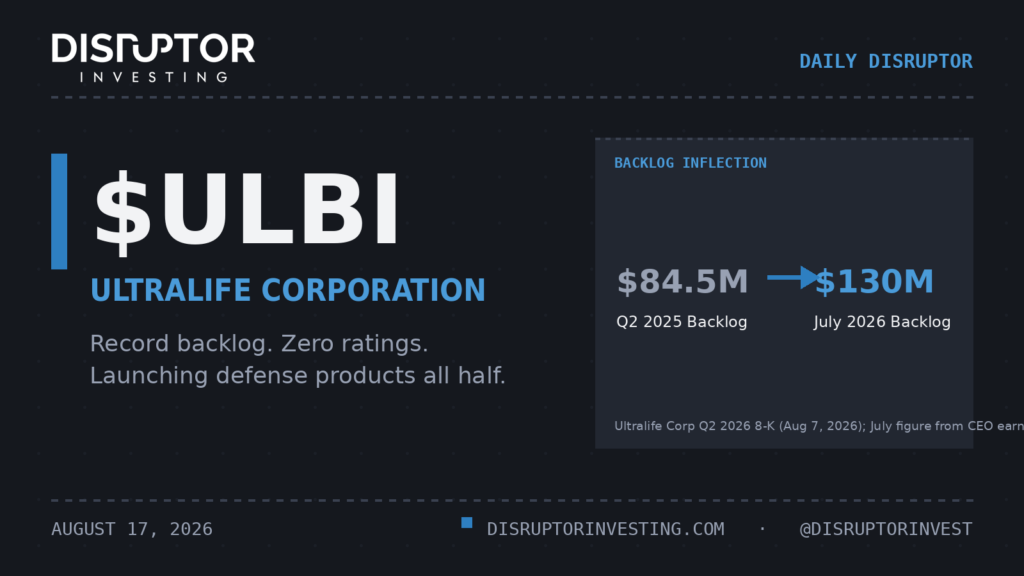
August 17, 2026
Daily Disruptor: $ULBI, The Defense Battery With a $130M Backlog and Nobody Watching
Ultralife just reported its highest backlog in company history, a 500-basis point gross margin expansion, and a 39% jump in its higher margin communications segment, yet…
Read the issue →