
← All sectors / The AI transformation
039 · Fusion energy
The power source that never arrives
Curve position
Binding constraint
Sustained net energy gain at commercial scale, and the magnet supply chain behind it.

Fusion has been twenty years away for sixty years. What changed recently is not the promise but the evidence: ignition has been demonstrated in a laboratory, superconducting magnet performance has jumped, and private capital has committed billions to companies targeting grid connection in the 2030s rather than the 2060s.
Historical context matters here because the skepticism is earned. Decades of government programs produced physics but no electricity, and every previous funding wave ended in disappointment. The difference in this cycle is that the money is private, the timelines are contractual, and several designs are being built rather than modeled.
The structural driver is the same one reshaping the entire energy complex: aI and electrification have created demand for firm, carbon free power that no existing source fully satisfies. Nuclear fission is the near term answer. Fusion is the option on the far end of the curve, and utilities and hyperscalers are paying to hold that option.
The technology layer splits across approaches. Tokamaks using high temperature superconducting tape are the most funded path. Inertial confinement, stellarators, and magnetized target designs each have backers. The engineering constraints are shared: plasma confinement, tritium breeding, materials that survive neutron bombardment, and heat extraction.
Adoption economics do not exist yet, and pretending otherwise is how investors get hurt in this sector. There is no fusion electricity being sold. What exists is a supply chain being built, with orders flowing to magnet makers, cryogenic specialists, vacuum systems, and precision fabricators years before any plant operates.
The beneficiaries you can actually own are therefore suppliers rather than developers. High temperature superconducting tape manufacturers, cryogenic equipment makers, specialty metals and tungsten suppliers, precision machining firms, and the engineering contractors doing the builds all book revenue regardless of which design wins.
The value chain runs from materials through components to reactor assembly and eventually to power sales. Every dollar of private fusion funding flows down that chain long before it flows back, which is why the supplier tier is the investable expression of this thesis today.
The overlooked layer is genuinely obscure: small cap specialty materials producers, superconducting wire manufacturers, cryogenic and vacuum equipment suppliers, and the industrial firms quietly winning fusion contracts inside otherwise unrelated businesses.
Competitive dynamics are shaped by capital access and national programs. Sovereign funds and defense adjacent budgets are participating, and countries treat fusion capability as strategic. That guarantees the field cannot simply be abandoned, even if individual companies fail.
The risks are as large as they get. Timelines will slip. Most current designs will not reach commercial power. Pure play exposure is venture risk wearing a stock ticker, dilution is the funding model, and the sector is vulnerable to a single high profile failure resetting sentiment for years. Position sizing here is the entire strategy.
What to watch: net energy gain milestones from private programs, magnet performance and tape production capacity, power purchase agreements signed for future delivery, and supplier order books. The research treats fusion as a supply chain story today and an energy story much later.
Coverage / Daily Disruptor issues in this sector

September 4, 2026
Daily Disruptor: $STDN, America’s only TRISO fuel maker just delivered its first reactor core
Standard Nuclear delivered the first commercially produced TRISO fuel reactor core in US history last quarter, its backlog has grown six fold in six months, and…
Read the issue →
September 2, 2026
Daily Disruptor: $ALOY, The Army’s Rare Earth Tenant
REalloys is days from finalizing a lease to build the only heavy rare earth processing facility on a U.S. military installation, and a January 2027 defense…
Read the issue →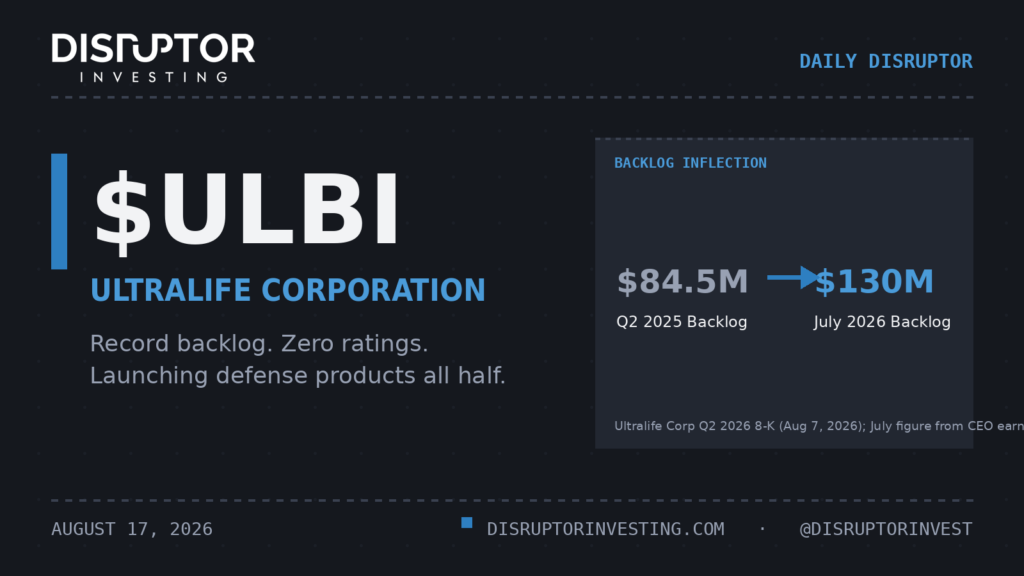
August 17, 2026
Daily Disruptor: $ULBI, The Defense Battery With a $130M Backlog and Nobody Watching
Ultralife just reported its highest backlog in company history, a 500-basis point gross margin expansion, and a 39% jump in its higher margin communications segment, yet…
Read the issue →