
← All sectors / The AI transformation
021 · Water & environmental services
The other utility
Curve position
Binding constraint
Municipal budgets and permitting for treatment capacity.
Why this sector sits at Liftoff
Water infrastructure funding and contamination rules with compliance deadlines created a dated demand change rather than a general trend.
Liftoff: spending is committed, deployment is early.
Reviewed on a two month cycle. The position moves only when a dated, verifiable change in the binding constraint justifies it.

Water is the buildout's quiet dependency: data centers consume it for cooling, chip fabs demand ultrapure volumes measured in millions of gallons daily, and the communities hosting both are asking hard questions. Water and environmental services are becoming strategic infrastructure with AI on both sides of the meter.
Historical context: water infrastructure has been chronically underfunded for generations: buried, invisible, and politically easy to defer. Aging systems, new contamination standards, and industrial demand growth are now converging on that deferred maintenance bill at once.
The structural driver is regulatory and industrial simultaneously: contamination rules (PFAS above all) mandate treatment spending measured in tens of billions, while fabs and data centers bring demanding industrial customers into water systems sized for households.
The technology layer spans advanced treatment (membranes, ion exchange, destruction technologies for persistent contaminants), smart metering and leak detection AI that finds the enormous share of treated water lost in distribution, and the digital twin software optimizing plants that once ran on operator intuition.
Adoption economics favor the sector's structure: regulated utilities earn returns on mandated capital spending, service companies bill remediation programs that run for decades, and industrial customers pay premium rates for guaranteed quality and reuse systems.
The beneficiaries include water utilities with constructive regulation, treatment equipment and membrane makers, testing and analytics laboratories riding every new standard, engineering firms designing the upgrades, and the pump, valve, and instrumentation suppliers inside every project.
The value chain runs from source and treatment through distribution to reuse and disposal, with a parallel industrial chain serving fabs and data centers directly. Ultrapure water systems for semiconductors are a specialty niche with qualification moats resembling chip materials.
The overlooked layer is small cap rich: regional treatment specialists, PFAS testing labs, water reuse technology vendors, irrigation efficiency plays overlapping agriculture, and the environmental remediation firms whose backlog compounds with every enforcement action.
Competitive dynamics are localized and relationship driven, municipal procurement favors incumbency and consolidators roll up fragmented service providers, while the industrial segment competes on guaranteed uptime and purity, where technical reputation is the moat.
Risks: municipal budgets and rate cases move slowly; regulation can shift with administrations; remediation liability cuts both ways for service providers; and drought or flood cycles scramble regional economics unpredictably.
What to watch: contamination rule enforcement timelines, utility capital plan approvals, data center and fab water commitment disclosures, and backlog at treatment and testing specialists. The research treats water as the other utility the AI buildout cannot route around.
Coverage / Daily Disruptor issues in this sector

August 26, 2026
Daily Disruptor: $NRGV, The $2 Billion Backlog The Market Forgot
Energy Vault just signed the largest contract in its history, a 1.25 GW deal worth up to $600 million, and most Wall Street analysts have not…
Read the issue →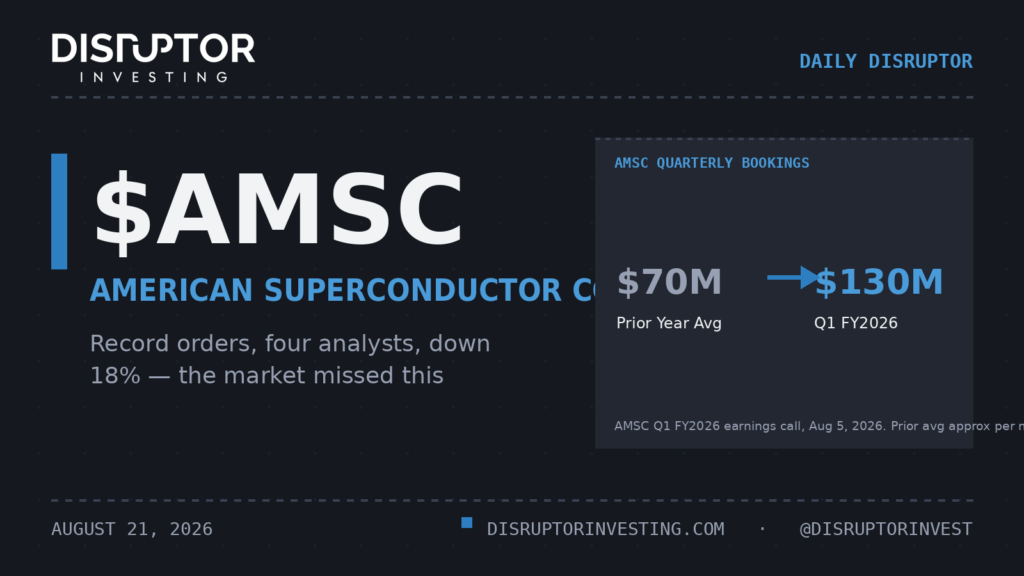
August 21, 2026
Daily Disruptor: $AMSC, Grid Hardware Nobody Is Watching
AMSC booked over $130 million in new grid orders in a single quarter while the stock traded near a twelve month low with only four analysts…
Read the issue →
August 5, 2026
Daily Disruptor: $FRVO, The Drill Bit Has Already Turned
Fervo Energy reports Q2 results on August 12 and targets first commercial power from Cape Station in Q4 2026, the event that converts a $7.2 billion…
Read the issue →