
← All sectors / The AI transformation
079 · Privacy enhancing technologies
Using data without seeing it
Curve position
Binding constraint
Performance overhead, which still makes the private path slower than the exposed one.
Why this sector sits at Liftoff
Privacy preserving computation became commercially necessary once model training on sensitive data collided with regulation. The constraint was performance overhead, and hardware and technique improvements reduced it.
Liftoff, because the requirement is now real and dated while adoption is still early.
Reviewed on a two month cycle. The position moves only when a dated, verifiable change in the binding constraint justifies it.
The most valuable training data sits in places it cannot legally leave: hospitals, banks, governments. Privacy enhancing technologies let models learn from that data without it ever being centralized or exposed, which unlocks datasets that are otherwise unusable.
Historically the answer was anonymization, which repeatedly proved reversible, and contracts, which are only as good as the counterparty. Neither satisfied regulators, so the data mostly stayed unused.
The structural driver is regulation plus data hunger. Privacy law restricts movement of personal and health data at the same moment that model performance depends on more of it, and the tension has to resolve technically.
The technology layer spans confidential computing in hardware enclaves, federated learning that trains across silos, homomorphic encryption that computes on encrypted values, secure multiparty computation, differential privacy, and synthetic data generation.
Adoption economics work where the data is otherwise inaccessible. If the alternative is no model at all, a performance penalty is acceptable, which is why healthcare, financial consortia, and government are the early buyers.
The beneficiaries include confidential computing hardware and platform vendors, federated learning specialists, synthetic data companies, and the cloud providers offering enclave based services.
The value chain runs from silicon enclaves through platform software to applications in regulated industries. Hardware support is the foundation, which ties part of this thesis to chip roadmaps.
The overlooked layer includes synthetic data vendors, secure enclave software firms, data clean room providers serving advertising and healthcare, and the consultancies implementing these architectures.
Competitive dynamics are early and fragmented, with hyperscalers offering baseline capability and specialists competing on performance and specific regulatory approvals.
Risks: performance overhead limits adoption, the category is technically complex to sell, hyperscalers may commoditize the base layer, and regulatory pressure could ease rather than intensify in some jurisdictions.
What to watch: confidential computing adoption in cloud regions, healthcare and financial data consortia forming, synthetic data acceptance by regulators, and hardware enclave capability in new server silicon.
Coverage / Daily Disruptor issues in this sector

September 2, 2026
Daily Disruptor: $ALOY, The Army’s Rare Earth Tenant
REalloys is days from finalizing a lease to build the only heavy rare earth processing facility on a U.S. military installation, and a January 2027 defense…
Read the issue →
August 27, 2026
Daily Disruptor: $WHD, The Wellhead That Drills Into Geothermal
After doubling its revenue base with a single acquisition, Cactus is now positioned at the intersection of Middle East oilfield spending and the coming wave of…
Read the issue →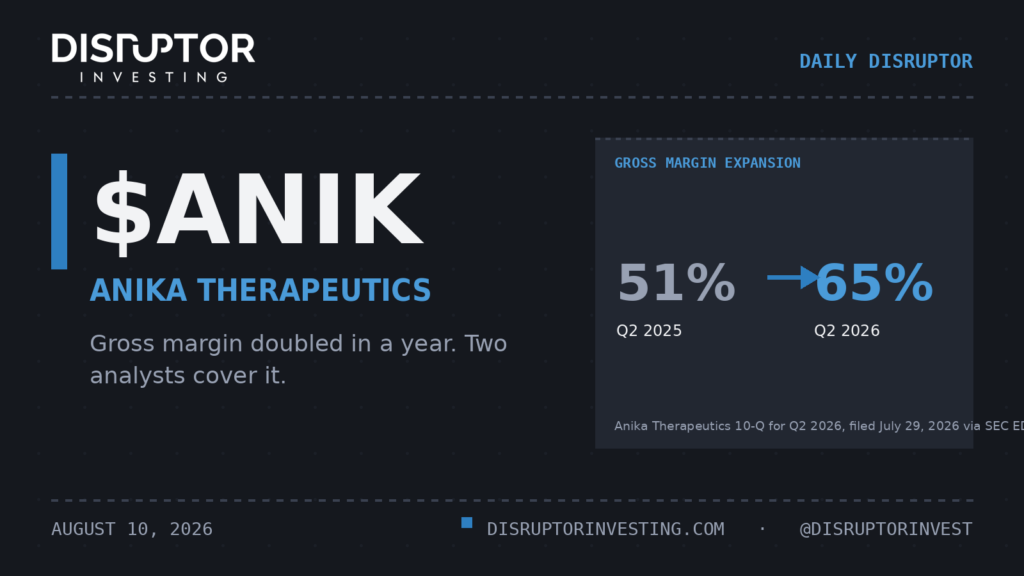
August 10, 2026
Daily Disruptor: $ANIK, a micro cap orthobiologics turnaround the street hasn’t priced
Anika Therapeutics just posted its best adjusted EBITDA quarter since 2020, beat the earnings consensus by more than 1,000%, and nobody noticed.
Read the issue →