
← All sectors / The AI transformation
069 · Digital twins & industrial simulation
Testing before building
Curve position
Binding constraint
Data quality from the physical asset, without which the twin drifts from reality.
A digital twin is a live model of a physical thing, fed by sensor data, used to predict behavior before committing to it. The concept is old. What is new is enough compute and enough sensors to make it accurate.
Historically simulation was a design phase activity that ended when the product shipped. Connecting the model to the operating asset turns it into an operations tool, which is a much larger and more recurring market.
The structural driver is the cost of physical iteration. Testing a grid configuration, a factory layout, or a flight control change in reality is expensive and sometimes dangerous. In simulation it is cheap and repeatable.
The technology layer spans physics simulation, sensor integration and data pipelines, reduced order models fast enough to run in real time, visualization, and the AI surrogate models that approximate expensive physics.
Adoption economics work where downtime or failure is expensive: aerospace, energy, heavy manufacturing, and increasingly data center design where thermal and power modeling determines capacity.
The beneficiaries include industrial software vendors, simulation specialists, sensor and connectivity suppliers, and the engineering services firms that build and maintain twins for clients.
The value chain runs from sensors through data infrastructure to simulation software and engineering services. Software vendors embedded in engineering workflows hold the strongest positions.
The overlooked layer includes industrial sensor makers, data historian and connectivity vendors, niche simulation firms in specific physics domains, and engineering services companies implementing the technology.
Competitive dynamics favor the established engineering software vendors who already own the design tools, since a twin built on the original design model is easier to maintain.
Risks: industrial software sales cycles are long, data quality from legacy assets is frequently poor, projects fail when the model diverges from reality, and customer capital spending is cyclical.
What to watch: industrial software revenue growth, twin deployments disclosed with named assets, sensor attach rates on new equipment, and engineering services backlogs.
Coverage / Daily Disruptor issues in this sector

September 2, 2026
Daily Disruptor: $ALOY, The Army’s Rare Earth Tenant
REalloys is days from finalizing a lease to build the only heavy rare earth processing facility on a U.S. military installation, and a January 2027 defense…
Read the issue →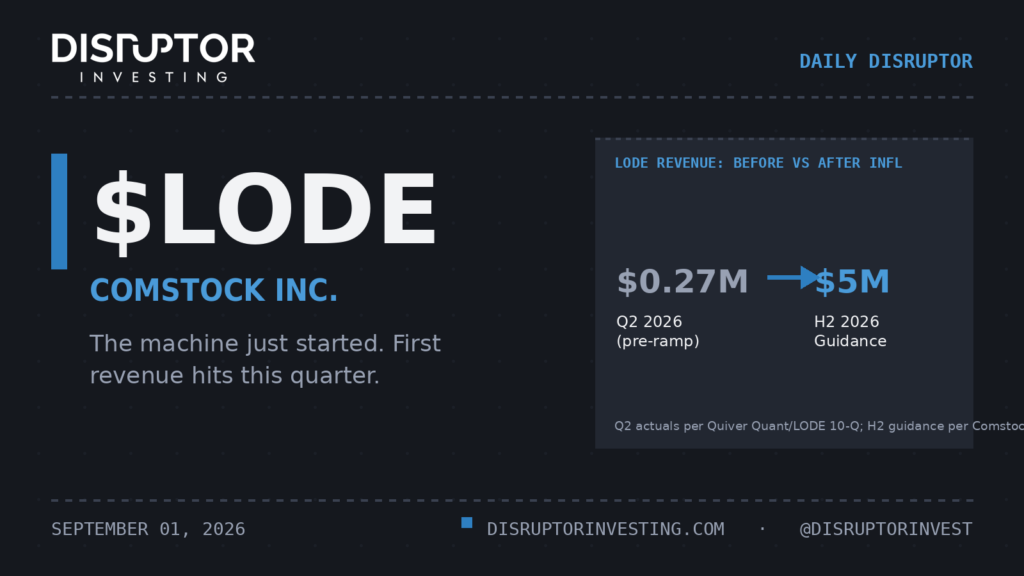
September 1, 2026
Daily Disruptor: $LODE, North America’s First Certified Solar Recycler Turns On
Comstock's industry scale solar panel recycling plant, North America's first certified zero landfill operation of its kind, just completed full system testing and is targeting its…
Read the issue →