
← All sectors / The AI transformation
058 · Construction robotics & industrialized building
Manufacturing the building
Curve position
Binding constraint
Trade adoption on fragmented job sites where every project is bespoke.
Construction productivity has been flat for decades while manufacturing multiplied. The difference is repeatability: factories make the same thing repeatedly, sites make something different every time. Industrialized construction attacks that by moving work into factories and putting robots on the parts that do repeat.
Historical context: prefabrication has been tried and abandoned in cycles since the postwar era, usually failing on transport costs, design inflexibility, or financing structures that were never built for factory produced buildings.
The structural driver is labor. Skilled trades are retiring faster than replacements arrive, wage inflation is persistent, and the housing and data center construction pipelines cannot be delivered with the workforce that exists.
The technology layer spans volumetric and panelized prefabrication, site robotics for layout, drywall, welding, and bricklaying, autonomous heavy equipment for earthmoving, computer vision for progress tracking, and the design software that makes buildings manufacturable.
Adoption economics work best on repeatable building types: data centers, warehouses, hotels, multifamily housing, and healthcare facilities where the same module repeats dozens of times across a project.
The beneficiaries include prefabrication manufacturers, construction robotics firms, autonomous heavy equipment makers, building products companies supplying factory built assemblies, and the contractors who adopt earliest on repeatable work.
The value chain runs from design through factory production to site assembly and finishing. Factories with committed pipelines are the scarce asset, since utilization determines whether the model works at all.
The overlooked layer includes building products manufacturers positioned for prefabrication, equipment rental firms adding robotics, construction software vendors, and engineering firms specializing in modular design.
Competitive dynamics are regional because modules are expensive to transport. That limits scale advantages and favors operators with dense local pipelines rather than national ambitions.
Risks: prefabrication has a long history of bankruptcies driven by underutilized factories, construction demand is rate sensitive and cyclical, trade and union resistance is real, and financing structures still disadvantage factory built projects.
What to watch: factory utilization rates at prefabrication companies, data center and multifamily pipeline commitments, robotics deployments converting from pilot to standard practice, and building code acceptance of modular methods.
Coverage / Daily Disruptor issues in this sector
September 9, 2026
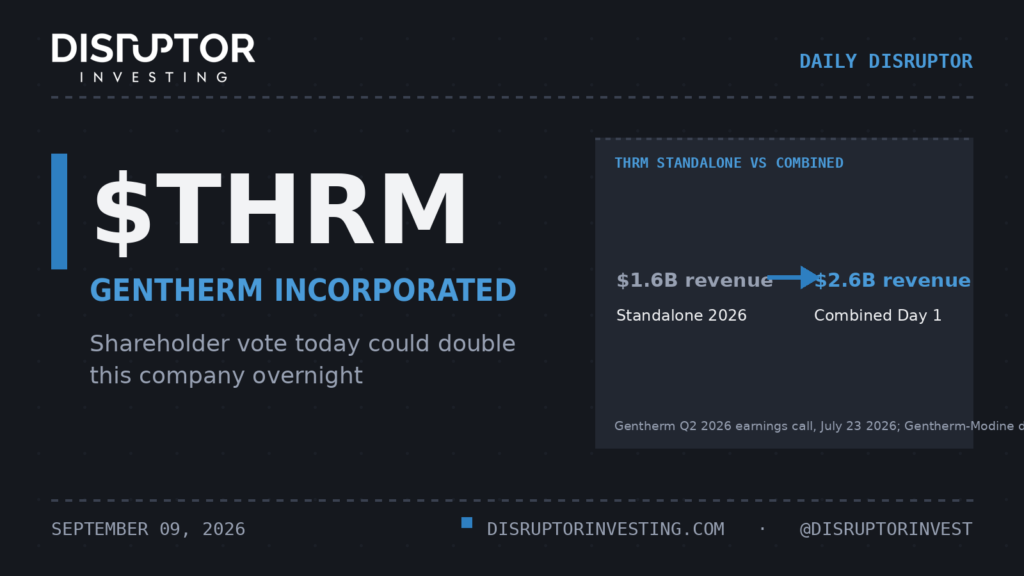
Daily Disruptor: $THRM, The Vote Is Tomorrow and the Street Has Not Caught Up
Gentherm holds a make or break merger vote tomorrow morning, and at roughly eleven times forward earnings the market is pricing it as if the deal…
Read the issue →
September 3, 2026
Daily Disruptor: $AAON, Revenue Doubled and the Stock Is at a 52-Week Low
AAON just posted the most dramatic acceleration in its 35-year history, with Q2 revenue doubling year over year, yet the stock trades near a 52-week low…
Read the issue →
September 2, 2026
Daily Disruptor: $ALOY, The Army’s Rare Earth Tenant
REalloys is days from finalizing a lease to build the only heavy rare earth processing facility on a U.S. military installation, and a January 2027 defense…
Read the issue →