
← All sectors / The AI transformation
042 · Agentic enterprise automation
Software that acts, not advises
Curve position
Binding constraint
Trust and permissioning: what an agent is allowed to do without a human approving it.
The shift from software that organizes work to software that performs it is the largest change in enterprise technology in twenty years. Agents that plan, call tools, and complete multi step tasks are being deployed against processes that previously required people, and the budget they compete for is payroll rather than IT.
Historical context: robotic process automation promised this a decade ago and delivered brittle scripts that broke whenever a screen changed. The difference now is that models handle ambiguity, recover from unexpected states, and work from instructions rather than recorded clicks. That is a categorical improvement, not an increment.
The structural driver is arithmetic. Labor is the largest line item in most companies, and the processes agents handle best, high volume administrative work with clear success criteria, are exactly where headcount concentrates. Even partial automation of those processes produces savings no software license has ever matched.
The technology layer spans agent orchestration frameworks, tool and API integration layers, evaluation systems that measure whether an agent actually succeeded, observability for debugging failures, and the identity and permissioning infrastructure that decides what an agent may touch.
Adoption economics are proving out where outcomes are measurable: claims processing: order entry, invoice handling, customer support resolution, and back office reconciliation. Buyers increasingly pay per outcome rather than per seat, which changes vendor revenue quality and makes results auditable.
The beneficiaries include the orchestration and integration vendors, the evaluation and observability layer, identity companies extending their control plane to non human actors, and the vertical software firms embedding agents into workflows they already own.
The value chain runs from models through orchestration and integration to vertical applications and services. The most defensible position is owning the workflow and the data, because that is what makes an agent reliable enough to trust with real decisions.
The overlooked layer includes integration and middleware vendors that agents cannot function without, identity and permissioning specialists, evaluation tooling companies, and the mid market software providers whose customers will never build agents themselves.
Competitive dynamics are unusually fluid. Model providers keep absorbing capability from the layer above, platform vendors bundle aggressively, and startups win on speed. The durable moats are integration depth, proprietary process data, and the trust required to let software act unsupervised.
Risks: agent reliability remains the binding issue and a single costly failure can halt a rollout, security exposure expands with every permission granted, buyers are still learning to measure value, and the model layer may commoditize much of what current vendors charge for.
What to watch: outcome based pricing disclosures, deployment counts moving from pilot to production, agent permissioning and identity standards, and net revenue retention at orchestration vendors. The research follows deployments with disclosed economics, not demonstrations.
Coverage / Daily Disruptor issues in this sector

August 26, 2026
Daily Disruptor: $NRGV, The $2 Billion Backlog The Market Forgot
Energy Vault just signed the largest contract in its history, a 1.25 GW deal worth up to $600 million, and most Wall Street analysts have not…
Read the issue →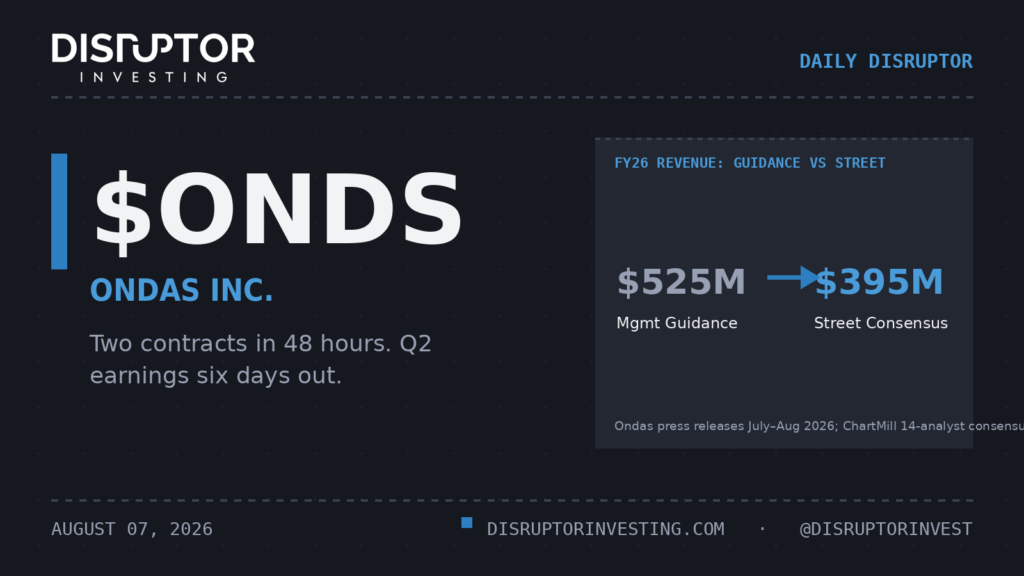
August 7, 2026
Daily Disruptor: $ONDS, The Drone Defense Stack Reporting in Six Days
Ondas has dropped two new defense contracts in the past 48 hours and reports Q2 results on August 13, with management guiding to at least $525M…
Read the issue →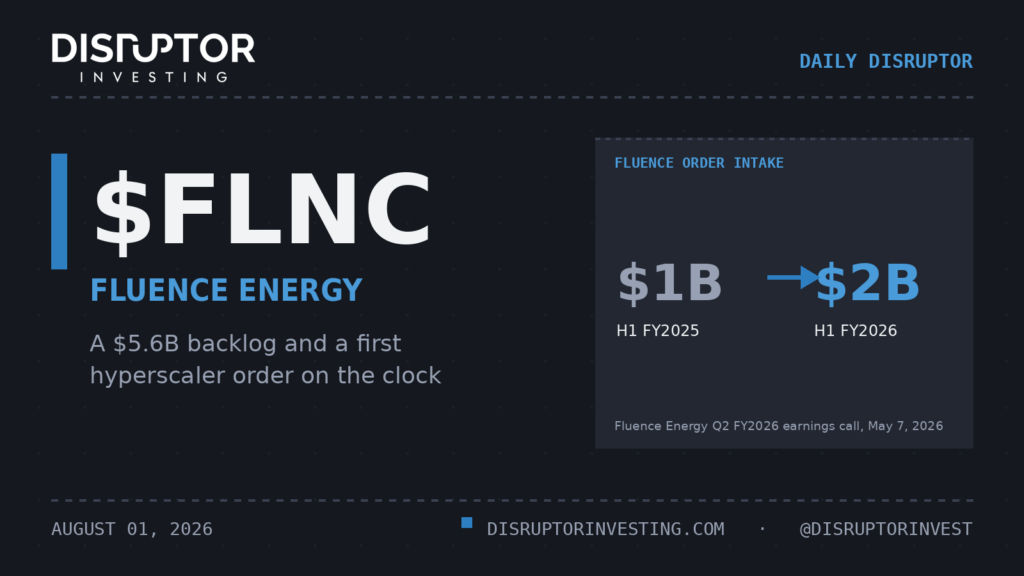
August 1, 2026
Daily Disruptor: $FLNC, the grid storage name with a hyperscaler order due in days
Fluence Energy reports Q3 results on August 5, and the call on August 6 should reveal whether the first purchase order from one of two hyperscaler…
Read the issue →