
← All sectors / The AI transformation
177 · Waste heat recovery & industrial efficiency
The energy already paid for
Curve position
Binding constraint
Payback periods that compete with every other capital project.
Why this sector sits at Launch Pad
The technology works and deployments exist, but the constraint is capital cycle and replacement rate, which move slowly and have not been reset by anything dated.
Launch Pad is the honest position. Operators upgrade on their own schedules, and no policy change or cost threshold has compressed that schedule.
It moves to Liftoff if a mandate, an incentive with a deadline, or a step change in payback period appears.
Reviewed on a two month cycle. The position moves only when a dated, verifiable change in the binding constraint justifies it.

A large share of industrial energy input leaves the process as heat that is simply vented. Recovering even part of it produces power or process heat that has already been paid for, which is the cheapest energy available to a plant.
Historically recovery projects were evaluated against cheap energy and often failed the payback test. Higher and more volatile energy prices, plus emissions reporting, changed the calculation.
The structural driver is energy cost plus grid constraint. A plant that cannot get more grid capacity can effectively create capacity by using what it already consumes more efficiently.
The technology layer spans heat exchangers, organic Rankine cycle systems generating power from moderate temperature heat, industrial heat pumps that upgrade low grade heat to useful temperatures, thermal storage, and the monitoring that finds where heat is being lost.
Adoption economics are measured in simple payback, which industrial buyers apply ruthlessly. Projects under a few years proceed and longer ones generally do not, regardless of merit.
The beneficiaries include heat exchanger manufacturers, organic Rankine cycle system makers, industrial heat pump suppliers, energy services companies financing projects, and the monitoring firms identifying opportunities.
The value chain runs from assessment through equipment to installation and operation. Energy services arrangements that take payment from savings remove the capital barrier entirely.
The overlooked layer includes heat exchanger makers, thermal storage suppliers, energy services companies, and the measurement and verification firms proving savings.
Competitive dynamics favour providers who can finance and guarantee savings, since the technical case is rarely the obstacle and the capital case usually is.
Risks: payback competes against every other capital project, energy price declines undermine the case, industrial production cycles affect utilisation, and retrofits into running plants are disruptive.
What to watch: industrial energy prices, energy services contract volumes, heat pump deployments in industrial settings, and efficiency mandates in industrial permits.
Coverage / Daily Disruptor issues in this sector

August 5, 2026
Daily Disruptor: $FRVO, The Drill Bit Has Already Turned
Fervo Energy reports Q2 results on August 12 and targets first commercial power from Cape Station in Q4 2026, the event that converts a $7.2 billion…
Read the issue →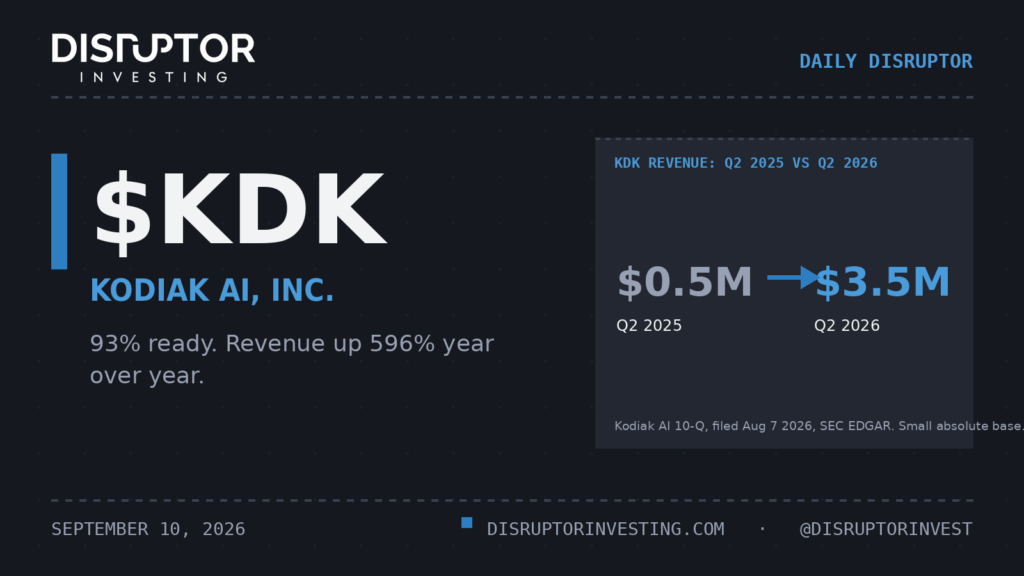
September 10, 2026
Daily Disruptor: $KDK, the driverless long haul launch is ten weeks away
Kodiak AI has 35 driverless semi trucks running commercial freight today, revenue growing at a pace the market has not priced, and a year end highway…
Read the issue →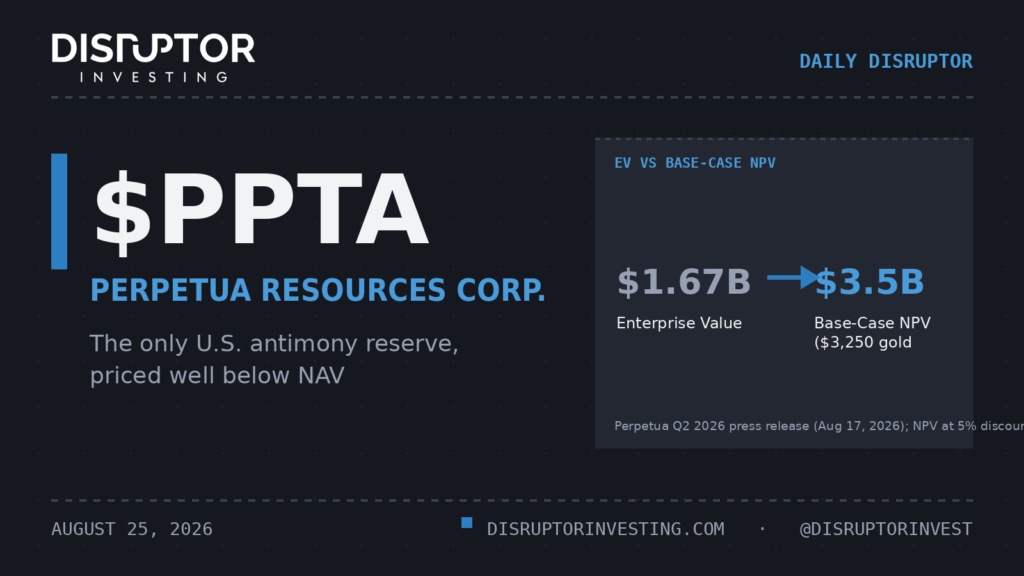
August 25, 2026
Daily Disruptor: $PPTA, America’s Only Antimony Reserve Is Underpriced at $4,000 Gold
Perpetua Resources holds the only identified domestic antimony reserve, just secured a $2.9 billion federal loan, and trades at a deep discount to its own base…
Read the issue →