
← All sectors / The AI transformation
154 · Insurance distribution & embedded coverage
Cover sold at the moment of need
Curve position
Binding constraint
Carrier appetite to underwrite products distributed by someone else.
Why this sector sits at Launch Pad
Adoption here is rising steadily rather than inflecting. The binding constraint is trust and workflow integration, and neither has been broken by a specific event. Buyers are running pilots and expanding them at their own pace.
We place this at Launch Pad because nothing dated has changed. There is no regulation with a compliance deadline, no certification, no cost threshold crossed. Gradual improvement is not an inflection, and calling it one would make the position meaningless.
It moves to Liftoff when we can name the event that changed the rate of adoption, not merely observe that adoption grew.
Reviewed on a two month cycle. The position moves only when a dated, verifiable change in the binding constraint justifies it.

Insurance sold at the moment of the underlying purchase converts dramatically better than insurance sold on its own. Booking travel, buying equipment, renting a property, or shipping goods are all moments where the relevant cover is obvious and the friction is low.
Historically distribution ran through brokers and agents, with acquisition costs consuming a large share of premium. Embedded distribution attacks exactly that cost.
The structural driver is acquisition economics. If the platform already has the customer and the context, the marginal cost of offering cover is close to nothing, which changes what products are viable.
The technology layer spans embedded quoting and binding interfaces, real time underwriting on data the platform already holds, policy administration, claims initiation inside the platform, and the compliance infrastructure for licensed distribution.
Adoption economics work for the platform as high margin attach revenue and for the carrier as acquisition cost far below what direct marketing achieves.
The beneficiaries include embedded insurance infrastructure providers, managing general agents building products for platforms, carriers with appetite for new distribution, and the platforms earning commission.
The value chain runs from carrier through managing general agent and infrastructure to platform and customer. The infrastructure layer connecting them is where the software value sits.
The overlooked layer includes policy administration systems, licensing and compliance services for distribution, claims platforms, and the reinsurers backing newer product lines.
Competitive dynamics favour infrastructure providers with multiple carrier relationships, since a platform wants one integration and several underwriters behind it.
Risks: carrier appetite withdraws in hard markets, loss experience on novel products is unproven, regulatory requirements for distribution are real, and platform partners can build or switch.
What to watch: attach rates at platform partners, loss ratios on embedded products, carrier capacity for new lines, and regulatory guidance on embedded distribution.
Coverage / Daily Disruptor issues in this sector
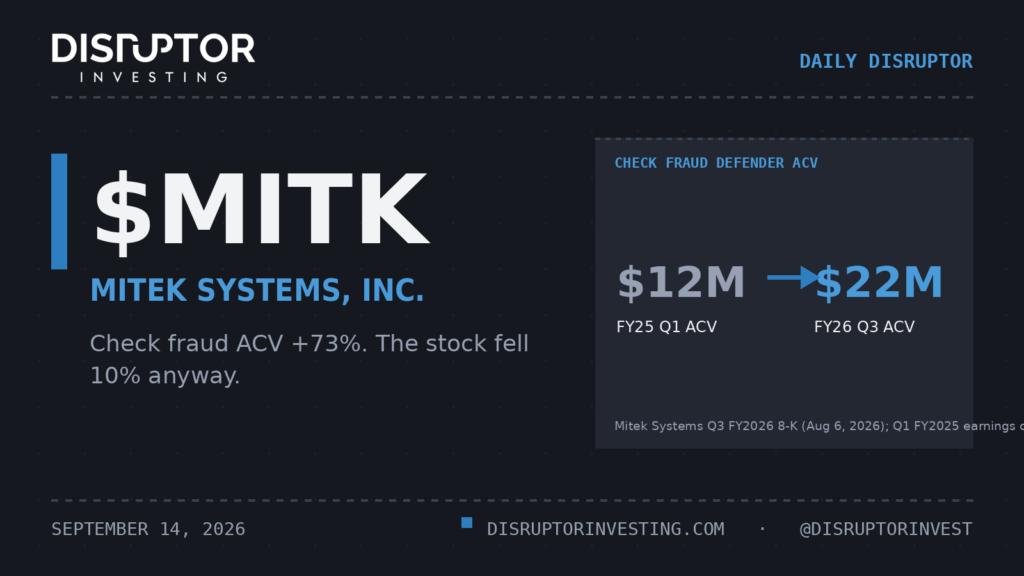
September 14, 2026
Daily Disruptor: $MITK, The Fraud Fighting Network Nobody Is Talking About After Earnings
Mitek's Check Fraud Defender consortium just added Fiserv as a reseller and a top five U.S. bank as a member, covering 70% of U.S. checking accounts,…
Read the issue →
August 27, 2026
Daily Disruptor: $WHD, The Wellhead That Drills Into Geothermal
After doubling its revenue base with a single acquisition, Cactus is now positioned at the intersection of Middle East oilfield spending and the coming wave of…
Read the issue →
August 26, 2026
Daily Disruptor: $NRGV, The $2 Billion Backlog The Market Forgot
Energy Vault just signed the largest contract in its history, a 1.25 GW deal worth up to $600 million, and most Wall Street analysts have not…
Read the issue →