
← All sectors / The AI transformation
117 · Semiconductor test & burn in
Finding the failure before the customer does
Curve position
Binding constraint
Test time per device, which directly limits throughput.
Every chip is tested before shipping, and as packages become more complex the testing becomes harder, longer, and a larger share of total cost. In automotive and datacentre applications where failure is expensive, test requirements are becoming more demanding rather than less.
Historically test was a cost to minimise, squeezed by reducing test time. Advanced packaging changed the calculation because a failure discovered after several die are stacked together destroys all of them.
The structural driver is known good die. When multiple expensive die are combined into one package, each must be verified before assembly, which multiplies the amount of testing performed.
The technology layer spans automated test equipment, probe cards contacting the wafer, burn in systems that stress devices to find early failures, thermal control during test, and the test program development that decides coverage.
Adoption economics are driven by yield loss avoided. Testing a die before stacking costs a fraction of discarding a completed package containing several good die and one bad one.
The beneficiaries include automated test equipment makers, probe card manufacturers, burn in system suppliers, thermal control specialists, and the outsourced assembly and test providers.
The value chain runs from test equipment through probe cards and consumables to the test house or fab. Probe cards are consumable and application specific, which makes them a recurring revenue stream.
The overlooked layer includes probe card makers, test socket suppliers, thermal control equipment, and the outsourced test providers serving companies without their own capacity.
Competitive dynamics are concentrated among a few equipment makers, with probe cards more fragmented and closer to the specific device being tested.
Risks: semiconductor cycles cut equipment orders sharply, test time reduction efforts work against volume growth, customer concentration is high, and export controls affect shipments.
What to watch: test equipment book to bill, advanced packaging volumes, probe card demand, and automotive qualification requirements.
Coverage / Daily Disruptor issues in this sector
August 25, 2026
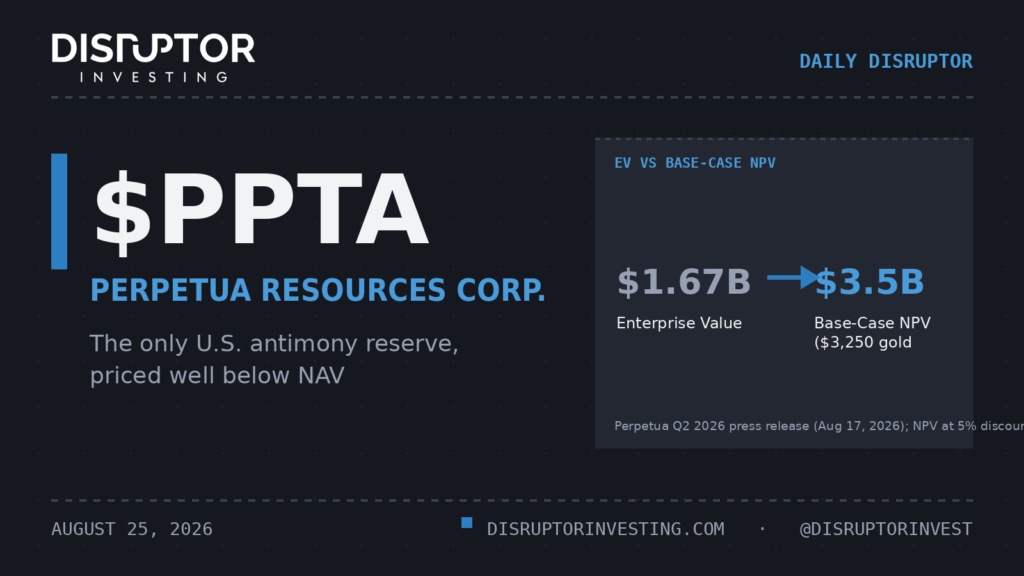
Daily Disruptor: $PPTA, America’s Only Antimony Reserve Is Underpriced at $4,000 Gold
Perpetua Resources holds the only identified domestic antimony reserve, just secured a $2.9 billion federal loan, and trades at a deep discount to its own base…
Read the issue →
August 6, 2026
Daily Disruptor: $LYEL, The CAR T Therapy Trading at a Fraction of Where Analysts Think It Belongs
Lyell Immunopharma carries two late stage CAR T cell programs, a 97% manufacturing success rate, and an earnings print plus a pivotal data update both arriving…
Read the issue →