
← All sectors / The AI transformation
112 · Water treatment technology & PFAS remediation
The bill for what was already released
Curve position
Binding constraint
Who pays, which litigation is still deciding.

Regulators set enforceable limits on persistent chemicals in drinking water, and in doing so created an obligation to remove substances that are already everywhere. That is a remediation market conjured by rulemaking rather than by demand.
Historically these compounds were unregulated and widely used, which means the contamination is distributed across thousands of water systems and industrial sites with no single responsible party.
The structural driver is a compliance deadline attached to a measurable standard. Utilities must test, report, and treat within a defined window, and the liability for failing to is clear.
The technology layer spans granular activated carbon, ion exchange resins, reverse osmosis, destruction technologies that break the compounds rather than concentrating them, and the analytical testing that detects parts per trillion.
Adoption economics are compliance driven and therefore price insensitive within reason. A utility facing a deadline buys what works, and the cost passes into rates.
The beneficiaries include treatment technology suppliers, activated carbon and resin producers, analytical laboratories, engineering firms designing installations, and the destruction technology developers if their methods prove out.
The value chain runs from testing through treatment technology and engineering to utility operation. Consumables recur, which makes carbon and resin supply the most durable position.
The overlooked layer includes analytical laboratories, carbon regeneration services, engineering consultancies sizing systems, and the industrial pretreatment providers serving manufacturers rather than utilities.
Competitive dynamics favour incumbent water treatment firms with utility relationships, while destruction technologies are earlier and more speculative.
Risks: litigation over who pays is unresolved and enormous, compliance deadlines can be extended, municipal budgets are constrained, and destruction technologies remain unproven at scale.
What to watch: compliance deadlines by jurisdiction, litigation settlements assigning liability, treatment installations at utilities, and analytical testing volumes.
Coverage / Daily Disruptor issues in this sector

August 26, 2026
Daily Disruptor: $NRGV, The $2 Billion Backlog The Market Forgot
Energy Vault just signed the largest contract in its history, a 1.25 GW deal worth up to $600 million, and most Wall Street analysts have not…
Read the issue →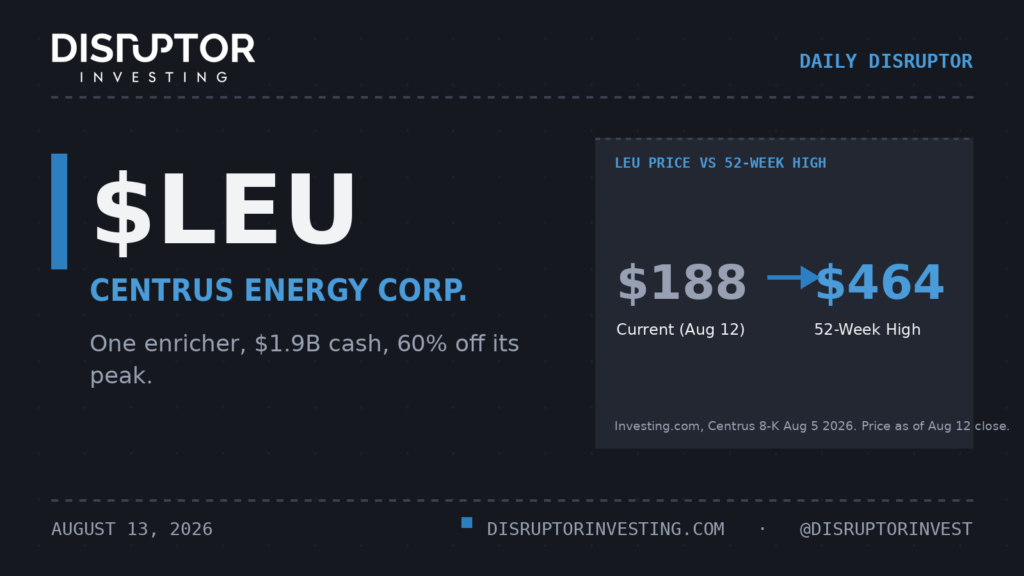
August 13, 2026
Daily Disruptor: $LEU, America’s Only Licensed Uranium Enricher Has a $4.5 Billion Backlog and Trades at Half Its High
Centrus Energy is the sole publicly traded, NRC licensed uranium enricher in the United States, sitting on $1.9 billion in cash and a record $4.5 billion…
Read the issue →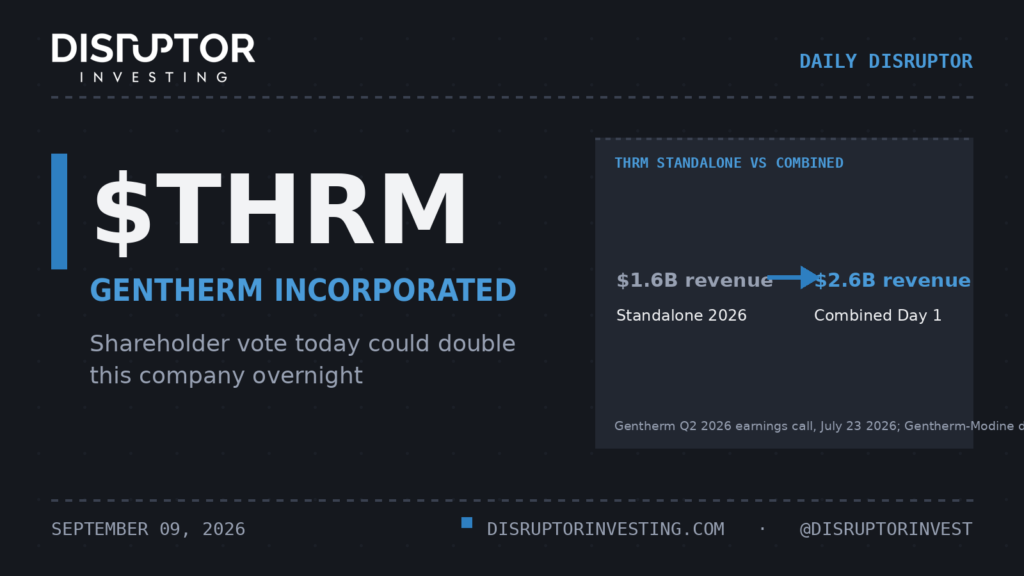
September 9, 2026
Daily Disruptor: $THRM, The Vote Is Tomorrow and the Street Has Not Caught Up
Gentherm holds a make or break merger vote tomorrow morning, and at roughly eleven times forward earnings the market is pricing it as if the deal…
Read the issue →