
Five million coherent photonic integrated circuits. That is not a projection or a design win announcement. Tower Semiconductor shipped that volume in partnership with Marvell, at production scale, on a platform most of the semiconductor industry had written off as too hard to commercialize. The number appeared almost as an aside in the Q1 2026 earnings materials, and the market initially shrugged.
It stopped shrugging. Between the Q1 print on May 13 and the June 22 closing high, the stock ran to nearly $317. It has since pulled back to around $222, sitting roughly 30% off that peak despite management raising its 2028 revenue target by $800 million and its 2028 net profit target by $450 million on July 14. That pullback is where this story gets complicated.
Our thesis is specific: Tower Semiconductor is the only independent foundry with a proven, high volume silicon photonics manufacturing platform at a moment when AI data center buildout is creating demand for coherent optical interconnects that no other merchant fab can reliably supply. The inflection in SiPho revenue is real, the contracted backlog is real, and the moat is genuine. But the stock at $222 and a $25 billion market cap is pricing in a great deal of that story already, which makes this less a classic under the radar setup and more an exercise in deciding whether the 2028 earnings power justifies the multiple you are paying today. We think it does, conditionally, and the conditions matter.
The 60 second version
- Tower Semiconductor ($TSEM) is an Israeli headquartered specialty analog foundry operating fabs in Israel, the United States, Japan, and Italy, generating revenue exclusively from wafer fabrication services across silicon photonics, RF, power management, image sensors, and MEMS platforms.
- The shift: AI data centers require coherent optical transceivers at a scale and speed the fiber optics industry cannot meet using traditional III V manufacturing; silicon photonics, made on standard CMOS adjacent equipment, is the only manufacturable answer, and Tower holds the only scaled independent process platform.
- The number: $680 million annualized SiPho run rate in Q2 2026, up 270% year over year, with $1.3 billion in signed customer contracts for 2027 and $290 million in prepayments already in the door.
- The catalyst: Q3 2026 earnings, confirmed November 16, 2026, the first print against the $520 million guidance midpoint management issued August 4; if SiPho is tracking toward a $1 billion annualized run rate in Q4 as guided, this call sets the tone for the entire 2027 contracted revenue story.
- Main risk: A pause in hyperscaler AI capex, or a shift toward proprietary co packaged optics architectures, leaves Tower holding $3 billion in Japan capacity commitments against materially lower utilization than the 2028 model assumes.
- Market cap: approximately $25 billion at roughly $222 per share as of September 10, 2026, well above our usual $5 billion ceiling, which we are disclosing explicitly and addressing directly in the valuation section.
Let us be direct about the screen failure first. Tower has a market cap of roughly $25 billion. Our standard cut is $5 billion. We are covering it anyway, for one reason: the silicon photonics inflection happening inside this company is the clearest real world demonstration we have found of AI infrastructure demand pulling through a semiconductor manufacturing constraint, and understanding how it is priced tells you something useful about every other SiPho adjacent name in the space, most of which are much smaller.
The stock is up more than 450% over the past year. It trades at roughly 64 times 2026 consensus earnings and about 13 times 2026 consensus revenue. Even on management’s own 2028 targets, which are optimistic by construction, you are paying 21 times projected net profit two years out. None of that is cheap. But the contracted revenue base, the prepayment structure, and the absence of any other foundry that can actually make these parts at scale suggest the premium is at least partially justified.
We think the most interesting analytical question right now is not whether Tower wins in silicon photonics. It almost certainly does. The question is whether the November 16 earnings call delivers Q4 guidance that confirms the path toward a $1 billion SiPho run rate, because that is the number that either validates or resets the 2028 model the street has just started to underwrite.
The shift
The AI data center buildout that everyone has been writing about for three years has a physical bottleneck that gets less attention than GPU shortages or power constraints. Moving data between GPUs, between racks, and between data centers at the bandwidth AI training and inference workloads now demand requires coherent optical transceivers at a scale the telecom fiber industry never had to produce. Traditional coherent optical components are built on indium phosphide, a III V semiconductor that is expensive, slow to fabricate, and essentially impossible to integrate with CMOS logic on the same chip.
Silicon photonics routes light through silicon waveguides using standard semiconductor manufacturing equipment. The physics works. The economics work. The integration with CMOS is straightforward. The problem, for most of the past decade, was that producing coherent photonic ICs in volume required process platforms that took years to qualify, and almost no one outside of Intel’s internal program had built one that worked reliably at scale.
What changed is not the physics. What changed is that AI infrastructure demand grew fast enough to make the qualification investment worthwhile for the hyperscalers’ supply chains, and Tower had a 300mm SiPho platform, PH18DA, that was already in customer hands. The demand signal arrived; Tower happened to be the only independent foundry standing at the loading dock. The IQE multi year agreement for InP epiwafers, signed alongside Tower’s capacity expansion, is a tell: the ecosystem is building around this platform, not around a hypothetical future one.
We are, by our reading, roughly where NAND flash was in 2010 or where advanced packaging was in 2021. The binding constraint has eased, the standard has not yet been set, and one or two companies with early process leads tend to hold that lead for longer than the market expects, because the switching cost for a qualified photonics process is measured in years of engineering time, not weeks of procurement negotiations.
The company
Tower Semiconductor has been doing specialty analog foundry work since 1993. It is not a glamorous business. You build fabs, you qualify processes, you run wafers for customers who do not want to own their own factories, and you charge a premium over commodity logic foundries because your processes do things commodity foundries cannot do. The company operates fabs in Israel at 200mm, two 200mm fabs in the United States, two fabs in Japan through the TPSCo subsidiary, and participates in a 300mm facility in Agrate, Italy. Revenue is entirely foundry services, zero products, zero inventory risk in the traditional sense.
Russell Ellwanger has been CEO since 2005. That tenure matters here because the silicon photonics program is not a pivot; it is a decade long platform development that predates the AI boom by years. The team did not chase the trend. The trend arrived at their address.
One detail from the Q2 2026 6-K that does not fit the clean narrative: Tower recorded $282.6 million in customer advance inflows in the first half of 2026, which is the cash component of the $290 million in prepayments disclosed on the Q1 call. That cash sits on the balance sheet as a liability, not revenue, until the wafers ship. So the $3.07 billion in cash the company is carrying overstates free cash by the amount of prepaid capacity not yet delivered. It is not a red flag, but it is a nuance that matters if you are stress testing the balance sheet in a demand softening scenario.
The numbers and what the street expects
H1 2026 revenue came in at $873.7 million, up 19.6% from $730.2 million in H1 2025. The acceleration is not spread evenly across the business. Q1 was up 15% year over year, Q2 was up 24%, and the guidance for Q3 at a $520 million midpoint implies 31% year over year growth. The direction of the trend is unambiguous.
The mix shift is where the real story sits. Silicon photonics and RF infrastructure combined represented 49% of Q2 corporate revenue, with SiPho running at a $680 million annualized rate after growing 270% year over year. That is a business that did roughly $180 million in annual revenue a year ago and is now on track to approach $1 billion by year end if the Q4 guidance holds. No other segment is growing anywhere near that rate; SiPho is carrying the company’s growth profile on its own.
Gross margin moved from 21.0% in H1 2025 to 28.5% in H1 2026, with Q2 alone printing at 30%. Gross profit dollars grew 72% year over year. The structural driver is the mix shift toward 300mm SiPho wafers, which carry higher average selling prices and better factory utilization economics than the legacy 200mm analog business. Net margin went from 13% in Q2 2025 to 20% in Q2 2026. Net income for H1 2026 was $155.8 million, basic EPS of $1.38 against $0.78 in H1 2025, a 77% increase.
The balance sheet is clean. Total debt is approximately $141.7 million against roughly $3.07 billion in cash and short term deposits, for a debt to equity ratio of about 5%. Management said on the Q2 call that the $3 billion Japan expansion will be funded from internal cash generation with no planned equity issuance. We have no reason to doubt that statement given the current cash position, though we note the $282.6 million in advance payments sitting as a balance sheet liability complicates the simple reading of the cash number.
Operating cash flow for H1 2026 was $686.9 million, which includes the advance inflows. Full year 2026 capex guidance was raised to $920 million, with roughly half paid through Q2. That is a heavy investment year, but the contracted revenue base gives it credibility.
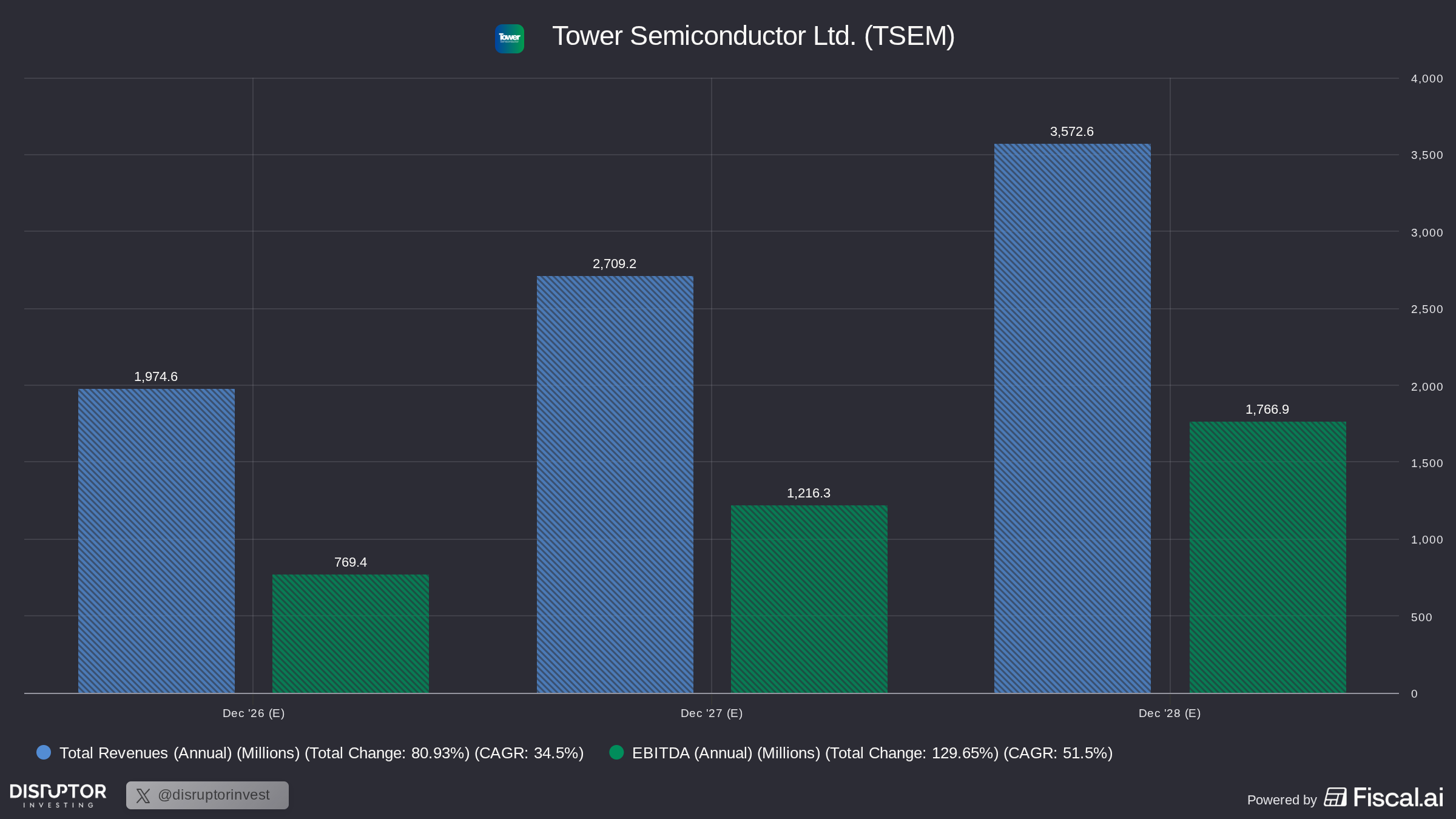
On the forward estimates: management guided Q3 2026 to $520 million plus or minus 5%, a range of $494 million to $546 million. That compares to a pre Q2 sell side consensus of somewhere in the $455 to $463 million range for Q2 itself, so the Q3 bar is materially above where analysts were modeling the business just weeks ago. Post Q2, consensus for full year 2026 revenue moved to approximately $1.97 billion from $1.89 billion, and consensus EPS moved to roughly $3.48 from $2.98. About nine to eleven analysts cover the stock, per multiple sources, all with Buy or Strong Buy ratings as of the most recent compilation. The consensus price target range runs from $270 at the low end, where Stifel initiated on September 1, to $367 at the high end from Bank of America, with a compiled average near $315 to $321.
The valuation is the conversation stopper, and we are not going to minimize it. At $222 and a $25 billion market cap, Tower trades at roughly 12.7 times 2026 consensus revenue and about 64 times 2026 consensus EPS. The stock is off 30% from its June 22 high, but it has still run more than 450% in twelve months. Even on management’s 2028 targets of $3.6 billion revenue and $1.2 billion net profit, which are management’s own targets rather than conservative consensus, the stock is at roughly 7 times 2028 revenue and 21 times 2028 net income. That is not an obvious bargain. We are flagging it plainly: TSEM fails our market cap screen and trades at a full multiple on near term numbers. Whether the 2028 earnings power justifies that multiple depends almost entirely on whether the SiPho demand trajectory holds.
Why it wins
The moat here is process qualification time, and it is larger than it looks. Tower’s PH18DA silicon photonics platform is the only independent, commercially proven process for coherent photonic ICs at multi million unit production volumes. Shipping five million coherent photonic ICs with Marvell is not a beta program. It is a qualification that took years and customer engineering cycles to achieve, and any new entrant has to run that same gauntlet from scratch.
TSMC has internal SiPho development. Intel has its own program. But neither is available to the broad fabless ecosystem as an open merchant foundry service on the terms Tower offers. For a Marvell, a Coherent, or any of the fifty plus active SiPho customers Tower now discloses, redesigning to a different platform means requalifying every laser, modulator, and detector component, then requalifying the assembled transceiver, then requalifying it in the hyperscaler’s data center. That process takes two to four years under good conditions.
The $290 million in prepayments and the $1.3 billion in signed contracts for 2027 are the financial expression of that switching cost. Customers are not just ordering wafers. They are pre funding specific capacity, which means they have already made the capital commitment that keeps them on Tower’s platform through at least the end of 2027. The Cadence PDK integration for OpenLight’s PH18DA, announced August 11, 2026, extends this further: design tools now route directly to Tower’s process, making it easier for new customers to start on this platform and harder to leave once they have built a design library.
Japan adds a dimension that is specifically about geopolitical risk management. Hyperscalers procuring coherent optical transceivers for AI infrastructure are under pressure from their own boards and from government customers to demonstrate supply chain diversity. Tower’s TPSCo footprint in Japan, now being expanded with approximately $1 billion in METI grants, gives it a non Taiwan, non China manufacturing option that no other independent SiPho foundry can offer. That is a selling point that does not appear in gross margin models but shows up in contract awards.
What could go wrong
The bear case deserves its strongest form. Tower is committing $3 billion to Japan capacity and $920 million in near term capex on the assumption that AI data center optical interconnect demand sustains and accelerates through 2027 and 2028. If that assumption is wrong, the company carries a fixed cost structure built for a $3.6 billion revenue business against a materially smaller actual revenue base. Semiconductor fabs do not modulate capacity easily. Underutilization at Tower would compress margins at the exact moment the capital commitment peaks.
The $1.3 billion in contracted 2027 revenue provides a floor, but management described capacity as “spoken for” rather than fully booked, and the distinction matters. Minimum commitments in foundry contracts can be renegotiated when demand softens, particularly when a customer’s own revenue is under pressure. We have not seen the contract terms, and Tower has not disclosed the named customers behind the $1.3 billion figure.
There is also an architectural risk that does not get enough attention. Co packaged optics, where the photonics die is packaged directly alongside the GPU or switch ASIC rather than in a pluggable transceiver, could reduce demand for the pluggable coherent transceivers that Tower’s current SiPho customers primarily produce. TSMC and others are pursuing co packaged optics integration, and if that architecture wins at the hyperscaler layer before Tower has secured co packaged design wins of its own, a portion of the addressable market shifts to captive foundries. This is a 2027 to 2029 risk, not a 2026 risk, but it belongs in any honest assessment of the 2028 model.
Finally: ten insider sales and zero insider purchases in the past six months. That is not a verdict, but it is a data point worth holding.
The investment thesis
Tower Semiconductor is the only company that can manufacture coherent photonic ICs at scale for the merchant market, at a moment when AI infrastructure demand for those parts is growing faster than any other semiconductor end market, and the gap between what the market is pricing for 2026 and what management has contractually locked in for 2027 is where the remaining upside lives.
What has to be true for this to work: SiPho demand from AI data center customers sustains through the contracted period, the Japan expansion executes on the timeline management has committed to publicly, and the 2028 revenue and margin targets prove to be achievable within a reasonable band of the numbers given. The market, at $222, appears to believe roughly the first of those three but has not fully priced the second or third. The $800 million increase in the 2028 revenue target and the $450 million increase in the 2028 net profit target, both announced July 14, have not yet been fully absorbed into consensus models, which still cluster around $1.97 billion for 2026 and have not published detailed 2028 estimates that match management’s framework.
The specific gap we are watching: management’s 2028 net profit target of $1.2 billion implies roughly $10.63 in earnings per share on the current share count. At 20 times that number, you get a stock price well above today’s level. The street has not yet built a model that takes the 2028 guidance seriously, in part because the Japan buildout is so capital intensive and the timeline is long enough to be discounted heavily. If the November 16 earnings call includes Q4 guidance pointing toward a $1 billion annualized SiPho run rate, it forces analysts to update their 2027 and 2028 estimates in a way that has not happened yet.
This is a name to hold through the November catalyst, not a setup to enter light and add on weakness. The thesis plays out over an eighteen to thirty month window tied to the 2027 contracted revenue delivery and the first Japan capacity coming online in late 2027. The position is long duration by the standards of this platform, and the valuation leaves very little room for execution error.
The falsification is simple: if Q3 2026 revenue comes in below the $494 million floor of the guided range, or if management pulls back the Q4 guidance toward a $1 billion SiPho run rate, the 2028 model begins to unravel and the multiple the stock currently carries is no longer defensible.
What we are watching
- November 16, 2026: Q3 2026 earnings report. Revenue versus the $520 million midpoint guidance; Q4 guidance versus the $1 billion annualized SiPho run rate milestone management has flagged; any update to the number of active SiPho customers beyond the current fifty plus disclosure.
- January 2027: The prepayment deadline management cited for additional 2028 wafer commitments. Whether new prepayments are disclosed on the Q4 call will confirm whether the contracted backlog is growing or simply rolling forward.
- Q4 2026 earnings call (expected February 2027): First formal update on Japan Track 1 construction progress at the Arai site; any disclosure of named customers in the 2027 contracted revenue base.
- November 2026: Watch for any hyperscaler AI capex commentary in Microsoft, Amazon, Google, and Meta Q3 earnings calls (October through November 2026). Softening capex language from any two of the four would be an early warning signal for Tower’s 2027 demand assumptions.
- Ongoing through Q4 2026: METI grant disbursement confirmation and any public filings related to the Japan expansion corporate structure; Tower has not disclosed the disbursement schedule and any delay would affect the 2028 capacity timeline.
The bottom line
The silicon photonics inflection at Tower Semiconductor is not a thesis. It is a fact in the filing. Revenue grew 270% year over year in a single segment, the company holds more contracted forward revenue than it generated in all of 2025, and the only foundry that can make these parts at scale is spending $3 billion to make more of them. The moat is real, the demand signal is real, and the balance sheet can fund the expansion without diluting shareholders.
What is also real is the valuation. At $25 billion in market cap and 64 times 2026 earnings, this is not a discovery. It is a judgment call about whether the 2028 earnings power is worth paying for today at a 21x multiple on optimistic management targets, two years out, with a capital program that leaves limited margin for error if optical interconnect demand plateaus before the Japan capacity fills.
We think the November 16 earnings call is the hinge. A Q3 beat and Q4 guidance that confirms the path toward a $1 billion annualized SiPho run rate forces the street to underwrite a 2028 model it has been reluctant to publish. That revision cycle is where the remaining gap between guidance and consensus closes. If Q3 misses the floor of the guided range, that is the single observable that tells us the thesis has broken, and the multiple has nowhere to go but down.
Not financial advice.
References
- Tower Semiconductor Ltd. Form 6-K, Exhibit 99-1 (Q2 2026 Results). US Securities and Exchange Commission. Published August 4, 2026. Accessed September 10, 2026. https://www.sec.gov/Archives/edgar/data/0000928876/000117891326003776/exhibit_99-1.htm
- Tower Semiconductor Ltd. Form 6-K, Exhibit 99-1 (Q4 2025 Results). US Securities and Exchange Commission. Published February 11, 2026. Accessed September 10, 2026. https://www.sec.gov/Archives/edgar/data/928876/000117891326000404/exhibit_99-1.htm
- Tower Semiconductor Investor Relations. Q2 2026 Press Release. Published August 4, 2026. Accessed September 10, 2026. https://towersemi.com/2026/08/04/08042026/
- Tower Semiconductor Investor Relations. Q1 2026 Press Release. Published May 13, 2026. Accessed September 10, 2026. https://towersemi.com/2026/05/13/05132026/
- StockTitan. Tower Semiconductor H1 2026 Form 6-K (Interim financials). Published August 17, 2026. Accessed September 10, 2026. https://www.stocktitan.net/sec-filings/TSEM/6-k-tower-semiconductor-ltd-current-report-foreign-issuer-cd9468d78b40.html
- StockTitan. Tower Semiconductor Q2 6-K (Balance sheet / net cash definition). Published August 6, 2026. Accessed September 10, 2026. https://www.stocktitan.net/sec-filings/TSEM/6-k-tower-semiconductor-ltd-current-report-foreign-issuer-ba4521265c26.html
- StockTitan. TSEM Overview / Short Interest / Shares Outstanding. Published August 14, 2026. Accessed September 10, 2026. https://www.stocktitan.net/overview/TSEM/
- Yahoo Finance. Tower Semiconductor Q2 2026 Earnings Call Highlights. Published August 4, 2026. Accessed September 10, 2026. https://finance.yahoo.com/markets/stocks/articles/tower-semiconductor-ltd-tsem-q2-210647059.html
- Yahoo Finance. Tower Semiconductor $3B Japan Investment (Reuters). Published July 14, 2026. Accessed September 10, 2026. https://finance.yahoo.com/technology/articles/tower-semiconductor-invest-3-billion-101006912.html
- Yahoo Finance. TSEM Quote / Key Statistics. Published September 8, 2026. Accessed September 10, 2026. https://finance.yahoo.com/quote/TSEM/
- Motley Fool. Tower Semiconductor (TSEM) Q2 2026 Earnings Call Transcript. Published August 11, 2026. Accessed September 10, 2026. https://www.fool.com/earnings/call-transcripts/2026/08/11/tower-semiconductor-tsem-q2-2026-earnings-call-transcript/
- TipRanks. Tower Semiconductor Q2 2026 Interim Balance Sheet / Customer Advances. Published August 17, 2026. Accessed September 10, 2026. https://www.tipranks.com/news/company-announcements/tower-semiconductor-posts-q2-2026-interim-results-with-rising-assets-and-customer-advances
- TipRanks. Tower Semiconductor $3B Japan Expansion (SiPho and SiGe). Published July 14, 2026. Accessed September 10, 2026. https://www.tipranks.com/news/company-announcements/tower-semiconductor-launches-3-billion-japan-expansion-in-silicon-photonics-and-sige
- TipRanks. TSEM Earnings Dates and Q3 Report Date. Published September 8, 2026. Accessed September 10, 2026. https://www.tipranks.com/stocks/tsem/earnings
- TipRanks. TSEM Market Cap. Published September 8, 2026. Accessed September 10, 2026. https://www.tipranks.com/stocks/tsem/market-cap
- Seeking Alpha. Tower Semiconductor: Silicon Photonics Inflection, Buy The Drawdown. Published August 31, 2026. Accessed September 10, 2026. https://seekingalpha.com/article/4941685-tower-semiconductor-stock-silicon-photonics-inflection-buy-drawdown
- Simply Wall St. TSEM Future / Analyst Forecasts. Published September 3, 2026. Accessed September 10, 2026. https://simplywall.st/stocks/us/semiconductors/nasdaq-tsem/tower-semiconductor/future
- Simply Wall St. TSEM Earnings and Revenue Performance (Q2 2026 results). Published August 5, 2026. Accessed September 10, 2026. https://simplywall.st/stocks/us/semiconductors/nasdaq-tsem/tower-semiconductor/past
- Simply Wall St. TSEM Up 15.4% After Q2 2026 Earnings. Published August 5, 2026. Accessed September 10, 2026. https://simplywall.st/stocks/us/semiconductors/nasdaq-tsem/tower-semiconductor/news/tower-semiconductor-tsem-is-up-154-after-stronger-q2-2026-ea
- Investing.com. TSEM Earnings Date and Report / Q3 Report Date November 16, 2026. Published August 4, 2026. Accessed September 10, 2026. https://www.investing.com/equities/tower-semicond-earnings
- Investing.com. TSEM Financial Summary (Debt/Equity 5%, TTM Gross Margin). Published September 2026. Accessed September 10, 2026. https://www.investing.com/equities/tower-semicond-financial-summary
- StocksToTrade. TSEM Draws Bullish AI Fueled Wall Street Targets / Stifel Buy $270. Published September 4, 2026. Accessed September 10, 2026. https://stockstotrade.com/news/tower-semiconductor-ltd-tsem-news-2026_09_04/
- 24/7 Wall St. TSEM Q2 2026 EPS Beats, Silicon Photonics $680M Run Rate. Published August 4, 2026. Accessed September 10, 2026. https://247wallst.com/cards/tower-semiconductor-q2-2026-earnings-tsem-01kz67hedey43atsc9qrbwe6z6
- 24/7 Wall St. Tower Semiconductor Q3 Guidance / Q2 data review. Published August 17, 2026. Accessed September 10, 2026. https://247wallst.com/cards/tower-semiconductor-q3-2026-earnings-tsem-01m07kce934y097gjxdahrts7y
- CompaniesMarketCap. TSEM Market Cap (August 2026). Published August 13, 2026. Accessed September 10, 2026. https://companiesmarketcap.com/tower-semiconductor/marketcap/
- Kraken. TSEM Stock Price Today / Market Cap. Published September 2026. Accessed September 10, 2026. https://www.kraken.com/stocks/tsem
- MacroTrends. TSEM 52-Week High and Low / Stock Price History. Published September 2026. Accessed September 10, 2026. https://www.macrotrends.net/stocks/charts/TSEM/tower-semiconductor/stock-price-history
- StockAnalysis. TSEM Statistics and Valuation (Short interest 2.72M / 2.44% of float; beta 0.87). Published July 30, 2026. Accessed September 10, 2026. https://stockanalysis.com/stocks/tsem/statistics/
- Macroaxis. TSEM Institutional Ownership approximately 75% / Shares 112.8M. Published April 24, 2026. Accessed September 10, 2026. https://www.macroaxis.com/executives/TSEM/Tower-Semiconductor
- Globe and Mail / GlobeNewswire. Tower Semiconductor Posts Record Q2 2026 Results and Guides to New Revenue Highs. Published August 5, 2026. Accessed September 10, 2026. https://www.theglobeandmail.com/investing/markets/stocks/TSEM/pressreleases/3660547/tower-semiconductor-posts-record-q2-2026-results-and-guides-to-new-revenue-highs/
- Globe and Mail. Tower Semiconductor Launches $3B Japan Expansion. Published July 15, 2026. Accessed September 10, 2026. https://www.theglobeandmail.com/investing/markets/stocks/TSEM/pressreleases/3305117/tower-semiconductor-launches-3-billion-japan-expansion-in-silicon-photonics-and-sige/
- Globe and Mail. Earnings Call Signals Photonics Fueled Surge. Published May 15, 2026. Accessed September 10, 2026. https://www.theglobeandmail.com/investing/markets/stocks/TSEM/pressreleases/1946464/tower-semiconductor-earnings-call-signals-photonics-fueled-surge/
- Tech Times. Tower Semiconductor Commits $3B to Silicon Photonics: Japan Backs the Bet. Published July 14, 2026. Accessed September 10, 2026. https://www.techtimes.com/articles/320470/20260714/tower-semiconductor-commits-3-billion-silicon-photonics-japan-backs-bet.htm
- Yahoo Finance. Tower Semiconductor $1.3B SiPho Contracts for 2027. Published May 13, 18, 2026. Accessed September 10, 2026. https://finance.yahoo.com/markets/stocks/articles/tower-semiconductor-ltd-tsem-signs-1-143800359.html
- BigGo Finance. TSEM Q2 2026 Earnings Call, SiPho, No Dilution, Prepayments. Published August 4, 2026. Accessed September 10, 2026. https://finance.biggo.com/news/US_TSEM_2026-08-04
- Quiver Quantitative. TSEM Q2 2026 Earnings Release. Published August 5, 2026. Accessed September 10, 2026. https://www.quiverquant.com/news/TOWER+SEMICONDUCTOR+%28%24TSEM%29+Releases+Q2+2026+Earnings
- GuruFocus. TSEM $3B Japan Expansion Announcement. Published July 14, 2026. Accessed September 10, 2026. https://www.gurufocus.com/news/8957166/tower-semiconductor-tsem-announces-3-billion-expansion-in-japan
- Tower Semiconductor Investor Relations. Investor Overview. Accessed September 10, 2026. https://ir.towerjazz.com/
- CNN Markets. TSEM Stock Quote / Recent News Timeline. Published September 2026. Accessed September 10, 2026. https://www.cnn.com/markets/stocks/TSEM