
In the first quarter of fiscal 2026, Penguin Solutions reported revenue of $343 million, up 1% year over year. The quarter after that, revenue was also $343 million, down 6%. Two consecutive flat to down quarters from a company that would go on to pre guide 30% growth for the following fiscal year. That sequence is the whole story in miniature: a deliberate, painful exit from low margin hyperscale hardware resale, followed by an acceleration so sharp that management raised full year growth guidance from 6% to 22% in a single fiscal year. The stock is up roughly 159% year to date and has given back about a third of its post earnings peak. At roughly $52, it trades at 16.7 times forward non GAAP earnings for a company that just grew revenue 48% and operating income 417% in a single quarter.
We think the market is mispricing the durability of that inflection. The bull case here is not about a hardware reseller getting lucky on a memory pricing cycle. It is about a company that spent three decades accumulating operational depth in high performance compute, quietly built proprietary inference memory technology that addresses a constraint every large language model deployment hits at scale, and then got co validated by NVIDIA in a way that is gated and credentialed, not purchased. The Q4 earnings print, estimated for October 5 to 8, is the moment where that thesis either gets confirmed or starts to crack.
The 60 second version
- Penguin Solutions ($PENG) designs, builds, and manages full stack AI factory infrastructure, combining proprietary memory, GPU compute clusters, and managed software for enterprises, sovereign AI programs, and neocloud providers.
- The shift: inference and agentic AI workloads are hitting a memory bottleneck, and Penguin’s CXL based MemoryAI KV cache server, delivering up to 11TB of addressable memory, is one of the few purpose built solutions for that constraint.
- The number: Q3 FY2026 net sales of $479M, up 48% year over year, with AI driven businesses growing 104% and representing 74% of total revenue. Management pre guided FY2027 at approximately 30% growth in both sales and non GAAP EPS, the most aggressive forward signal in the company’s public history.
- The catalyst with a date: Q4 FY2026 earnings, estimated October 5 to 8, 2026, where management will confirm or revise the FY2027 30% pre guidance. The AI Infra Summit in Santa Clara runs September 15 to 17, where PENG is presenting its MemoryAI server, and the Lektra distributed AI micro datacenter partnership was announced this morning.
- Main risk: gross margin durability. GAAP gross margins fell 360 basis points year over year to 28.1% in Q3, management explicitly guided Q4 margins lower, and the largest revenue segment, Integrated Memory at 57% of Q3 sales, carries direct DRAM spot market exposure. A memory pricing correction and a revenue miss would arrive together.
- Market cap: approximately $2.7 billion on roughly 50.75 million shares at approximately $52 to $54.
Here is the specific detail that reframes what Penguin actually is: in Q2 FY2026, among the five new AI and HPC customers added, one was a Tier One financial institution deploying the MemoryAI CXL based KV cache server. Financial institutions do not buy commodity hardware on spot. That is a managed services engagement with a multi year retention profile, and it shows up in zero publicly disclosed backlog figures because Penguin does not publish one.
The thesis is this: Penguin is being valued as a memory distributor with cyclical margin risk, when the business it is actually building more closely resembles a managed AI infrastructure operator with proprietary memory technology and an NVIDIA co validated partner status that competitors cannot simply purchase. The Q4 call in four weeks is when the street has to decide which of those two descriptions fits.
The shift
The binding constraint in AI infrastructure has moved. Through 2023 and into 2024, the bottleneck was GPU availability, and every company with access to H100 allocations printed revenue. By late 2025, GPU supply had loosened enough that raw compute access was no longer the scarce input. What became scarce instead was memory bandwidth at inference time, specifically the ability to hold and rapidly retrieve the context windows that large language models and agentic systems require to function without latency spikes or quality degradation.
This is what practitioners call the memory wall. As AI workloads shift from training, which is GPU bound and happens once, to inference, which is memory bound and happens continuously, the architecture of the stack underneath changes. A cluster optimized for training throughput is not the same as one optimized for persistent, low latency inference serving. The CXL memory standard, which allows memory to be pooled and disaggregated across a cluster rather than locked to individual processors, is the technology that eases that constraint. It is not a consumer product. Deploying it correctly requires knowing how the memory hierarchy interacts with the GPU scheduling layer, the networking fabric, and the software stack sitting on top.
That is where three decades of high performance compute operational experience becomes relevant. Penguin has run over four billion hours of GPU cluster runtime across government, research, and enterprise customers. That runtime is not a marketing figure. It is the reason a Tier One financial institution in Q2 chose Penguin’s proprietary KV cache server rather than assembling something from commodity DRAM and open source tooling. And it is the reason NVIDIA credentialed Penguin as an AI Factory Specialized Partner in June 2026, a status that is earned through demonstrated competency, not purchased through a reseller agreement.
The sector sits at a specific point on the adoption curve: the training infrastructure buildout is largely complete at hyperscale, and the inference infrastructure buildout is just beginning at enterprise and sovereign levels. Penguin’s deliberate exit from hyperscale resale and pivot toward enterprise and sovereign deployment is a bet that the second wave is larger and stickier than the first. The Q3 numbers suggest that bet is paying out.
The company
Penguin Solutions was founded in 1988 as SMART Modular Technologies, initially assembling specialty memory modules for OEM customers in telecom and industrial markets. The company went public in 2017 under the ticker SGH. Its most consequential move came in 2018 with the acquisition of Penguin Computing, which brought in a team with deep roots in HPC cluster design for government labs, research institutions, and eventually commercial AI workloads. The company rebranded as Penguin Solutions in 2024 and flipped the ticker to PENG, signaling that the computing heritage was now the identity.
Today the business runs across three segments. Integrated Memory, the largest at roughly 57% of Q3 revenue, sells high performance DRAM modules and the proprietary MemoryAI CXL based KV cache server. AI Infrastructure designs and deploys full GPU clusters, writing the software layer (ClusterWareAI and OriginAI) that sits above the hardware. Optimized LED, the legacy Cree LED business, exists and generates cash but receives no strategic investment. The company is not hiding the LED segment; it shows up clearly in the filings. It is simply being managed down.
Leadership is currently in transition. CFO Nate Olmstead departed effective July 8, 2026, one day after the company reported its strongest quarter as a public entity. Aaron Johnson is serving as interim CFO. The timing is awkward. The company is in the middle of a complex capital structure refinancing, accelerating revenue, and approaching what may be its most closely watched earnings call. We cannot confirm from a primary IR source the exact scope or term of Johnson’s interim appointment, and that is a genuine gap in our visibility.
One detail from the Q3 filings that does not fit the clean growth narrative: despite record revenue and record operating income, GAAP gross margin fell to 28.1%, down roughly 360 basis points year over year. Non GAAP gross margin runs slightly higher at around 30% to 31%, but the direction is the same. The company is growing fast and getting slightly less profitable per dollar of revenue, which is the classic symptom of a hardware heavy mix in a pricing volatile commodity market. Management knows this and is pushing toward software and services to correct it. The question is the speed of that correction versus the speed of memory pricing shifts.
The numbers and what the street expects
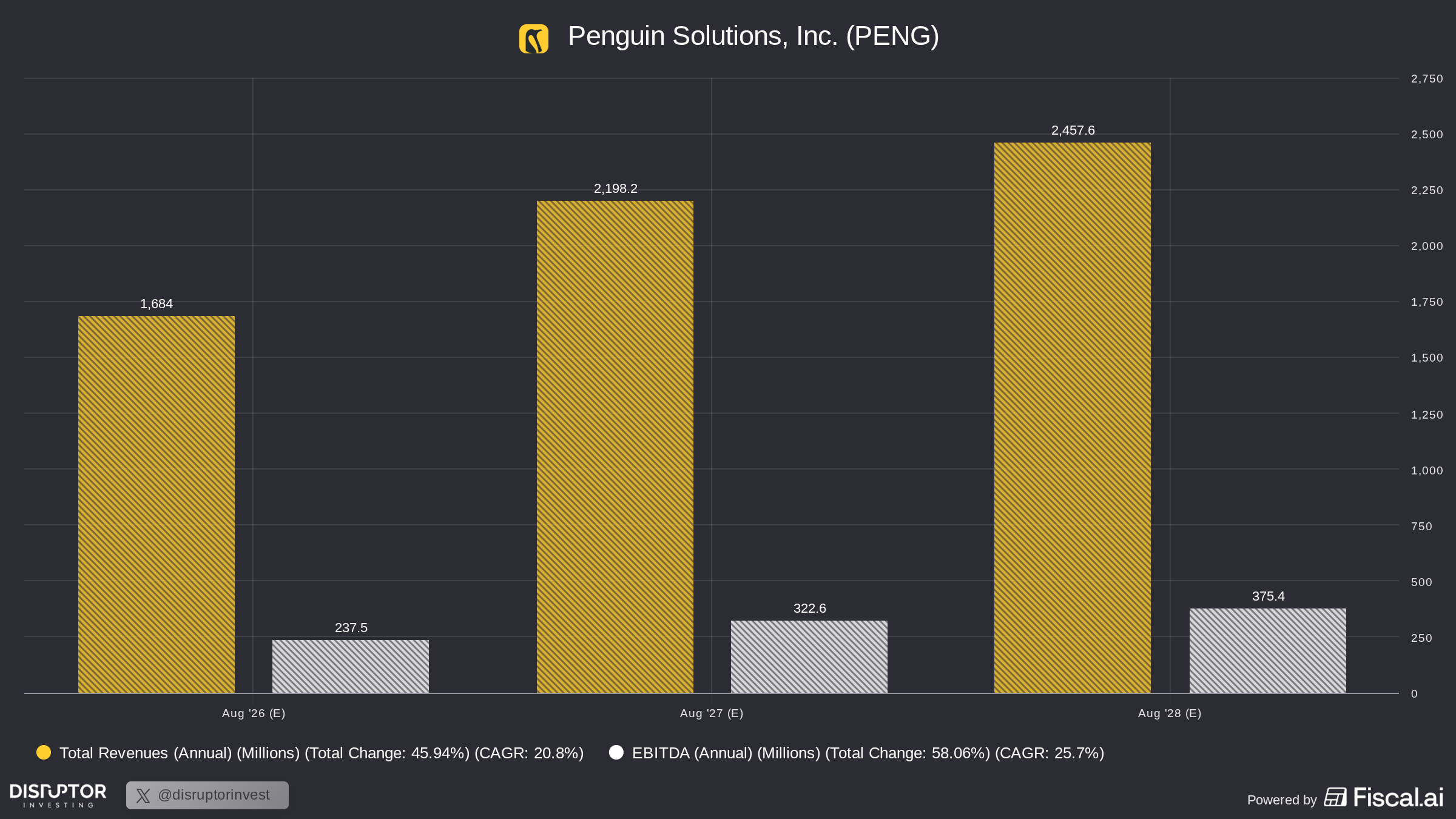
Full year FY2025 revenue was $1.37 billion, up 17% year over year. The FY2026 trajectory shows the shape of the transition clearly: Q1 at $343 million up 1%, Q2 at $343 million down 6%, Q3 at $479 million up 48%. The Q1 and Q2 softness was planned, driven by the deliberate exit from low margin hyperscale hardware resale. The Q3 surge reflects what the business looks like when that drag is gone and enterprise and sovereign demand is filling the space.
Management’s FY2026 guidance, issued July 7, is specific: net sales growth of 22% plus or minus 2%, implying a full year revenue range of roughly $1.63 billion to $1.70 billion. GAAP EPS guidance is $1.97 plus or minus $0.05, and non GAAP EPS guidance is $2.60 plus or minus $0.05. The full year guidance started the year at 6% growth and has been revised up at each step.
Street consensus for Q4 FY2026, per ChartMill as of September 2026, sits at revenue of approximately $524.7 million and non GAAP EPS of approximately $0.78, across 13 analysts. That Q4 revenue consensus was revised upward by roughly 16% over the past three months, a strong directional signal that the analyst community is catching up to management rather than leading it. The average price target post Q3 revisions sits at $74.29, though some aggregators show lower averages near $51 as of early September, reflecting the stock’s pullback from its post earnings peak near $90.
The Q3 beat relative to prior consensus was material. Revenue came in 14% above estimates, and GAAP EPS beat by approximately 189%, per Simply Wall St data published July 8. That magnitude of beat, on revenue and not just earnings, is the kind that forces model revisions rather than minor tweaks.
On gross margins, management explicitly guided Q4 lower than Q3’s 28.1% GAAP figure, citing less favorable memory pricing expected through the back half. That means the consensus for Q4 already prices in a step down. If memory pricing holds or firms, Q4 has upside. If DRAM markets soften further than expected, the miss risk is real and simultaneous on both revenue and margin.
The forward picture for FY2027 is where the real gap between management and the street exists. Management’s preliminary FY2027 outlook, issued alongside Q3 results, points to roughly 30% growth in both net sales and non GAAP EPS. No street consensus exists yet for FY2027, because only one quarter of FY2026 remains and most sell side models have not formally extended that far. The AI Infrastructure segment is expected to grow mid teens in FY2027 as the hyperscale exit rolls off the comparable base, with Integrated Memory and software carrying the acceleration above that. The diluted share count for Q4 FY2026 is expected to reach approximately 62 million shares, up from the basic 50.75 million, due to convertible debt becoming in the money as the stock rose. That dilution is already in management’s guidance figures and is mechanical rather than a sign of equity issuance pressure.
Operating cash flow is a watch item. Analysts have flagged negative operating cash flow in recent periods, driven by working capital expansion as rapid revenue growth requires building inventory and carrying receivables. The company is not burning cash from operating losses. It is financing growth driven working capital, which is a different and more manageable problem, but it is worth monitoring in the Q4 filing for signs of normalization or further expansion.
Why it wins
The moat here has three components that compound on each other rather than standing independently. The first is operational depth. More than four billion hours of GPU cluster runtime across government, research, and commercial customers gives Penguin the ability to make deployment commitments that a hardware reseller cannot. When a sovereign AI program needs a cluster running within a defined window with defined uptime guarantees, the question is not who has the cheapest NVIDIA allocation. It is who has done this before at scale without failure.
The second is NVIDIA co validation. The AI Factory Specialized Partner designation, announced June 23, 2026, is not a marketing agreement. NVIDIA’s own credentialing process requires demonstrated competency in designing, building, deploying, and operating full stack NVIDIA based AI factory infrastructure. The Haein AI Factory, built jointly with NVIDIA and SK Telecom as one of Korea’s largest GPU as a Service clusters, is the live reference architecture that validates that competency. Preferred access to NVIDIA’s AI factory sales pipeline is a structural advantage over hardware only competitors who have not been through that credentialing process.
The third is the MemoryAI KV cache server itself. Delivering up to 11TB of CXL based memory for inference workloads, it addresses the memory wall at a moment when every enterprise deploying persistent agentic AI is hitting that wall. CXL memory disaggregation is complex to implement correctly, and Penguin sells it as a software differentiated stack rather than commodity DRAM. That is the difference between a one time hardware sale and a managed service relationship.
A pure hardware distributor can match the components. Replicating the operational history, the NVIDIA relationship, and the proprietary software layer simultaneously takes years. That combination is why a Tier One financial institution selected Penguin’s solution in Q2 rather than assembling something from open source tooling.
What could go wrong
The strongest bear case is not about whether AI spending continues. It is about whether Penguin specifically captures that spending at the margins the current multiple requires. DRAM and HBM pricing are notoriously cyclical, and Integrated Memory is now 57% of quarterly revenue. If memory pricing normalizes sharply, either from supply additions or from a pause in enterprise procurement, Penguin’s two largest levers, revenue and margin, move in the wrong direction simultaneously. Management already guided Q4 gross margins lower than Q3. A further deterioration would make the FY2027 30% growth pre guidance look optimistic before the fiscal year has even begun.
The interim CFO situation deserves plain treatment. Nate Olmstead resigned the day after the company’s best quarter. We do not know why. Aaron Johnson is carrying interim duties through an oversubscribed convertible note refinancing, a complex capital structure, and what will be one of the most scrutinized quarterly calls the company has had. Management transitions at inflection points add execution risk that does not show up in revenue models.
Short interest at 20.7% of float, having increased 40.7% over the prior twelve months, tells us that a significant number of informed market participants disagree with the bull case. The shorts’ argument is likely exactly what we described above: memory pricing cyclicality and gross margin pressure will make the FY2027 acceleration impossible to deliver. If Q4 results show margin compression beyond what consensus expects, the cover dynamic reverses and becomes a crowding out effect instead.
Finally, insider activity is unanimously directional. Eight open market transactions in the prior six months, all sales, zero purchases, from two insiders including the President of the Optimized LED segment and the Chief Legal Officer. This is not a fire alarm signal given the stock’s run, but it is worth acknowledging that no one inside the building is adding exposure at current prices.
The investment thesis
Penguin Solutions is being priced as a memory cycle trade when it is building the infrastructure for something more durable: managed AI factory deployment where proprietary memory technology, NVIDIA co validation, and four billion hours of operational experience combine into a switching cost moat that commodity hardware distributors cannot replicate quickly.
What has to be true for this to work: the FY2027 30% growth pre guidance holds on the Q4 call in October, gross margins stabilize as the software and services mix increases, and the Integrated Memory segment maintains pricing power even as DRAM supply conditions normalize. The market appears to believe, based on the current multiple of 16.7 times forward non GAAP earnings, that at least one of those conditions fails. We think the probability that all three fail simultaneously is lower than the current discount implies, though we acknowledge that the gross margin trend is the piece where we have the least visibility.
The specific gap in estimates that makes this interesting is FY2027. No sell side consensus yet exists for that year. Management’s 30% pre guidance, if confirmed in four weeks, will force rapid model extension across 13 covering analysts who have not yet built out those estimates. A stock at 16.7 times this year’s earnings, growing at 30% next year, with an 82% buy consensus and an average price target of $74.29, is the setup where estimate revisions do the work rather than multiple expansion.
This is a name to hold through the Q4 catalyst, with the October 5 to 8 earnings print as the event that either validates or resets the thesis. The timeframe is weeks, not quarters, for the first decision point. After that, assuming the FY2027 pre guidance holds, the thesis plays out over the first two quarters of FY2027 as actual revenue against that 30% baseline either confirms the trajectory or exposes the memory pricing vulnerability.
The falsification is single and observable: if Q4 FY2026 results come with a reduction or explicit withdrawal of the FY2027 30% growth pre guidance, the thesis is wrong and the stock should trade lower regardless of Q4 headline revenue.
What we are watching
- AI Infra Summit, Santa Clara, September 15 to 17, 2026: PENG presenting the MemoryAI KV cache server; watch for any new customer or deployment announcements from the floor.
- Q4 FY2026 earnings, estimated October 5 to 8, 2026: confirmation or revision of the FY2027 approximately 30% growth pre guidance is the single most important data point.
- Q4 FY2026 gross margin disclosure: management guided lower than Q3’s 28.1% GAAP figure; the actual number and the sequential direction will tell us whether the memory pricing headwind is manageable or structural.
- Operating cash flow in the Q4 10-Q filing: watch for normalization of working capital outflows relative to the revenue ramp, or further deterioration.
- Interim CFO status: any announcement of a permanent appointment, or absence of one, going into the Q4 call carries signal about internal stability.
- Lektra deployment timeline, expected across multiple sites: any project level update or additional Lektra customer wins would validate the distributed micro datacenter vertical as a real revenue line.
- DRAM and HBM spot pricing through September and October: the Integrated Memory segment’s margin is directly correlated; any sharp move in either direction affects Q4 and FY2027 framing.
The bottom line
The shift inside AI infrastructure has moved from GPU scarcity to memory architecture, and Penguin is one of a small number of companies that was positioned for that transition before it became consensus. Three decades of HPC operational experience, an invitation only NVIDIA co validation, and a proprietary CXL memory product for inference are not things that appeared in the last eighteen months. They were built while the company was still being described as a memory module distributor and an LED business in the same sentence.
The Q3 numbers, 48% revenue growth, 417% GAAP operating income growth, 74% of revenue from AI driven businesses, were real. The FY2027 30% pre guidance is the claim that now needs to be defended. Management has a consistent pattern of conservative guidance followed by upward revisions this fiscal year, starting at 6% and reaching 22%. Whether that pattern holds at the 30% level, against a harder comparable base and a gross margin headwind from DRAM pricing, is the question the October earnings call will answer.
What would change our mind is simple: a Q4 print where management walks back the FY2027 30% growth pre guidance and cites either memory pricing deterioration or weaker than expected enterprise pipeline. That outcome would tell us the Q3 acceleration was more cyclical than structural, and the valuation would need to reset accordingly. Until that call, the gap between a 16.7 times earnings multiple and a 30% growth trajectory is where the argument lives.
Not financial advice.
References
- Penguin Solutions IR. Penguin Solutions Reports Q3 Fiscal 2026 Financial Results. Published July 7, 2026. Accessed September 10, 2026. https://ir.penguinsolutions.com/news/news-details/2026/Penguin-Solutions-Reports-Q3-Fiscal-2026-Financial-Results/default.aspx
- Nasdaq. Penguin Solutions Reports Q3 Fiscal 2026 Financial Results. Published July 7, 2026. Accessed September 10, 2026. https://www.nasdaq.com/press-release/penguin-solutions-reports-q3-fiscal-2026-financial-results-2026-07-07
- SEC EDGAR. Penguin Solutions Form 8-K Exhibit 99.1, Q3 FY2026. Published July 7, 2026. Accessed September 10, 2026. https://www.sec.gov/Archives/edgar/data/0001616533/000161653326000041/pengq3-26form8xkxex991.htm
- SEC EDGAR. Penguin Solutions Form 10-Q Balance Sheet for the quarterly period ended May 29, 2026. Filed July 2026. Accessed September 10, 2026. https://www.sec.gov/Archives/edgar/data/0001616533/000161653326000043/peng-20260529.htm
- Penguin Solutions IR. Q3 FY2026 Earnings Call Prepared Remarks. Published July 7, 2026. Accessed September 10, 2026. https://s204.q4cdn.com/917347554/files/doc_financials/2026/q3/PENG-Q3-FY26-Earnings-Call-Prepared-Remarks-for-posting.pdf
- Penguin Solutions IR. Penguin Solutions Reports Q2 Fiscal 2026 Financial Results. Published April 1, 2026. Accessed September 10, 2026. https://ir.penguinsolutions.com/news/news-details/2026/Penguin-Solutions-Reports-Q2-Fiscal-2026-Financial-Results/default.aspx
- Penguin Solutions IR. Penguin Solutions Reports Q1 Fiscal 2026 Financial Results. Published January 6, 2026. Accessed September 10, 2026. https://ir.penguinsolutions.com/news/news-details/2026/Penguin-Solutions-Reports-Q1-Fiscal-2026-Financial-Results/default.aspx
- Penguin Solutions IR. Penguin Solutions Reports Q4 and Full Year Fiscal 2025 Financial Results. Published October 7, 2025. Accessed September 10, 2026. https://ir.penguinsolutions.com/news/news-details/2025/Penguin-Solutions-Reports-Q4-and-Full-Year-Fiscal-2025-Financial-Results/default.aspx
- Penguin Solutions IR. Penguin Solutions Becomes an NVIDIA AI Factory Specialized Partner. Published June 23, 2026. Accessed September 10, 2026. https://ir.penguinsolutions.com/news/news-details/2026/Penguin-Solutions-Becomes-an-NVIDIA-AI-Factory-Specialized-Partner/default.aspx
- Penguin Solutions IR. Penguin Solutions Announces Closing of Oversubscribed Convertible Notes Offering. Published July 16, 2026. Accessed September 10, 2026. https://ir.penguinsolutions.com/news/news-details/2026/Penguin-Solutions-Announces-Closing-of-Oversubscribed-Convertible-Notes-Offering/default.aspx
- SEC EDGAR. Form 8-K Exhibit 99.2, Convertible Notes Pricing. Published July 14, 2026. Accessed September 10, 2026. https://www.sec.gov/Archives/edgar/data/0001616533/000119312526307989/d103073dex992.htm
- StocksToTrade. PENG Stock Jumps As Nvidia Taps Penguin Solutions For AI Factory Push. Published July 8, 2026. Accessed September 10, 2026. https://stockstotrade.com/news/penguin-solutions-inc-peng-news-2026_07_08-3/
- Seeking Alpha. Penguin Solutions: Rapid Growth From AI Integrated Memory Solutions. Published July 8, 2026. Accessed September 10, 2026. https://seekingalpha.com/article/4920600-penguin-solutions-rapid-growth-from-ai-integrated-memory-solutions
- Investing.com. Earnings Call Transcript: Penguin Solutions tops Q3 2026 estimates, raises outlook. Published July 7, 2026. Accessed September 10, 2026. https://www.investing.com/news/transcripts/earnings-call-transcript-penguin-solutions-tops-q3-2026-estimates-raises-outlook-93CH-4780386
- Investing.com. Penguin Solutions at Rosenblatt AI Summit: pushing deeper into software. Published August 17, 2026. Accessed September 10, 2026. https://www.investing.com/news/transcripts/penguin-solutions-at-rosenblatt-ai-summit-pushing-deeper-into-software-93CH-4863907
- ChartMill. PENG Forecast, Price Target and Analyst Ratings. Accessed September 10, 2026. https://www.chartmill.com/stock/quote/PENG/analyst-ratings
- StockAnalysis. Penguin Solutions (PENG) Statistics and Valuation. Accessed September 10, 2026. https://stockanalysis.com/stocks/peng/statistics/
- StockAnalysis. Penguin Solutions (PENG) Market Cap. Published July 13, 2026. Accessed September 10, 2026. https://stockanalysis.com/stocks/peng/market-cap/
- StockTitan. Short interest in Penguin Solutions. Published June 30, 2026. Accessed September 10, 2026. https://www.stocktitan.net/overview/PENG/
- AlphaSpread. Penguin Solutions Cash, Balance Sheet as of May 29, 2026. Accessed September 10, 2026. https://www.alphaspread.com/security/nasdaq/peng/financials/balance-sheet/cash
- Simply Wall St. Penguin Solutions Stock Analysis. Published September 8, 2026. Accessed September 10, 2026. https://simplywall.st/stocks/us/semiconductors/nasdaq-peng/penguin-solutions
- Simply Wall St. Penguin Solutions Stock Forecast and Analyst Predictions. Published July 8, 2026. Accessed September 10, 2026. https://simplywall.st/stocks/us/semiconductors/nasdaq-peng/penguin-solutions/future
- TipRanks. Penguin Solutions Earnings Dates. Accessed September 10, 2026. https://www.tipranks.com/stocks/peng/earnings
- MarketChameleon. PENG Earnings Dates. Accessed September 10, 2026. https://marketchameleon.com/Overview/PENG/Earnings/Earnings-Dates/
- TipRanks. Penguin Solutions Issues Zero Coupon Convertible Notes and Refinances. Published July 18, 2026. Accessed September 10, 2026. https://www.tipranks.com/news/company-announcements/penguin-solutions-issues-zero-coupon-convertible-notes-and-refinances
- StockTitan. Form 8-K: Vanguard Reports 6.89% Stake in Penguin Solutions, Schedule 13G Passive Investment Disclosure. Published April 2026. Accessed September 10, 2026. https://www.stocktitan.net/sec-filings/PENG/schedule-13g-penguin-solutions-inc-passive-investment-disclosure-5-59b631cc7853.html
- TradingKey. PENG Institutional Confidence. Published July 30, 2026. Accessed September 10, 2026. https://www.tradingkey.com/markets/stocks/peng/sentiment
- Penguin Solutions IR. Penguin Solutions to Showcase AI Infrastructure and Memory Solutions at AI Infra Summit 2026. Published September 2, 2026. Accessed September 10, 2026. https://ir.penguinsolutions.com/news/news-details/2026/Penguin-Solutions-to-Showcase-AI-Infrastructure-and-Memory-Solutions-at-AI-Infra-Summit-2026/default.aspx
- Offshore Source via BusinessWire. Penguin Solutions Full Stack AI Factory Platform Enables Lektra’s Distributed AI Data Centers. Published September 10, 2026. Accessed September 10, 2026. https://offshoresource.com/business-wire/penguin-solutions-full-stack-ai-factory-platform-enables-lektras-distributed-ai-data-centers
- Quiver Quantitative. PENG Institutional Holdings. Accessed May 2026. https://www.quiverquant.com/stock/PENG/institutions/
- Motley Fool. Penguin Solutions Q4 FY2025 Earnings Call Transcript. Published October 8, 2025. Accessed September 10, 2026. https://www.fool.com/earnings/call-transcripts/2025/10/08/penguin-solutions-peng-earnings-transcript/