
The 30 second version
- Ormat owns about 1,355MW of geothermal and solar plants and sells the power under fixed price contracts, mostly to utilities in the western US.
- The company is in Orbit. The new curve inside it is geothermal priced for data centres, still at Launch Pad, as buyers who need power every hour start paying more for it.
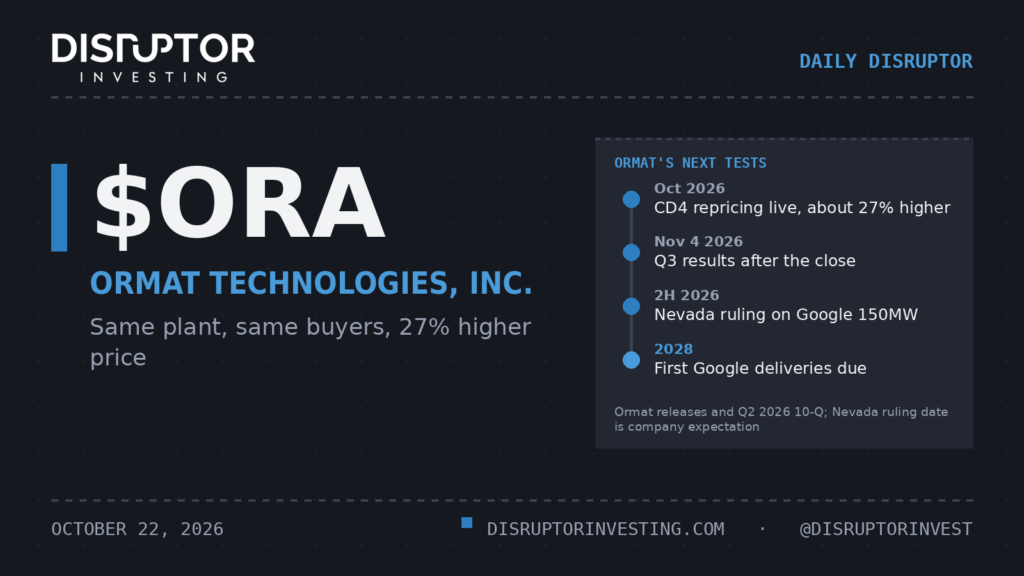
- Evidence: a California contract repriced about 27% higher that went live on October 1, a Google portfolio deal for up to 150MW, and 202MW of new plants all under contract.
- Next tests: Q3 results after the close on November 4, and the Nevada regulator’s ruling on the Google contract, which Ormat expects in the second half of 2026.
- It breaks if the Google contract is rejected or slips past March 2027, or if the $630 million floor of the EBITDA guide is cut.
Three weeks ago a geothermal plant near Mammoth Lakes, California started selling the same electricity to the same two buyers for roughly 27% more than it charged in September. No new wells, no new turbines. Two community power agencies agreed to rewrite a contract with six years left, and added five more.
The plant is Casa Diablo IV, owned by Ormat Technologies. In dollars the uplift is small. What it reveals is larger: buyers who need power at 3 a.m. as much as at noon will now pay more for contracts signed four years ago, and Ormat owns a fleet of them.
The timing matters: the first quarter at the new price has just begun, Q3 results land on November 4, and Nevada’s utility commission is due to rule on Ormat’s Google contract. The market is pricing the company as a utility whose earnings have peaked. We think it is reading the wrong line.
What just happened
On March 10, Ormat signed a blend and extend amendment with Central Coast Community Energy and Silicon Valley Clean Energy, which together buy 15MW of the output from Casa Diablo IV. The term went from 10 to 15 years, now running to 2037, each buyer’s share rose from 7MW to 7.5MW, and the price rose about 27%. The new terms took effect on October 1, 2026, so the fourth quarter is the first to carry them.
It is one of a series. Ormat’s proxy statement records that the 52MW Heber 1 contract with the Southern California Public Power Authority was extended by 25 years from February 2026. In Hawaii, the 10-Q says a new fixed price contract for the Puna plant, with more capacity and a term to 2052, should take effect in 2027. New buyers are arriving too: Google through NV Energy in February, and Switch, the data centre operator, for about 13MW from 2030.
In August, Ormat raised its 2026 guidance to revenue of $1.15 billion to $1.20 billion and adjusted EBITDA of $630 million to $650 million, up from $615 million to $645 million in February. But look at the source. Battery storage guidance jumped from $95 million to $110 million up to $140 million to $155 million, while the electricity segment was trimmed to $710 million to $725 million. That is why the market shrugged.
The business
Electricity, 65% of second quarter revenue, comes from plants Ormat owns, and 94.4% of that segment’s first half revenue was earned at fixed rates. Product sells Ormat’s own generating units and whole plants to other developers, with a backlog of $202.8 million in August. Energy Storage runs a 495MW battery fleet paid either merchant prices, in markets such as PJM, or fixed tolling fees.
The bill is simple. A utility or a large buyer pays per megawatt hour delivered. On our rough arithmetic, 2025 electricity revenue of $693.9 million across about 1,355MW is around $500,000 per megawatt a year. Most of the cost arrives up front, in drilling and the plant. After that, delivering one more megawatt hour costs very little, so a higher price on an existing contract falls almost straight through to EBITDA. That is why a 15MW repricing matters beyond its size.
Wind and solar are cheaper but stop when the weather does; gas runs all night but is not carbon free. Newer geothermal developers such as Fervo are still private and still proving their costs. Ormat’s edge is that it owns the resource, the land, the water rights and the grid connections, and builds its own generating equipment. One filing detail shows how much is still on old terms: Puna in Hawaii is paid at the utility’s avoided cost, which tracks oil, until its fixed contract starts.
Who keeps the benefit? Under NV Energy’s Clean Transition Tariff, Google pays for the firm clean supply it asks for, so other customers do not carry the premium and the supplier keeps the higher price. Cheaper AI models mean more compute and more power demand, which helps. The real substitution risk is cheaper firm power, one reason Ormat runs its own enhanced geothermal pilots with SLB and Sage Geosystems. (The SLB well at Desert Peak, Nevada is due to start drilling this quarter, about as close as geothermal gets to a product launch.)
Where it sits on our curve
Our Disruption Map places geothermal and next generation baseload early on our curve, with enhanced geothermal at Launch Pad. Ormat itself is Orbit: sixty years old, about $1 billion of revenue. The thesis rests on a new curve inside it, geothermal priced by buyers who need carbon free power every hour. The Google portfolio sits at Launch Pad, signed but awaiting approval, with deliveries planned for 2028 to 2030. Repricing of the existing fleet has already reached renewal, the strongest step short of cash: two buyers committed in writing to pay about 27% more.
The binding constraint is firm, carbon free supply near where data centres connect, and the buyer’s threshold is whether a regulator will let the utility pass that premium to the customer who asked for it. Ormat has not published the Google price, so we cannot put a number on the gap to that threshold. Nevada approval, plus one more repricing of 15% or more, would steepen the curve.
The strongest alternative is that the 2026 raise is a battery windfall from PJM merchant prices and that data centre contracts are too small and too far off to matter. The electricity segment tells the two apart. If its revenue and margin turn up in the fourth quarter and the 2027 guide, repricing is working. If storage still carries the whole increase, the alternative wins.
The numbers
Revenue over the last five quarters ran $234.0 million, $249.8 million, $276.0 million, $403.9 million and $258.8 million. The spike in the first quarter of 2026 is the $105.1 million sale of the Topp 2 plant in New Zealand, a one off. Adjusted EBITDA moved from $134.6 million to $138.4 million, $158.7 million, $194.9 million and then $143.9 million in the second quarter, up 6.9% on a year earlier. Electricity revenue grew more slowly, to $169.3 million from $159.9 million.
Bulls tend to skip the margins. Electricity gross margin fell from 34.6% in 2024 to 28.5% in 2025 and was 23.7% in the second quarter, against 24.2% a year earlier, after curtailments and maintenance. Storage went the other way, to 56.2% from 11.9%. That is the shape the repricing has to change.
On the balance sheet, Ormat held $513.7 million of cash and $377.3 million of unused credit lines at June 30. Our sum of its borrowings is about $3.15 billion, roughly $2.64 billion net of cash. Operating cash flow was $129.2 million in the first half against $251.8 million of capital spending, with another $449.0 million planned for the rest of 2026. Diluted shares were 62.5 million in the second quarter, up 2.5% on a year earlier.
The guidance implies second half EBITDA of about $291 million to $311 million, against $297.1 million in the second half of 2025. Street figures we have seen, but could not confirm in a primary source, carry 2027 revenue roughly flat. That reading misses the Topp 2 sale. Strip out the $105.1 million and a flat 2027 means the recurring business grows about 9%.
What the price already requires
At about $87 a share and 62.5 million diluted shares, the equity is worth about $5.4 billion. Add our $2.64 billion of net debt and $137 million of noncontrolling interest and the enterprise value is near $8.2 billion, or 12.8 times the $640 million EBITDA midpoint. On 12 times, which we regard as fair for contracted generation with modest growth, today’s price needs about $685 million of EBITDA by 2027 to 2028, roughly 7% above this year.
Assume net debt climbs to about $2.9 billion. Downside: merchant battery prices fall back, nothing else reprices, EBITDA settles near $600 million, worth about $67 a share at 12 times. Central: the 202MW of contracted geothermal and solar projects come online, Casa Diablo IV, Heber 1 and Puna earn their new rates, storage cools, and EBITDA reaches about $700 million by 2028, worth $86 at 12 times and $91 at 12.5 times. Upside: Google is approved, two or three more contracts reprice, a pilot works, and EBITDA reaches $780 million, about $106 a share.
So the central case supports the price, without much to spare. The gap is what that central case leaves out. It gives the Google portfolio, up to 150MW or about 11% of the current geothermal and solar fleet, no value at all. The market reads a storage led guide and a revenue line flattered by a one off sale. We read the electricity contracts, which started repricing this month.
What breaks it
Written now, before the results: the thesis breaks if the Nevada commission rejects the Google contract or pushes its decision past March 2027, if the full year EBITDA guide is cut below $630 million, or if Q3 adjusted EBITDA comes in under $130 million, against $138.4 million a year ago. A slower failure would be a 2027 guide in February that shows electricity revenue flat with both Casa Diablo IV and Puna repriced.
Ormat reaches November and the Nevada ruling on cash in hand, without new equity, but the build is borrowed. About $366 million of convertible notes sit in current liabilities, including $175 million of zero coupon Series B notes that holders can hand back on March 15, 2027, and quarterly interest expense is up to $43.9 million from $36.7 million. If refinancing that stack costs materially more, the gain from repricing goes to lenders rather than shareholders.
What we are watching
- November 4, 2026, Q3 results after the close: strengthens if adjusted EBITDA is $142 million or more, electricity revenue beats last year’s $167.1 million and the guide holds or rises. Breaks if EBITDA is under $130 million or the $630 million floor is cut.
- By December 31, 2026, Nevada ruling on the Google contract: approval on the filed terms strengthens the case. Rejection, or a decision pushed past March 2027, breaks it.
- Fourth quarter 2026, Desert Peak drilling with SLB: a start on schedule supports the enhanced geothermal option. A slip into late 2027 weakens it without breaking the core thesis.
- Late February 2027, 2027 guidance: strengthens if electricity revenue is guided up 5% or more with storage flat. Breaks if electricity is guided flat or down and EBITDA guidance starts below $640 million.
Not financial advice.
References
- Ormat Technologies. Ormat Technologies Announces Signing of ‘Blend and Extend’ Amendment for CD4 Geothermal Power Plant. Published March 10, 2026. Accessed October 21, 2026. https://investor.ormat.com/news-events/news/news-details/2026/Ormat-Technologies-Announces-Signing-of-Blend-and-Extend-Amendment-for-CD4-Geothermal-Power-Plant/default.aspx
- Ormat Technologies. Ormat Technologies, Inc. to Host Conference Call Announcing Third Quarter 2026 Financial Results. Published October 6, 2026. Accessed October 21, 2026. https://www.marketscreener.com/news/ormat-technologies-inc-to-host-conference-call-announcing-third-quarter-2026-financial-results-ce785dd9d98cf623
- Ormat Technologies. Form DEF 14A, 2026 proxy statement. US Securities and Exchange Commission. Published April 2026. Accessed October 21, 2026. https://www.sec.gov/Archives/edgar/data/0001296445/000119312526166752/ora-20260420.htm
- Ormat Technologies. Form 10-Q for the quarterly period ended June 30, 2026. US Securities and Exchange Commission. Published August 2026. Accessed October 21, 2026. https://www.sec.gov/Archives/edgar/data/0001296445/000129644526000014/ora-20260630.htm
- Ormat Technologies. Ormat Technologies Announces the Signing of Geothermal Portfolio PPA of Up to 150 MW to Support Google’s Data Center Operations Through NV Energy. Published February 17, 2026. Accessed October 21, 2026. https://investor.ormat.com/news-events/news/news-details/2026/Ormat-Technologies-Announces-the-Signing-of-Geothermal-Portfolio-PPA-of-Up-to-150-MW-to-Support-Googles-Data-Center-Operations-Through-NV-Energy/default.aspx
- Ormat Technologies. Form 8-K, Exhibit 99.1: Ormat Technologies Reports Second Quarter 2026 Financial Results. US Securities and Exchange Commission. Published August 5, 2026. Accessed October 21, 2026. https://www.sec.gov/Archives/edgar/data/0001296445/000143774926025961/ex_999557.htm
- Ormat Technologies. Form 8-K, Exhibit 99.1: Ormat Technologies Reports Fourth Quarter and Year End 2025 Financial Results. US Securities and Exchange Commission. Published February 25, 2026. Accessed October 21, 2026. https://www.sec.gov/Archives/edgar/data/1296445/000143774926005680/ex_925292.htm