
$MBOT is the story Wall Street hasn’t found yet: a commercial-stage robotic surgical company with FDA clearance, accelerating revenue, and a federal government distribution channel trading at a sub-$130M market cap. This is pre-market July 24, and the setup heading into what should be a Q2 full earnings report in mid-August is as clean as any inflection I’ve tracked this year.
Let’s start with what’s actually happening. Microbot Medical’s LIBERTY Endovascular Robotic System is the only FDA-cleared single-use, remotely operated robotic system for peripheral endovascular procedures, a U.S. market of 2.5 million annual cases. The company spent years in development and cleared the FDA in September 2025. It then ran a limited market release through Q1 2026, posted its first commercial revenue, and launched the Full Market Release on April 13, 2026. Q2 results announced July 7 showed greater than 100% quarter-over-quarter revenue growth alongside equivalent customer growth. Accounts have now expanded across Massachusetts, North Carolina, Michigan, and Pennsylvania. Two of those new commercial adopters were sites that participated in the company’s ACCESS-PVI pivotal trial, physicians who ran the trial and then bought the system. That is the strongest form of product validation there is.
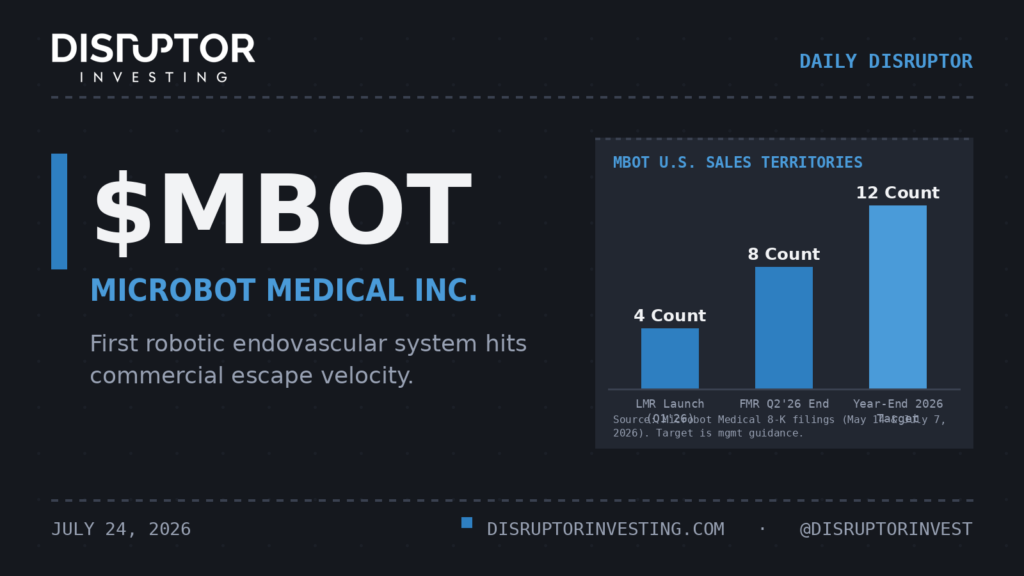
The inflection points layering in ahead are what make this interesting pre-market today. First, territory expansion: $MBOT went from 4 to 8 U.S. sales territories in Q2, and management has guided to 12 by year-end, a 50% footprint increase still ahead. Second, the Sanmina manufacturing deal (signed June 30, 2026) adds a second production facility with a global manufacturing leader, designed to support both domestic scale and international demand while improving gross margins. Third, international regulatory momentum: Israel granted marketing clearance in May, and the company is targeting CE Mark completion by the end of 2026, opening the European Union market. Fourth, the federal channel: the Lovell Government Services agreement puts LIBERTY in front of the Veterans Health Administration, Military Health System, and Indian Health Service, more than 2,000 federal healthcare sites. That’s a distribution runway that dwarfs what 8 commercial territories can access independently. Watch the Q2 full earnings call (expected mid-August) for the first hard revenue number, any update on the Sanmina ramp timeline, and incremental CE Mark progress, those are the metrics that matter over the next 60 days.
Clinical data from the ACCESS-PVI trial presented at the Society of Interventional Radiology showed 100% robotic navigation success and a 92% reduction in radiation exposure. That radiation reduction isn’t a marketing line; it’s an occupational safety argument that leading medical societies have now endorsed through updated guidelines, giving hospital procurement committees a structural reason to evaluate LIBERTY beyond procedure efficiency alone. $ISRG built its first decade on exactly this kind of compound clinical-plus-operational sell. $MBOT is targeting the same logic at a fraction of the market cap.
Risk: This is a micro-cap at ~$128M market cap with minimal trailing revenue roughly $0.1M TTM as of Q1 2026. The 100%-plus Q2 growth sounds dramatic but is off an extremely small base; absolute revenue remains immaterial until scaling truly takes hold. Cash burn remains a concern for a company still in early commercial launch. Sanmina deal and CE Mark are both described as LOA and targeted, not finalized or guaranteed. Any slip in territory expansion, a hospital budget freeze, or a slower-than-expected federal procurement cycle could stall the momentum narrative sharply. Dilution risk is real at this market cap. Not financial advice.