
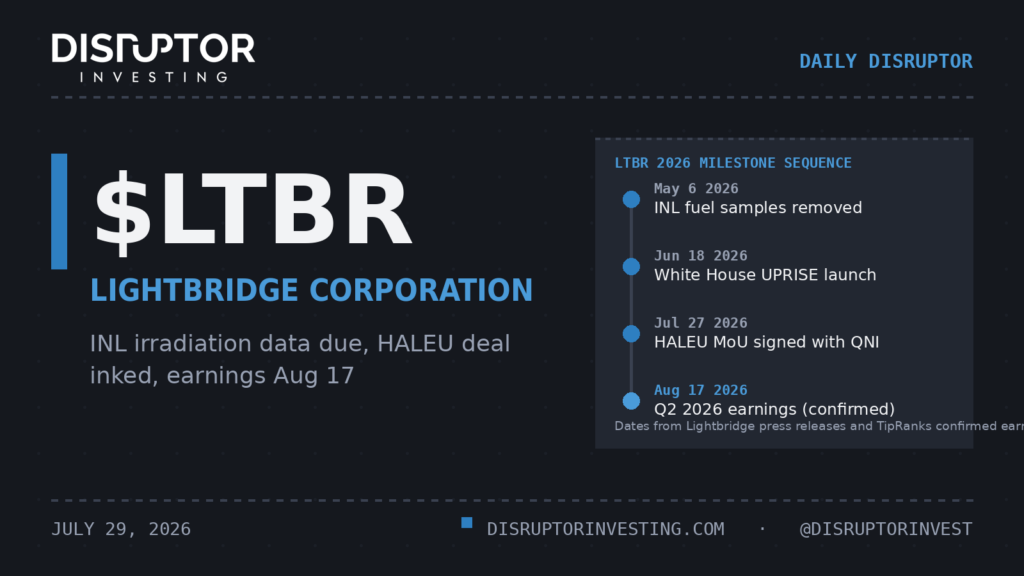
The constraint in the nuclear fuel sector is not technology, it is data. Utilities will not commit to a new fuel design without irradiation performance numbers from a qualified test reactor, and those numbers take years to generate. That logjam is exactly what is breaking for $LTBR. The first batch of Lightbridge Fuel material samples were removed from Idaho National Laboratory’s Advanced Test Reactor in June and will cool down over the next several months before post irradiation examination begins, expected later this year. That examination is not a press release. It is the foundational dataset that unlocks regulatory licensing submissions. The market is sitting on the launch pad and treating it like a parking lot.
Two days ago, on July 27, Lightbridge and Quadrant Nuclear Industries signed a memorandum of understanding to establish a framework for collaboration on the long term supply of HALEU fuel, with discussions focused on potential supply and offtake from QNI’s planned Vanguard facility at Idaho National Laboratory. That planned Vanguard facility is designed to produce up to 18 metric tons of HALEU annually at full capacity. The MoU is non binding, I want to be clear about that, but it matters because HALEU sourcing is the one supply chain problem that could delay commercialization independent of how good the irradiation data turns out to be. Getting a framework in place now, before the data even lands, is the right sequencing. There is also the federal tailwind: Lightbridge participated in the White House launch of the DOE’s UPRISE initiative in June, a federal program seeking approximately 5 GW of additional nuclear capacity from existing reactors. Lightbridge Fuel is designed to enable power uprates of up to 30% or more for new build reactors and up to 20% or more for existing light water reactors, while running approximately 1,000 degrees Celsius cooler than conventional fuel. UPRISE essentially wrote the demand brief for the product Lightbridge is building. Something I noticed in the Q1 filing: patent allowances arrived from three major jurisdictions in Q1 2026, Canada, the United States, and the European Patent Office, expanding protection for Lightbridge Fuel across the CANDU fleet, the U.S. domestic light water reactor market, and 39 European contracting states. Three jurisdictions in a single quarter is not routine. It rarely shows up in the summary coverage.
On the five point screen. Growth profile: Lightbridge is pre revenue, so this is a milestone velocity story, not a revenue acceleration story. The inflection is the pace of qualification data, not a top line. Catalyst with a date: Lightbridge is scheduled to report Q2 2026 earnings on August 17, 2026. That is inside three weeks. Post irradiation examination commences later in 2026, which I read as Q3 or early Q4. Fundamentals: Cash and cash equivalents stood at $215.7 million and total liabilities were just $1.3 million at March 31, 2026. That is about as clean a balance sheet as a development stage company gets. The burn rate is real, quarterly net losses have been running in the $4 to $6 million range, but at that pace the cash runway extends well beyond the next commercial milestone. Technicals: LTBR is trading near the bottom of its 52-week range and below its 200-day moving average. The stock has traded in a day range of $8.42 to $8.93 with pre market at approximately $8.69. The chart is not a setup anyone would love. The stock traded above $31 in the last twelve months and has given back most of that. Volume has been contracting. This is not a technical breakout story yet, it is a thesis ahead of the chart setup, and those are the ones you need the most conviction to hold. Positioning: Approximately 6.5% of stock is owned by insiders. Institutional ownership is thin and analyst coverage sparse. No ETF owns it in size. Short interest has been declining modestly from peak levels. The asymmetry is intact but the setup requires patience.
The honest risk paragraph. Lightbridge has no revenue and never has. The $215.7 million cash position and minimal liabilities provide a long runway for R&D, yet ongoing cash burn and past reliance on capital markets have eroded shareholder value. The stock has done a round trip from under $3 to over $31 and back below $9 in under eighteen months, down roughly 50% over the last six months by one measure. Dilution has been real across multiple raises. The post irradiation examination could produce data that slows the commercialization timeline rather than accelerating it. And the HALEU MoU is non binding and establishes no pricing, quantity, or exclusivity commitments; any binding terms require a definitive agreement after further negotiation. The August 17 earnings print is more likely to be a narrative update than a financial event, but the market will trade it either way. Position size accordingly.
I think the market is wrong about the timing here. The post irradiation examination data is the gating item for every subsequent step, licensing submissions, utility conversations, commercial structuring. When that data arrives, the entire pipeline downstream accelerates in a way that a press release cannot replicate. The stock is near its floor, the balance sheet is the strongest it has ever been, and three catalysts land before the end of the quarter. That is worth paying attention to. Not financial advice.
The setup
LTBR is sitting at 8.02, which places it at just 4% of its 52 week range and 71.1% below its 52 week high. The stock is in a clear downtrend: price is below both its 50 day and 200 day moving averages, the 50 day itself is below the 200 day, and the gap to the 200 day average is 43.0%. The 3 month return is negative 38.9% and the 6 month return is negative 49.8%. Relative to the broad market, LTBR has underperformed by 42.2 points over the past three months. Volume over the last 10 days is running at 0.80x the 50 day average, so there is no unusual buying activity to note. The average true range is 6.9% of price, meaning daily swings are large relative to the stock level. Nothing in these numbers suggests the selling pressure has resolved.
The historical base rate covers 219 prior days when LTBR was in a comparable technical position. In those instances the median one month move was negative 2.8% and the median one quarter move was negative 5.3%. The stock was higher a month later only 41% of the time and higher a quarter later only 42% of the time. The quarterly range ran from negative 29.0% to positive 258.1%, which reflects how volatile the outcomes were. Because this base rate comes from one ticker in one set of past circumstances, it carries no predictive obligation. Still, with a below 50% forward hit rate and a negative median outcome, the historical record does not offer a contrarian setup worth leaning on. Anyone sizing a position here should treat the wide outcome range, not the median, as the more relevant planning input.