
The 30 second version
- Modine builds the chillers, fan walls and coolant units that carry heat out of AI data halls, and sells most of them to hyperscalers.
- The product is in Flight: buyers book it years ahead. The constraint now is parts for Modine’s own factories, and that cut Data Centers gross margin to 20.2% last quarter.
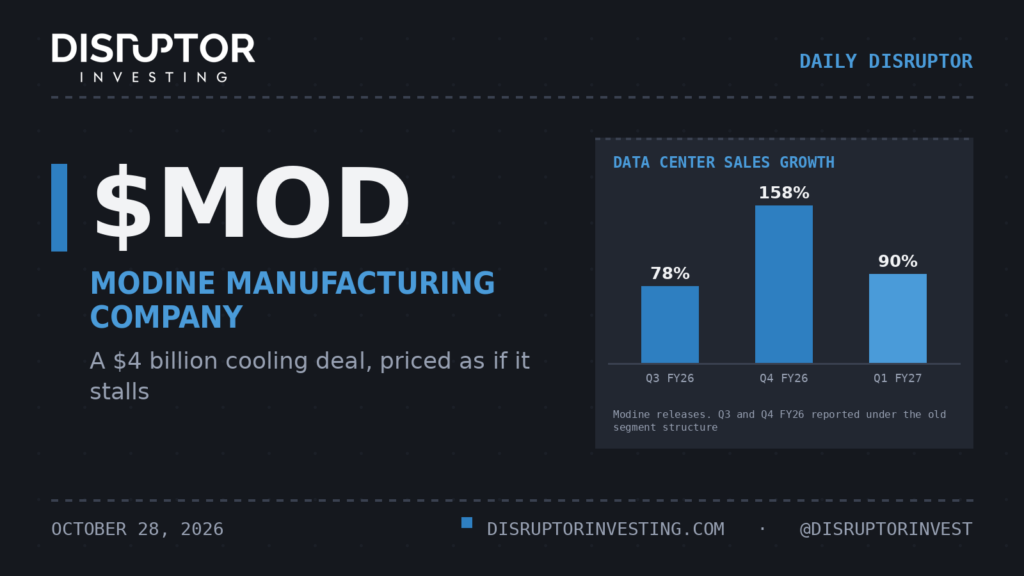
- The evidence: one customer paid $165 million in cash to reserve more than $4 billion of output for 2027 to 2029, and Data Centers sales rose 90%.
- The test is fiscal second quarter results after the close on Tuesday, November 3, with the first outlook for the company since the vehicle business left.
- The thesis breaks if Data Centers sales stall below $350 million, or if margin falls under 20% after the parts problem was supposed to be fixed.
Last May a single data center customer handed Modine $165 million in cash for a promise of factory time. In return Modine guaranteed capacity to supply more than $4 billion of Airedale cooling equipment across calendar 2027 to 2029. An investigation published in August named the customer as Google. Modine has not confirmed that.
Spread over three years, that comes to more than $1.3 billion a year from one buyer. Modine’s whole Data Centers segment sold $348.6 million last quarter. On Tuesday the shares closed at $136.51, less than half their 52 week high, which gives a market value of roughly $7.2 billion.
Next Tuesday’s report matters more than most. It is the first since the company shed its Performance Technologies business on October 1, so the outlook gets rebuilt from scratch. It will also show whether the parts shortage that squeezed the last quarter is over.
What just happened
The separation closed on October 1. Performance Technologies, the old engine and vehicle cooling business, merged into Gentherm. Modine holders got 0.44619 Gentherm shares for each Modine share they owned. Modine collected a cash distribution of about $156 million and used it to pay down debt, and the deal valued the departing business at about $946 million. What remains is data center cooling, commercial HVAC and refrigeration. One quirk: Gentherm bought the Modine name itself. Shareholders vote on November 13 to rename the company Modexus Solutions, and it will license the Modine brand back for its HVAC lines.
On October 21 the company set the date: results after the close on November 3, then a call at 10:00 a.m. Central the next morning. Modine had already said its fiscal 2027 guidance assumed Performance Technologies for the full year, and promised an updated outlook for the continuing business once the deal closed. That update is now due.
In the meantime the shares slid more than a quarter in the two weeks to Monday’s close of $130.27, then rose 4.8% on Tuesday. We found no company disclosure that explains the fall.
The business
Airedale is the British cooling brand Modine bought in 2022, and it is the core of the data center business. Its chillers reject heat from the facility water loop. Its fan walls move air through the halls. Its coolant distribution units feed liquid to the server racks. Hyperscalers, neoclouds and colocation operators pay per unit or per system delivered, under project orders, and now also under capacity agreements that hold factory space for years.
Q1 showed what a unit costs. Segment gross margin was 20.2%, against 29.8% a year earlier, so about 80 cents of each sales dollar went on metal, compressors, fans and labour. On the call, management put the damage from parts shortages at 450 to 550 basis points: factories were staffed for volumes that missing components would not allow. Last year’s figure was also flattered by a favourable warranty settlement. Even so, segment adjusted EBITDA rose 27% to $51.7 million.
The 10-Q shows the shortage in one line. Inventories grew $105.4 million in a single quarter while receivables fell $68.3 million. Those are units waiting on parts. Hunterbrook’s reading of a leaked internal database puts names to it. A fan shortage at one supplier, ebm papst, was holding back about $114 million of orders at the Rockbridge plant. An evaporator shortage affected another $25.6 million at Jefferson City.
The second segment, Commercial HVAC, grew 22% to $261.6 million, helped by coils sold to data center customers and $19.7 million from acquisitions. Vertiv is the bigger rival in data center thermal, and the large HVAC groups compete too. Buyers pick Modine mostly because it can deliver: in a market short of cooling, guaranteed capacity is what a customer pays for. Liquid cooling is the soft spot. Hunterbrook says Modine has mostly missed it so far and is trying to get a 1 megawatt coolant unit certified against Nvidia’s requirements.
Where it sits on our curve
Our Disruption Map places thermal management and data center cooling at Flight, with liquid cooling still nearer Liftoff. Modine’s air side and chiller business fits Flight on its own evidence. The process works and is now scaling. Orders hit a record for a third straight quarter and backlog nearly doubled in a year. The evidence sequence has reached expansion: repeat hyperscale orders, plus a customer paying cash before delivery. Hunterbrook’s files also list about $3 billion of firm or likely commitments from AWS, Crusoe and more than a dozen others, so the demand does not rest on one buyer.
The buyer’s threshold is simple: cooling on site on the date the hall is due to switch on. Buyers now prepay to make sure of it. The constraint has moved inside Modine, to parts and labour efficiency. Our threshold is segment gross margin back in the mid 20s while quarterly Data Centers sales rise above about $400 million. These are classic Flight risks. Cash goes into inventory and capex before it comes back, and Q1 free cash flow was minus $5.0 million.
The strongest alternative is that AI buyers pulled demand forward. On that reading two hyperscalers dominate the book and treat Modine as an assembler, and its margin gets negotiated away. Management also mentioned a customer program delay in Q1. The two readings separate on one observation: if this is a supply problem, margin rebuilds as volume climbs. If the buyers hold the power, volume grows and margin stays near 20%.
The numbers
The top line shows the turn. Group sales rose 31% to $805.0 million in fiscal Q3 2026, 47% to $954.4 million in Q4, and 28% to $874.1 million in Q1 fiscal 2027. Data center sales grew 78%, then 158%, then 90% to $348.6 million, although Q1 was below Q4 because of the shortages. Gross margin went the other way: 23.1%, then 22.5%, then 20.8%. Adjusted EBITDA hit a record $146.1 million in Q4, then fell back to $106.5 million.
The balance sheet is not the problem. Net debt was $432.9 million at June 30. After the $156 million distribution it falls to roughly $280 million on our arithmetic, before second quarter cash flow. Diluted shares were 54.0 million against 53.7 million a year earlier, so there is effectively no dilution.
The guidance for fiscal 2027 is sales up 20 to 35% and adjusted EBITDA of $650 million to $680 million, with Performance Technologies counted all year. Do the subtraction. Take the $665 million midpoint, remove Q1’s $106.5 million and about $108 million for three more quarters of the departed business at its Q1 pace. That leaves roughly $150 million a quarter for the continuing company over the rest of the year, against about $70 million in Q1. The estimates we can see have been drifting lower. The market does not believe the ramp.
What the price already requires
At $136.51 and 54.0 million diluted shares, the equity is worth about $7.4 billion. Add net debt and enterprise value is about $7.7 billion. At 15 times, a modest multiple for a business growing this fast, the price needs about $510 million of adjusted EBITDA in fiscal 2028, the year to March 2028. On the recast segment figures, the continuing business earned about $315 million in fiscal 2026 after an estimate for corporate costs.
Our cases for fiscal 2028 take $80 million off each for corporate costs. Downside: parts trouble lingers, Data Centers sells $1.8 billion at a 15% EBITDA margin, HVAC $1.05 billion at 15%. That gives about $348 million, roughly $91 a share. Central: Data Centers at $2.3 billion and 19%, which is about where Q1 margin lands once the shortage cost is added back, and HVAC $1.1 billion at 16%. That gives about $533 million, roughly $143. Upside: guidance lands and margins recover fully, $2.7 billion at 21% plus $1.15 billion at 17%, about $683 million, roughly $184.
The gap is in the timing. Our central case works out to about $133 million a quarter in fiscal 2028, which is below what management’s own guidance implies for the next three quarters. The capacity agreement alone averages more than $1.3 billion a year from calendar 2027, and none of that shows in a reported number yet. The price assumes the ramp arrives late and stays short. Our central case supports today’s price with modest room. Most of the upside depends on the margin coming back.
What breaks it
Written now, before the report: Data Centers sales below $350 million, which means no growth on Q1, or segment gross margin below 20% would break the supply explanation. So would a continuing business EBITDA outlook below $460 million for fiscal 2027, or any sign that the capacity agreement customer has deferred 2027 volumes. On the data we have, the announcement describes guaranteed capacity, and it does not say the customer must buy all of it.
The next most likely failure is execution under strain. According to a summary of the Q1 call, the head of the segment resigned suddenly and the chief executive now runs Data Centers himself. A move toward liquid cooling at the chip would also favour rivals with deeper product lines. Financing is not the risk. The company funds itself, the customer’s prepayment helps pay for the expansion, and net debt is well under one year of EBITDA.
What we are watching
- November 3, after the close (call November 4): fiscal Q2. Strengthens if Data Centers sales reach $390 million or more at a gross margin of 23% or more, backlog rises, and the continuing business outlook is $500 million or more. Breaks if sales come in under $350 million, margin under 20%, or the outlook under $460 million.
- Early November 2026, Q2 10-Q: inventory and customer deposits. Strengthens if the inventory build slows as units ship. Breaks if inventory grows by another $100 million or more while Data Centers sales are flat.
- November 13, 2026: the vote on the Modexus name. This is housekeeping, not a test of the thesis, but it finishes the separation.
- Early February 2027, fiscal Q3: strengthens with Data Centers sales above $450 million at a gross margin of 24% or more, and confirmation that capacity agreement shipments start in calendar 2027. Breaks if margin slips back under 21%.
Not financial advice.
References
- Modine Manufacturing Company. Modine Announces Landmark $4 Billion Long Term Capacity Agreement through 2029 with Strategic Data Center Customer for Airedale by Modine Cooling Solutions. Published May 26, 2026. Accessed October 27, 2026. https://investors.modine.com/news/news-details/2026/Modine-Announces-Landmark-4-Billion-Long-Term-Capacity-Agreement-through-2029-with-Strategic-Data-Center-Customer-for-Airedale-by-Modine-Cooling-Solutions/default.aspx
- Patel D, Ahn J. BREAKING: Modine’s Anchor Multi Billion Dollar Customers Are Google and Amazon. Hunterbrook Media. Published August 21, 2026. Accessed October 27, 2026. https://hntrbrk.com/investigations/modine
- Modine Manufacturing Company. Modine Reports First Quarter Fiscal 2027 Results. Published July 29, 2026. Acc