
The stock dropped 33% in a single session on May 6. The earnings were actually good. Adjusted EPS came in at $0.64, more than tripling the consensus estimate of $0.21. Revenue beat. Bookings were the best in years. And yet by the open on Wednesday the stock was down a third, from $114 to around $76, because gross margin had compressed and GAAP net income had fallen sharply from the year before. The market looked at a single number, drew a conclusion, and left.
I think that conclusion was wrong. Limbach Holdings, $LMB, is a building systems firm that designs, installs, and maintains the mechanical, electrical, plumbing, and controls infrastructure inside mission critical facilities. Hospitals. Life science campuses. And, increasingly, data centers. The margin squeeze in Q1 2026 came almost entirely from digesting a $66 million acquisition made eight months earlier. The bookings picture told a different story: $209 million in a single quarter, a 1.5x book to bill ratio, and 27% of those orders coming from data centers. That is not a business in decline. That is a business whose revenue has not yet caught up to its order book.
Q2 2026 results land on August 4. That is five days from today. The stock sits around $72, well below its 50-day moving average of roughly $93 and its 200-day moving average of roughly $105. The 52-week high was $154. This is the setup: a company executing a structural shift toward higher margin owner direct relationships, with data center bookings accelerating just as the AI infrastructure buildout demands exactly what Limbach sells, trading near a 52-week low because one quarter of margin noise spooked a thinly covered small cap.
The curve
Data center thermal management is in the early deployment phase. That sounds late, but it is not. The wave that is just breaking now is not the original cloud buildout. It is the AI infrastructure cycle, which demands something categorically different from what hyperscalers built between 2015 and 2022. Data center cooling has moved from a back office efficiency issue to one of the core constraints around AI infrastructure, because higher density GPU servers are pushing more heat into smaller footprints, making conventional air cooling systems less suitable for the most demanding facilities.
The global data center liquid cooling market sits at $4.07 billion in 2026 and is projected to reach $27.65 billion by 2033, implying a 31.5% compound annual growth rate. That figure covers the equipment. It does not capture the installation, commissioning, and long term service contracts for the mechanical infrastructure that supports it. That is the slice Limbach operates in, and it is the slice that still has very little organized competition at the regional level.
The binding constraint holding the sector back is not demand. Demand is not in question. The constraint is capacity: the ability to find, hire, and deploy crews of qualified mechanical and electrical tradespeople fast enough to meet the velocity hyperscalers want. As AI facilities push higher rack density, modular mechanical systems and prefabricated piping can help reduce on site complexity and speed deployment of cooling support infrastructure. That is exactly what Limbach’s prefabrication and modular construction capability addresses, and it is why data center operators are increasingly seeking partners with engineering depth rather than just low bids.
The moment the constraint inflects is when the regional specialty contractors with real prefabrication capabilities and established owner relationships get locked in on multi year projects. The structure of the recent deals being done in the sector says as much about the AI infrastructure market as the dollar figures. For years, data center operators treated cooling systems as standard facility equipment purchased during ordinary construction cycles. AI infrastructure is breaking that model, because dense GPU clusters have compressed deployment schedules while driving dramatic increases in thermal loads.
ASHRAE’s 2026 AI Data Center Energy Performance Framework points to direct to chip cooling, rear door heat exchangers, and immersion cooling as key thermal approaches for denser AI environments. Each of those approaches requires skilled mechanical contractors on site, not just equipment vendors. The distinction matters for Limbach’s positioning because the company sits on the labor and integration side of the value chain, not the product side. When a hyperscaler commits to a new campus, they need somebody to run the pipe and commission the systems. That business is regional, relationship driven, and hard to replicate quickly.
The strategic M&A activity in the equipment tier confirms the urgency. Ecolab agreed in March 2026 to acquire CoolIT Systems for about $4.75 billion, underscoring how liquid cooling, thermal design, water efficiency, and facility level energy management are becoming increasingly important parts of the AI data center buildout. When equipment suppliers are consolidating at those prices, the installation and service business underneath them is repricing too. It just happens more quietly.
The company
Limbach was founded in 1901. It is not a startup. It is a 125-year old mechanical contractor that spent most of its history doing exactly what the name suggests: heating, ventilation, air conditioning, plumbing. Hospitals, universities, office buildings. The kind of work that nobody notices until something goes wrong. The strategic turn that matters for this piece happened quietly over the past four years, when management began aggressively shifting the revenue mix from General Contractor Relationships toward Owner Direct Relationships, which Limbach calls ODR. The difference is significant.
In the old GCR model, Limbach bid on projects controlled by general contractors, competed on price, and had no ongoing relationship with the end user. ODR flips that. In ODR work, Limbach deals directly with building owners and facilities managers, often focused on existing facilities and recurring needs. The margins are meaningfully higher, the relationships are stickier, and the lifetime value of the customer is multiples of a one off construction contract. Limbach posted $646.8 million in revenue and $169.3 million in gross profit in 2025, with Owner Direct Relationships reaching 75.1% of total revenue and ODR revenue growing 40.6%.
The data center vertical fits the ODR model almost perfectly. Data center operators are sophisticated building owners with continuous maintenance and upgrade needs. They want partners who understand their systems over a multi year horizon, not subcontractors bidding fresh on every project. McCann noted at the Oppenheimer conference that Limbach has performed data center work for eight or ten years, with a concentration in Columbus, Ohio, and characterized current activity as an expansion of existing relationships rather than entirely new ones. That matters. The bookings accelerating in 2026 are flowing through channels Limbach already owns.
In July 2025, Limbach acquired Pioneer Power, a 1947-founded industrial mechanical firm serving the Upper Midwest, for $66.1 million. Pioneer Power was expected to contribute annualized revenue and adjusted EBITDA of approximately $120 million and $10 million, respectively, beginning in 2026. The $10 million EBITDA on $120 million of revenue is a thin margin, and that is the entire source of the gross margin compression that panicked the market in May. Management is explicit that Pioneer’s margins will normalize toward company average over two to three years as integration matures. The Q1 filing showed a line I found interesting: excluding Pioneer Power, consolidated gross margin would have been 25%, essentially flat with historical levels. The margin story is a Pioneer story, not a business story.
On June 18, Limbach highlighted modular construction solutions for data centers, positioning its prefabrication and MEPC platform around faster delivery of mission critical infrastructure. The company said it supports owners with utility plants, mechanical skids, equipment modules, prefabricated piping systems, design assist work, BIM coordination, virtual construction, constructability reviews, logistics planning, commissioning, startup, and Day 2 operations. That is a full service offering, not a commodity trade. The prefabrication capability in particular is the kind of thing that takes years to build and cannot be replicated by a staffing agency pretending to be a mechanical contractor.
The geographic footprint is relevant. With approximately 1,500 team members across 21 offices throughout the Eastern and Midwestern United States, Limbach combines national capabilities with strong local execution. Columbus, Ohio, where Limbach already has data center relationships, is one of the largest data center markets in North America. Northern Virginia, another core market, is the largest. The company is not trying to build a national presence from scratch. It is already there.
The numbers and what the street expects
Full year 2025 revenue was $646.8 million. Q1 2026 brought $138.9 million, up 4.3% year over year, with the gain entirely acquisition driven. Total revenue was driven primarily by the Pioneer Power acquisition, which contributed $23.5 million. Organic revenue declined 13.4%, with ODR falling 5.4% and GCR dropping 30.2% organically. That organic decline is what the market saw. What it did not see as clearly is that Q1 organic pressure was a direct consequence of weak bookings in mid-2025, which was itself a consequence of the transition away from GCR. The bookings picture in Q1 2026 was radically better than the revenue picture, and bookings become revenue with a lag of two to four quarters.
Bookings were a highlight of the quarter at $209 million, with a 1.5x book to bill ratio. Management stressed that bookings over the last two quarters totaled more than $434 million, which it views as evidence that demand is strengthening and that revenue momentum should improve as 2026 progresses. Data centers accounted for 27% of Q1 bookings, and a new project should exceed $30 million. That is a single contract larger than the entire organic GCR revenue for the quarter.
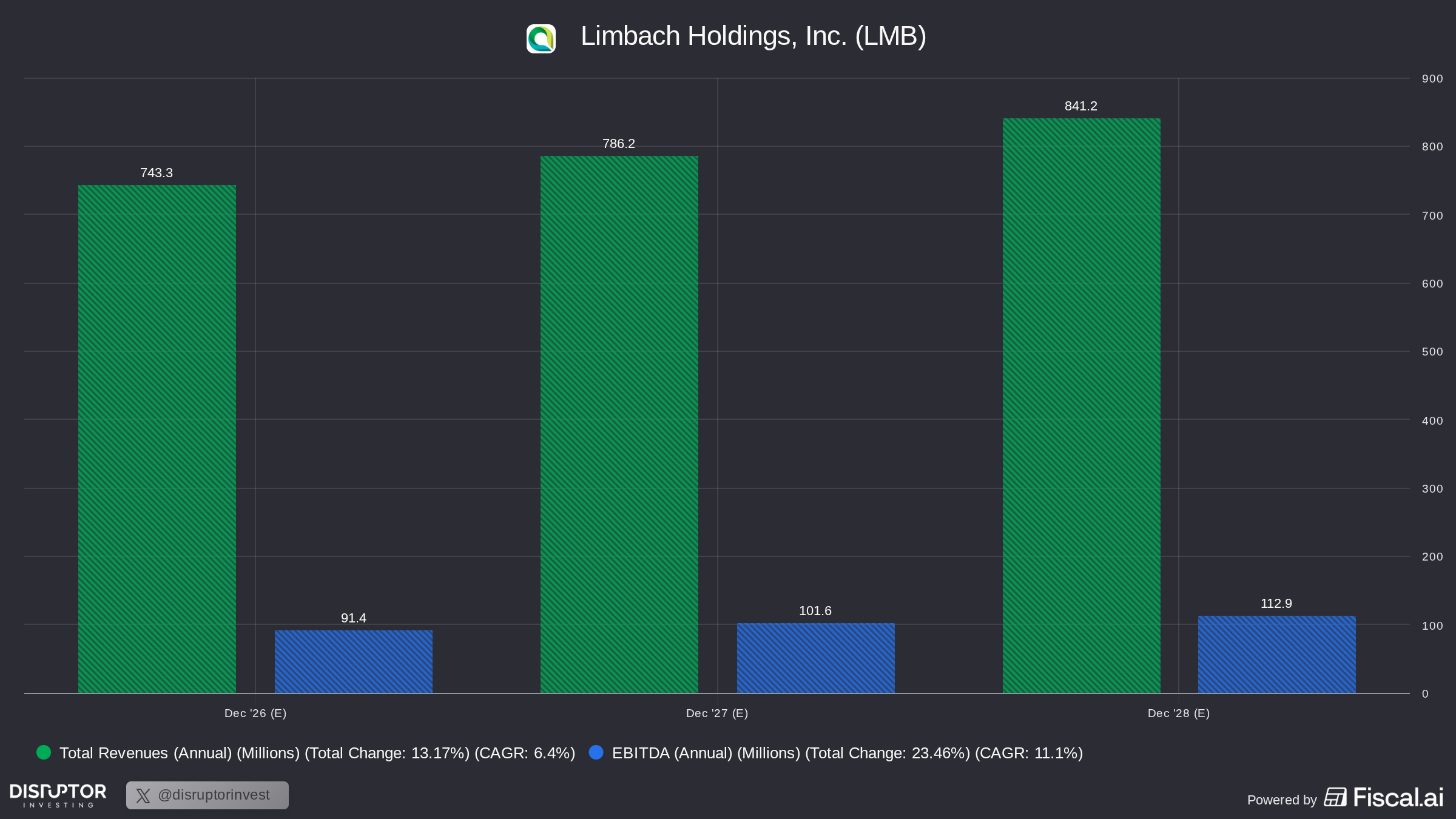
Management guidance for full year 2026, reaffirmed after Q1, calls for revenue between $730 million and $760 million, implying year over year growth of 13% to 17%, and adjusted EBITDA of $90 million to $94 million, implying year over year growth of 10% to 16%. The Seeking Alpha consensus for fiscal 2026 shows revenue of $742.5 million and EPS of $3.66. The full year guidance midpoint is $745 million, essentially in line with consensus. The gap that interests me is between guidance for the back half of the year, where management says organic ODR growth will accelerate, and what the street has built into its models after the Q1 margin miss.
On the balance sheet, Limbach maintained a strong balance sheet with $41.2 million in net debt and a net debt to adjusted EBITDA ratio of just 0.55x. Total debt was $57.0 million, including $32.4 million in revolver borrowings, against a $100 million facility that does not mature until July 2030. The company is not a dilution story. Shares outstanding total 11.92 million, and that figure has grown just 0.14% over the past year. The $50 million share repurchase authorization is still active. This is not a company borrowing to survive. It is a company borrowing to grow, with a leverage ratio that most industrials would envy.
Technically the picture is ugly. LMB is trading near the bottom of its 52-week range and below its 200-day simple moving average. The 50-day MA sits near $93, the 200-day near $105, and the stock is at $72. The stock has decreased 42.54% in the last 52 weeks. Short interest is 8.31% of outstanding shares, elevated but not extreme. Volume has been thin. This is a name that fell hard, scared institutional holders out, and has been drifting since without a narrative to pull them back. The Q2 print could be that narrative.
For Q2 2026, analyst consensus EPS estimates range from $0.73 to $0.95 depending on the source, with management saying at the Q1 call that they are comfortable where consensus expectations currently stand on Q2 revenue and EBITDA. That is unusual language and is worth noting. It signals management does not expect a miss. Nine analysts cover the name per ChartMill. The average price target is $124.44, implying a price increase of more than 70% from the current level. The lowest target on record is $90 and the highest is $156. Estimates on Q2 revenue have been revised down slightly over the past three months, not up, which means the bar for a positive surprise is lower than it was in the spring.
Why it wins
The ODR model is the moat. Once Limbach has a direct service relationship with a large data center operator, that relationship has compounding value. The operator’s systems age. Upgrades are needed. Expansions get planned. The mechanical contractor who already knows the facility, already has trained technicians on site, and already has relationships with the facilities managers gets the next project almost by default. This is different from the GCR world, where every job is a fresh competition on price.
The prefabrication capability reinforces the moat. Limbach’s platform includes mechanical skids, equipment modules, prefabricated piping systems, and BIM coordination, none of which a smaller regional competitor can replicate quickly. A data center operator accelerating deployment timelines will pay for certainty. The prefab shop removes uncertainty from the field phase. That is worth a premium and it is the kind of value proposition that creates pricing power independent of the broader commodity labor market.
The Pioneer acquisition, despite its near term margin drag, expands Limbach’s addressable market into the Upper Midwest industrial sector. Acquisitions are the top capital allocation priority, with six deals since late 2021 and a robust pipeline, supported by the expanded $100 million revolver, with targets focused on geographic and vertical expansion and expected margin improvement into 2027. The acquisition machine is not accidental. It is methodical geographic expansion of an owner direct service platform that gets more valuable the larger it gets.
The data center vertical is also beginning to diversify Limbach’s revenue seasonality. Traditional building systems work is heavily back half weighted, with revenue building through the year and Q4 as the strongest quarter. Data center work, as CEO McCann noted on the Q1 call, could have a somewhat different profile that is not so backloaded, because customers want fast conversions. More consistent quarterly revenue reduces the planning risk for a company this size. That is a structural improvement, not a marketing pitch.
What could go wrong
The Pioneer integration is the most immediate risk, and I am not dismissing it. Excluding Pioneer Power, consolidated gross margin would have been 25%. That footnote is the whole margin story. But if Pioneer margins do not converge toward company average by mid-2027 as management projects, the EBITDA guidance becomes difficult to hit without incremental revenue growth to compensate. Management has two to three years to prove the integration thesis. Investors do not always wait that long.
The organic revenue decline in Q1 was real, at 13.4% on an organic basis. ODR fell 5.4% and GCR dropped 30.2% organically. Management attributed this to weak bookings in mid-2025, but a sustained organic decline in ODR would undermine the entire strategic narrative. If the bookings surge in late 2025 and early 2026 does not convert to revenue on schedule, the back half recovery story breaks. Bookings are commitments, not contracts, and some percentage will slip or be renegotiated.
The labor market is the constraint the company cannot fully control. Qualified mechanical and electrical tradespeople are in short supply, and Limbach’s ability to staff up fast enough to capture the data center opportunity is genuinely uncertain. A competitor who can recruit faster in a hot market could capture projects Limbach has already won relationships for. The prefabrication capability helps, but it does not eliminate field labor dependency.
The technical picture is a risk in itself. The 50-day moving average sits near $93 and the 200-day near $105, both well above where the stock is trading. A name this far below its moving averages with 8.3% short interest can see additional technical selling before it stabilizes, particularly if Q2 results come in at consensus rather than above it. The upside asymmetry is real, but so is the downside if the print disappoints.
What I am watching
August 4, 2026 is the date. Limbach releases Q2 2026 financial results after the market closes that day, with a conference call the following morning. What I am specifically watching for is whether data center bookings as a percentage of total bookings continue to rise above the 27% reported in Q1, whether ODR organic revenue has returned to positive growth, and whether gross margin shows sequential improvement from the 22.4% Q1 trough. Management told the street they are comfortable with consensus for Q2. A beat on margin, even a modest one, combined with an acceleration in data center bookings, would likely be the catalyst for a meaningful rerating.
Beyond Q2, I am watching the Pioneer integration cadence. The specific metric I want to see improve is Pioneer’s contribution to ODR gross margin, which should start to become visible in segment disclosures by Q3. Pioneer Power’s entry into the data center vertical is expected to deliver immediate revenue beginning in Q2 2026, with initial project value at $6 million. That is small but it is the proof of concept that the acquisition brings data center capability, not just industrial margin drag.
The longer term catalyst is what happens to the ODR mix as data center bookings convert. Management guidance calls for ODR to represent 75% to 80% of total revenue for fiscal 2026. If data center work, which historically has faster burn times than healthcare or life science retrofits, pulls that percentage higher while also improving overall project margins, the FY2026 EBITDA guidance of $90 to $94 million starts to look like a floor rather than a midpoint. That is the trade worth watching.
The bottom line
The thermal management wave is in early deployment and the binding constraint is capacity, not demand. Every hyperscaler announcing a new campus or expansion needs someone to design, install, and maintain the mechanical infrastructure that keeps the facility running. Limbach sits inside that constraint. It has the owner relationships, the prefabrication platform, the geographic footprint, and the expanding data center bookings to benefit from a multiyear build cycle that is just beginning to accelerate.
The stock is where it is because a single quarter of margin noise from a known acquisition obscured a genuinely improving order book. The business has not broken. The integration math is difficult but manageable, the balance sheet is clean, and the catalyst is five days away. I could be wrong if the Q2 print shows margin deterioration rather than improvement, or if the data center bookings number plateaus. Either of those would change my view. But at 27.04 times trailing earnings and 20 times forward, for a business with a 1.5x book to bill and accelerating data center exposure, the market is pricing risk that may already have peaked.
Not financial advice.
The setup
LMB is in a clear downtrend. Price sits below both its 50 day and 200 day moving averages, and the 50 day has crossed below the 200 day, which confirms the bearish trend structure. At 2% of its 52 week range and 50.9% below the 52 week high, the stock has been more than cut in half from its peak. The one month return is negative 12.1%, the three month return is negative 25.9%, and relative strength against the broader market over three months is negative 28.4 points, meaning the stock has dramatically underperformed. Volume over the last ten days is running at 0.71x the 50 day average, so selling has not been accompanied by a surge in participation. RSI sits at 31, near but not yet at the conventional oversold threshold. The average true range is 5.1% of price, which means daily swings are wide relative to the share price and position sizing needs to reflect that volatility.
The historical base rate for LMB in comparable technical positions covers 19 prior instances. In those cases the stock was higher one month later 74% of the time, with a median one month move of positive 10.4%, and higher one quarter later 89% of the time, with a median quarterly move of positive 10.0% and a range of negative 4.4% to positive 25.3%. The sample of 19 is small. That is not enough observations to lean on heavily, and because these are all drawn from one ticker, the pattern may reflect company specific episodes rather than anything durable. The base rate is what happened before. It is not a forecast, and the future is not required to follow it. Given the ongoing downtrend and the severity of recent losses, anyone using these figures to inform a decision should treat them as a faint signal at best and weigh them against the real possibility that the trend continues before any stabilization occurs.