
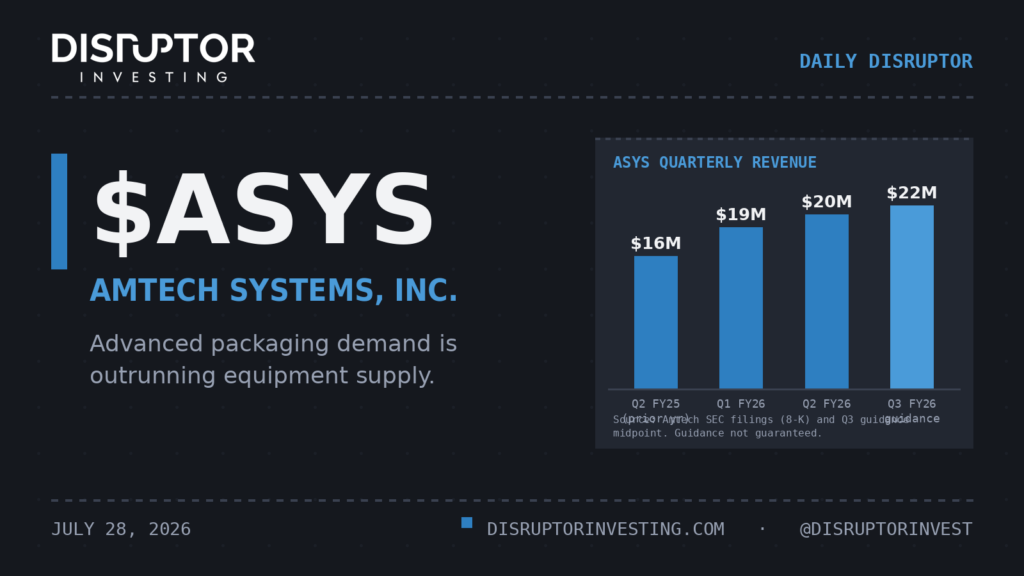
The constraint in semiconductor packaging equipment is lead time, not demand. OSATs across Southeast Asia are racing to add advanced packaging capacity for AI accelerators, but the thermal processing tools they need, reflow ovens, belt furnaces, diffusion systems, are built by a handful of small suppliers. $ASYS is one of them. The company makes equipment for solder reflow in advanced packaging and for substrate fabrication, and it serves the exact bottleneck that $NVDA and the hyperscalers are running into downstream. The constraint is easing for chip designers. It is tightening for the equipment layer one step below them.
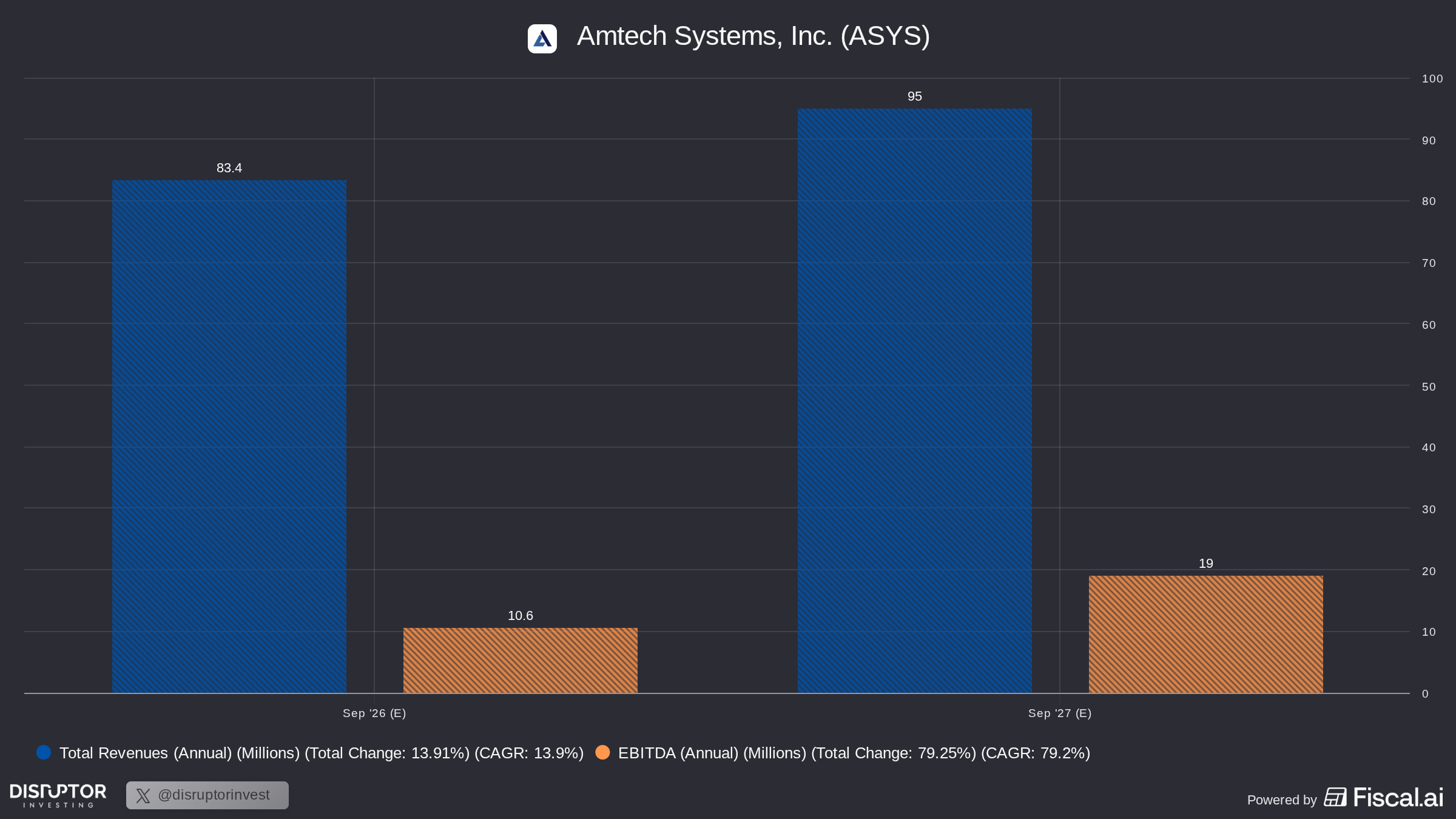
The growth numbers are inflecting, not just improving. Amtech reported fiscal Q2 2026 revenue of $20.5 million, driven by AI product demand, representing 31% growth from the prior year. That follows a Q1 print of $19.0 million, itself up solidly from the prior year period. Q3 2026 revenue guidance is $20.5 to $22.5 million, with AI related equipment sales in the Thermal Processing Solutions segment anticipated to exceed 40% of segment revenue. Gross margin approached 48% in the March quarter, up from prior year levels that were distorted by a goodwill impairment. Orders year to date rose 24% and backlog increased 16% to $22.3 million, supported by AI related advanced packaging demand in Asia. Earnings are forecast to grow by 243% in the next year. That is an inflection, not a trend continuation.
Two hard dated catalysts land in the next five weeks. First, Amtech will announce fiscal Q3 2026 results on August 5, 2026 after market close, with a conference call at 5:00 PM ET. Second, the company plans to launch next generation higher density packaging equipment at SEMICON Taiwan in early September, which management says can expand the addressable market beyond the current product set. That product debut matters because Amtech is seeing increased quoting activity and bookings for panel level packaging, which management says aligns well with the company’s process capabilities. Two distinct events, five weeks apart. On positioning, $ASYS has thin analyst coverage, a micro cap float, and joined the Russell 2000 and Russell 3000 indexes at the annual reconstitution in June 2026, which forced passive funds to accumulate shares and may have reset the ownership base. Over the last 90 days the stock has risen roughly 79%, so this is not a cold name. But the Q3 print and the SEMICON debut are both still ahead.
Fundamentals and balance sheet: mostly clean, one flag to state plainly. Cash of $24.4 million and a 2.9-to-1 current ratio provide flexibility for R&D and potential acquisitions. No debt. Operating cash flow turned positive. The one thing to own up to: Amtech closed a $60 million oversubscribed public equity offering in June 2026, adding roughly 2.9 million shares at $20.50. That is dilution. The offering was oversubscribed, which signals demand, and management said proceeds go toward growth and potential M&A. Still, the share count expanded materially, and any reader who held before June paid for that capital raise through dilution of their position. Institutional ownership from earlier filings was roughly 50%, but that figure predates the June offering. The updated percentage is unconfirmed.
The risk here is real and worth naming. $ASYS is a semiconductor capital equipment company serving a cyclical end market with short lead times, meaning order patterns can reverse quickly. Progress in the Semiconductor Fabrication Solutions segment has been masked by weak PR Hoffman product sales due to soft demand from major silicon carbide customers. SiC is an EV story, and that story is soft right now in Western markets. Revenue is still under $90 million annualized, so a single large order or cancellation moves the revenue line visibly. The stock has run hard since its lows and is within 14% of its 52-week high. If Q3 guidance disappoints on August 5, the correction will be sharp. Watch the order number and AI mix percentage more than the headline revenue, because that is where management’s credibility in the AI packaging thesis gets tested. Not financial advice.