
There are roughly 700,000 miles of high voltage transmission lines strung across the United States. Every single one of them uses hardware to attach, support, protect, and dead end the conductors. Helical rods, suspension clamps, spacers, diverters, splice closures, substation connectors. The work is unglamorous and invisible to most investors. The company that invented the preformed wire grip in 1947 and still sells it to utilities in more than 20 countries is now sitting directly in the path of the largest grid capital spending wave in modern American history.
That company is Preformed Line Products. The ticker is $PLPC. The market cap as of July 26, 2026 sits around $1.52 billion. It hit an all time high of $414.35 on July 1 and has pulled back from there. Q2 2026 earnings land July 29, two days from now. That is not a coincidence for why I am writing this today.
The thesis is simple and I want to state it plainly. The grid hardware sector is entering early deployment, the binding constraint holding it back is not money or political will but the sheer scarcity of qualified installation labor and long lead times on specialized equipment. Reconductoring with advanced conductors is the fastest available solution to transmission capacity shortage, and $PLPC is the only publicly traded pure play on the hardware that makes reconductoring physically possible. The market has started to notice, but the repricing is incomplete because most investors still think of this as an old line industrial rather than a grid infrastructure compounder.
The curve
The transmission and grid hardware sector is in early deployment. The money is committed and the need is acute, but only a fraction of the actual physical work has begun. U.S. utilities are projected to spend more than $1.1 trillion on grid infrastructure over five years, with $208 billion committed in 2025 alone. Globally, about $5.8 trillion is forecast for grid upgrades between 2026 and 2035, with roughly $700 billion earmarked for digital grid technology. That is not a speculative forecast. It is capital expenditure guidance from regulated utilities that have already filed rate cases and gotten commission approvals.
The single binding constraint is not transformer lead times or permitting delays, though both are real problems. The binding constraint is transmission line installation capacity, meaning the crews, tooling, and products needed to actually put wire on towers at scale. The Department of Energy’s National Transmission Planning Study estimates the U.S. will need to build nearly 5,000 miles of new high capacity transmission lines per year to meet growing demand, yet in 2024 only 322 miles of new high voltage transmission lines were completed. That gap is structural and it will not close through permitting reform alone.
Reconductoring is the workaround that changes the math. Reconductoring is a process that swaps out the old wires on a transmission line with new, advanced conductors able to carry more electrical current along the same transmission route with minimal retrofitting or construction. Because they can reuse existing towers and avoid structural retrofits, advanced conductors reduce construction complexity and capital spend, generating 30 to 40 percent savings for reconductoring projects versus new line builds. You do not need new rights of way. You do not start a new permitting clock. Research has shown that reconductoring can more than double transmission capacity, supporting load growth of up to 110 percent and reducing line losses by up to 30 percent, and by operating within existing rights of way, these projects can typically be implemented within 18 to 36 months.
The scale of what reconductoring could unlock is substantial. Advanced reconductors have the potential to quadruple transmission capacity expansion in the U.S. by 2035 compared to new builds alone, and could help generate $85 billion in potential cost savings. Research published in PNAS in September 2024 modeled all 53,000 U.S. transmission segments and found reconductoring could deliver nearly four times as much interzonal capacity by 2035 at marginally higher total investment than greenfield new build.
The policy layer is accelerating. On March 12, 2026, the U.S. Department of Energy announced approximately $1.9 billion to catalyze electricity infrastructure investments under the SPARK program, with a specific focus on reconductoring and advanced transmission technology upgrades. The REWIRE Act was introduced in February 2026 and funds reconductoring projects while streamlining permitting and encouraging collaborative national research. The High Capacity Grid Act, introduced in December 2025, would make advanced conductors the standard for new transmission projects and incentivize utilities to use the best available conductors for their lines. These bills are bipartisan and they are moving.
What decides when this sector inflects from early deployment into full deployment is utility adoption. The primary barrier may not be reconductoring’s effectiveness, but rather utilities’ lack of experience with it. That is actually good news for $PLPC. The inflection happens not when the technology is proven at the lab level but when utilities put their first projects out to bid and discover that the hardware supplier network is thin. That is the moment when a 77 year old incumbent with established utility relationships and proprietary product designs gets very interesting.
The company
Preformed Line Products was founded in 1947 in Cleveland, Ohio, when its engineers invented the helical wire grip, a formed wire product that uses the geometry of a helix to clamp onto conductors without sharp point stress concentrations. That one insight seeded a product family that now spans hundreds of SKUs covering almost every physical connection point in an overhead or underground power network. The company designs and manufactures products and systems employed in the construction and maintenance of overhead, ground mounted, and underground networks for energy, telecommunication, cable, data communication, and other similar industries, providing formed wire solutions, connectors, fiber optic and copper splice closures, solar hardware mounting applications, and more.
PLP operates through four geographic segments: PLP USA, Americas, Europe, Middle East and Africa, and Asia Pacific. The PLP USA segment manufactures traditional products primarily supporting domestic energy, telecommunications, and solar products. Operating in over 20 countries means $PLPC captures the global grid buildout, not just the American one.
The company has been methodically expanding into substation hardware through acquisitions. Recent purchases include SubCon Electrical Fittings in Austria, Maxxweld Conectores in Brazil, and Delta Conectores in Mexico, all as part of the company’s expansion in the substation hardware sector. Then in May 2026, PLP acquired Delta Star Conetores Eletricos Ltda., a Brazil based manufacturer specializing in high voltage and extra high voltage substation connectors. Each deal is bolt on, financially disciplined, and adds a capability that a utility doing a grid upgrade project needs to source.
The robotics angle matters more than it sounds. In February 2026, PLP announced a new multi year partnership with FulcrumAir to co develop next generation robotic systems for overhead power line construction, targeting improved efficiency, safety, and reliability for utilities worldwide. This expanded collaboration builds on earlier joint products like the LineSpider and LineFly robots, highlighting how automation could reshape how utilities build and maintain critical grid infrastructure. The labor constraint holding back reconductoring is precisely what these robots are designed to address. $PLPC is not just selling the hardware that goes on the line, it is co developing the machine that installs it.
The strategic logic here is that $PLPC sits where every transmission upgrade has to start: at the wire attachment point. You cannot reconductor a line without removing the existing dead end hardware and installing new suspension assemblies on the replacement conductor. That is PLP’s core product. When utilities ramp up reconductoring projects under DOE SPARK funding, the first purchase order goes to the company that makes the helical fittings. That has been PLP for most of the utility world for most of the last eight decades.
The numbers
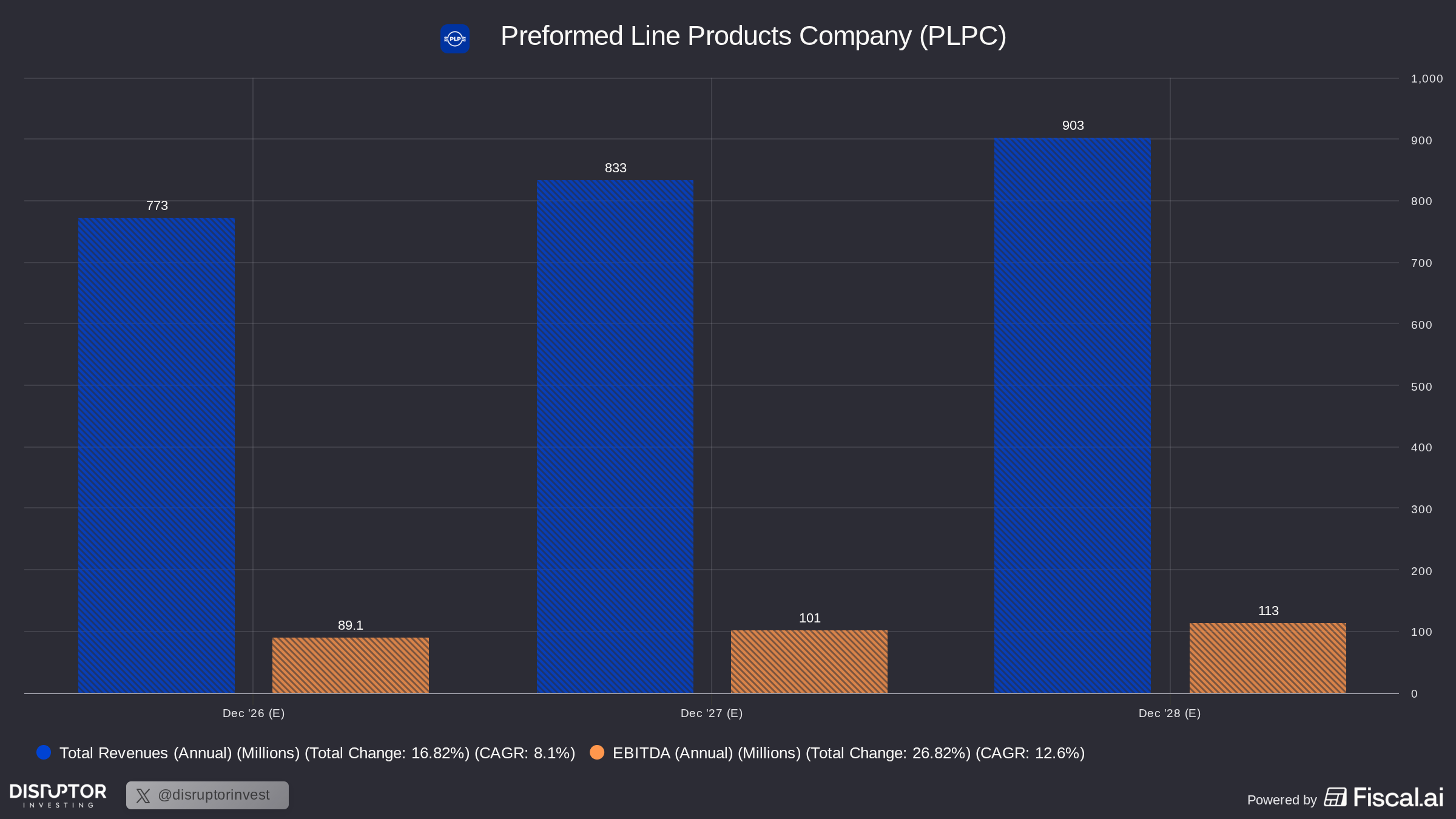
In full year 2025, PLPC’s revenue was $669.34 million, an increase of 12.74 percent compared to the previous year’s $593.71 million. Net income was $35.3 million, down 4.9 percent from 2024, with a profit margin of 5.3 percent. The margin contraction is real and worth watching, but it reflects deliberate investment in headcount and a one time French tax charge rather than structural pricing pressure.
The acceleration continued into 2026. Q1 2026 net sales came in at $176.3 million, an increase of 19 percent from Q1 2025, with USA sales growth of 26 percent driven by demand in energy and communications markets, and gross profit margin of 31.3 percent, up 150 basis points from Q4 2025. Diluted EPS was $2.14 per share, up 24 percent from Q4 2025. The sequential improvement in margin from Q4 to Q1 is the metric I am watching most closely, because it tells you whether the cost investments are beginning to leverage.
The balance sheet is clean. The company ended Q1 2026 with $69.5 million in cash, cash equivalents, and restricted cash, and total debt of $41.9 million. It maintained a $60 million revolving credit facility, of which $7.1 million was drawn and $52.9 million remained available. Net cash positive. No financial distress risk. The acquisitions are being funded out of operating cash flow, which is exactly how you want a serial acquirer to behave in this kind of cycle.
Dilution is not an issue here. PLPC has approximately 4.9 million diluted shares outstanding. That share count has barely moved over the last decade. The dividend has been increased, not diluted away. Cash dividends declared per share were $0.21 in Q1 2026 compared with $0.20 in Q1 2025. This is a company that allocates capital through acquisitions and dividends rather than equity issuances, which is what you want from a compounder in a demand surge.
Why it wins
The moat has two layers. The first is specification inertia. Utility engineers specify PLP hardware by product number in their engineering standards and relay those specifications to contractors who have been installing PLP fittings for decades. Switching to an alternative means retraining crews, updating standards documents, and accepting liability for a product that has not been installed on your system before. That is a high bar to clear when your job is grid reliability.
The second layer is the product design library. Transmission infrastructure hardware is sold to transmission system operators under long cycle contracts, with the largest projects carrying five to seven year delivery windows. PLP has engineered hundreds of SKUs for every conductor size and tower geometry in commercial use. A new entrant would need years to replicate that catalog, and they would still be fighting the specification inertia problem on the other end.
The moment the constraint breaks, meaning the moment utility adoption of reconductoring accelerates from isolated pilots to broad procurement, PLP’s domestic USA business accelerates sharply. Within the broader AI infrastructure theme, “U.S. electrification and U.S. infrastructure development stand out as two of the more compelling themes over the next 12 months, as AI demand reinforces already strong investment cycles.” The USA segment is already growing at 26 percent year over year and reconductoring mandates have not yet entered broad deployment.
The FulcrumAir robotics partnership adds a longer term kicker. If robotic installation of PLP hardware reduces labor requirements and project timelines, utilities have less reason to avoid reconductoring projects on the grounds of crew scarcity. $PLPC is not just positioned to supply the wave, it is working to remove the constraint that would limit the wave’s size. That is a rare and underappreciated dynamic.
What could go wrong
Margin compression is the first real risk. Full year 2025 net income of $35.3 million carried a profit margin of 5.3 percent, down from 6.2 percent in 2024. Personnel costs are rising to support growth, tariff headwinds have affected cost of goods, and international currency volatility has been a persistent noise factor. If revenue growth slows before the cost investments leverage out, earnings will disappoint in a stock that is trading at a forward multiple well above historical norms.
Tariff risk is real and specifically relevant. $PLPC manufactures in the United States but also in Brazil, Austria, Australia, and other countries. Input materials including aluminum and steel move through global supply chains. In February 2026, a U.S. Supreme Court ruling held that certain tariffs under the International Emergency Economic Powers Act were invalid, and the company continues to monitor a potential refund process that remains uncertain. The tariff environment is still shifting and any new round of industrial import duties could hit either input costs or export competitiveness.
Reconductoring adoption could stay slower than the research suggests. The primary barrier to reconductoring is utilities’ lack of experience with it, not its effectiveness. Utilities are conservative institutions. FERC rate treatment for reconductoring projects, the question of whether and how quickly regulators allow utilities to earn a return on the investment, is still being worked out in several jurisdictions. A slow regulatory clock could delay adoption even after the technical case is overwhelming.
The stock’s multiple expansion has been dramatic. PLPC reached its all time high on July 1, 2026 at $414.35. It has pulled back roughly 25 percent from that level as of this writing. The stock trades at a forward P/E ratio of approximately 32 times, against an average forward P/E of 15 times in the U.S. electrical industry. That is a lot of grid optimism already priced in. A miss on Q2 or a guidance cut could compress the multiple sharply, and there is a wide gap between the current price and where the stock was 18 months ago.
What I am watching
Q2 2026 earnings drop July 29. Preformed Line Products reports Q2 2026 results for the period ending June 30, 2026, on July 28, 2026, with one analyst projecting revenue of $193 million and EPS of $2.41. I want to see whether the USA segment continues its 26 percent growth trajectory and whether gross margins stay at or above 31 percent. If gross margin slips back toward 30 percent or below on a sequential basis, that would tell me the tariff and labor cost headwinds are not abating. If it holds or expands, the investment thesis gets significantly stronger.
The DOE SPARK program is the medium term catalyst I am tracking most closely. DOE anticipates making selections for the $1.9 billion SPARK program in August 2026. When specific projects receive funding awards, the timeline from announcement to procurement begins. PLP hardware will be on the bid list for every overhead transmission project in that cohort. Watch for SPARK award announcements in August and September 2026 and track whether any of the winning utilities have existing PLP supplier relationships.
On the acquisition front, the Delta Star integration is the near term test. PLP has now done four substation hardware deals in three years across Brazil, Austria, and Mexico. The track record matters. I want to see the Americas segment margin hold or improve through the second half of 2026 as Delta Star is absorbed. If the integration goes cleanly, PLP’s pattern of buying small specialists with strong regional utility relationships and plugging them into its global distribution network has demonstrated repeatability, and the substation exposure diversifies revenue away from pure overhead line hardware just as substation spending accelerates.
The metric I would most change my mind on is USA segment gross margin. If reconductoring projects begin scaling and the product mix shifts toward higher value conductor attachment hardware, margins should improve. If instead the growth is coming from lower margin commodity fittings sold on price, the thesis weakens. That distinction will show up in segment level gross margin disclosure over the next two to three quarters.
The bottom line
The transmission hardware sector is in early deployment of a cycle that is projected to reach $1.4 trillion in electricity infrastructure investment from 2025 to 2030, double the amount invested in the prior ten years. The binding constraint right now is not capital or policy, it is the physical bottleneck of getting qualified hardware and installation resources onto aging rights of way faster than utilities can source them. Reconductoring is the fastest path through that bottleneck, and $PLPC has made the hardware that every reconductoring project requires for 77 years.
The risks are real. The multiple is elevated. The margin compression trend needs to reverse, not just stabilize. And the stock just came off a 25 percent pullback from an all time high, which means the narrative was almost certainly getting ahead of the numbers at the peak. But the underlying demand is structural, the company’s positioning within that demand is durable, and a quarterly earnings print two days from now represents one of the cleanest near term tests of whether the thesis is on track. I want to see the USA segment hold its growth rate and gross margin improve sequentially. If both happen, the pullback will look like the entry point. If one of them breaks, I will want to understand why before drawing any conclusions about the long term story.
Not financial advice.