
The midday story in biotech today is one of the most unusual setups I have seen in a small cap gene therapy name. REGENXBIO ($RGNX) is sitting at the intersection of three simultaneous regulatory filing events, all targeted for Q3 2026, all in programs with verified Phase 3 data, and all inside a company with a market cap that most screeners still file under $600 million. The constraint that has held $RGNX back for most of the past eighteen months is simple: the FDA’s prior leadership was applying unusually strict evidentiary standards to rare disease gene therapies, issuing Complete Response Letters on programs where the agency had previously aligned on trial design. That constraint broke in June when a new FDA posture reversed course on NAVSUNLI and two other gene therapies inside five days.
In the space of five days this June, the FDA reversed its position on two rare disease gene therapies it had previously rejected, agreeing on June 17 that uniQure’s AMT-130 for Huntington’s disease could support a BLA submission under accelerated approval, and on June 22 reopening the path for REGENXBIO’s NAVSUNLI, a gene therapy for the neurological form of Hunter syndrome, just four months after rejecting it. Through a recent collaborative discussion, the FDA acknowledged the existing NAVSUNLI clinical data is sufficient to be considered for the accelerated approval pathway and that the company does not need to enroll additional patients or conduct additional studies. REGENXBIO expects the Type A meeting to take place in July and to resubmit the BLA rapidly following the meeting in Q3 2026. That meeting is expected this week.
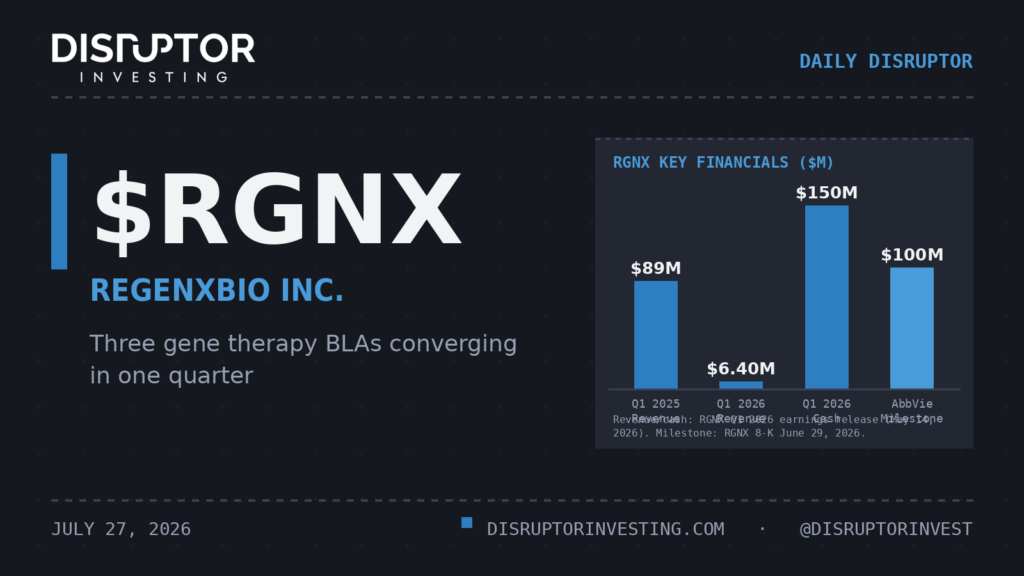
NAVSUNLI is not the only filing lined up. On June 24, REGENXBIO announced the successful completion of dosing in the confirmatory study of RGX-202, a potential best in class gene therapy for Duchenne muscular dystrophy, positioning the company to initiate a BLA under the accelerated approval pathway in Q3 2026 for a potential FDA approval in the second half of 2027. The AFFINITY DUCHENNE Phase III portion met its primary endpoint with 93% of patients above 10% microdystrophin expression and statistically significant correlation to functional improvement, supporting a strategy to pursue accelerated approval. Then there is the retina program. On June 29, REGENXBIO announced the first patient has been dosed in the Phase IIb/III NAAVIGATE clinical trial of investigational surabgene lomparvovec in diabetic retinopathy using suprachoroidal delivery. The company earned a milestone payment of $100 million from AbbVie under their collaboration agreement, with payment expected to be received in July 2026. That is a non dilutive cash injection into a balance sheet that, as of Q1, held $150.5 million, with cash and securities expected to fund operations into early 2027.
The metrics I am watching: confirmation that the NAVSUNLI Type A meeting completed cleanly, then a formal BLA resubmission filing by September; a BLA submission acceptance notice for RGX-202 in Q3; and topline data from the ATMOSPHERE and ASCENT pivotal trials of sura vec in wet AMD, expected in Q4 2026. Each of those three events is independent. Any one of them that lands without a new FDA complication re rates this stock. All three landing is a different conversation entirely. As of July 2026, $RGNX has a market cap of approximately $533 million. Three late stage programs, all filing this quarter, for half a billion dollars.
The risk is real and I want to name it plainly. Q1 2026 revenue was $6.4 million versus $89.0 million a year ago, with a net loss of $90.1 million. The company is burning cash fast. The $100 million AbbVie payment extends the runway but does not solve it. Companies like REGENXBIO were sent on a regulatory rollercoaster ride as the agency dramatically reversed course after having previously signed off on their registrational studies, and there is no guarantee the new FDA posture holds for every review. A BLA acceptance is not a BLA approval. An adcomm vote against NAVSUNLI, a clinical hold on RGX-202, or an expedited review that turns slow would each knock a leg out from under this thesis. Dilution risk is also on the table if any filing slips past early 2027. Position accordingly. Not financial advice.