
← All sectors / The AI transformation
082 · Enterprise search & knowledge infrastructure
Finding what the company already knows
Curve position
Binding constraint
Permissions, because a model that ignores access controls cannot be deployed.

An enterprise model is only as useful as what it can retrieve. Most organizations have decades of documents, tickets, contracts, and messages spread across systems that were never designed to be searched together, let alone by a model.
Historically enterprise search was a poorly regarded category, delivering keyword results nobody trusted. Semantic retrieval changed the quality enough that the same buyers are looking again, with a different problem to solve.
The structural driver is that every enterprise AI deployment hits the same wall: the model is fine, the retrieval is the problem. Companies discover this after the pilot, which is why spending is shifting from models to the data layer around them.
The technology layer spans connectors to source systems, chunking and embedding pipelines, vector and hybrid search, permission aware retrieval that respects who may see what, evaluation tooling, and the caching that keeps costs manageable.
Adoption economics are justified by employee time. Knowledge workers spend a meaningful share of the week looking for information, and recovering part of that is a large number in any organization.
The beneficiaries include retrieval platform vendors, vector database companies, connector and integration specialists, and the collaboration suite vendors that already hold the content and the permission model.
The value chain runs from source systems through connectors and indexing to retrieval and the application. Whoever owns the permission model holds the strongest position, which favors incumbent suite vendors.
The overlooked layer includes integration and connector vendors, data quality and deduplication tools, evaluation and observability software for retrieval, and the services firms doing implementation.
Competitive dynamics are difficult for independents, because the largest collaboration vendors bundle retrieval into products enterprises already pay for. Specialists win where content sits outside those suites.
Risks: bundling by incumbents is the central threat, retrieval quality is hard to prove before purchase, projects stall on data hygiene, and the category has a history of disappointing buyers.
What to watch: retrieval spending disclosed separately from model spending, vector database adoption, permission aware deployments in regulated industries, and bundling announcements from suite vendors.
Coverage / Daily Disruptor issues in this sector
August 25, 2026
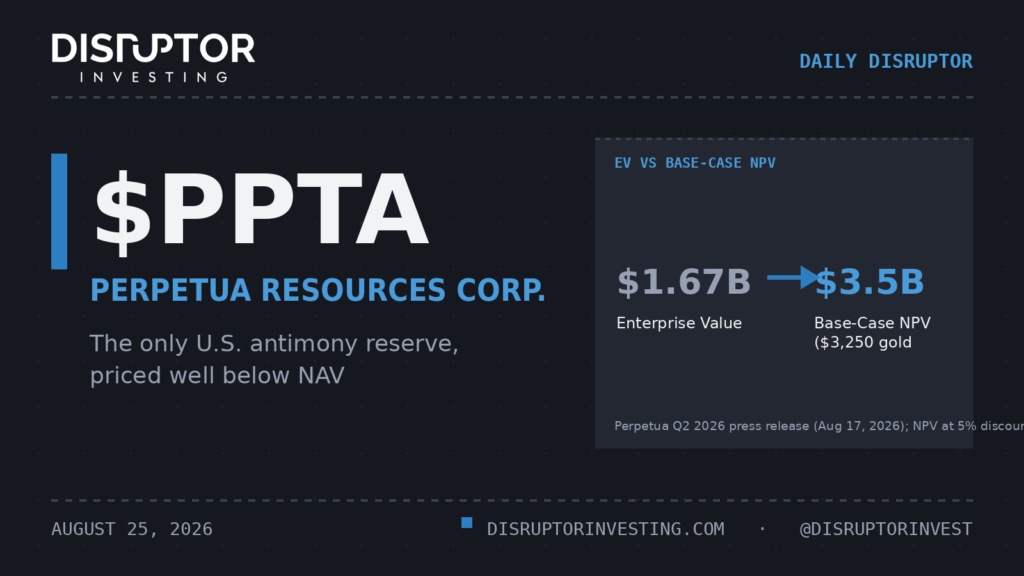
Daily Disruptor: $PPTA, America’s Only Antimony Reserve Is Underpriced at $4,000 Gold
Perpetua Resources holds the only identified domestic antimony reserve, just secured a $2.9 billion federal loan, and trades at a deep discount to its own base…
Read the issue →
August 6, 2026
Daily Disruptor: $LYEL, The CAR T Therapy Trading at a Fraction of Where Analysts Think It Belongs
Lyell Immunopharma carries two late stage CAR T cell programs, a 97% manufacturing success rate, and an earnings print plus a pivotal data update both arriving…
Read the issue →