On July 1, 2026, a company headquartered in Bethesda, Maryland, signed a contract worth $900 million with the U.S. Department of Energy. The contract locks in performance based milestone payments to build commercial scale enrichment capacity for a fuel that does not yet exist in meaningful quantities anywhere in the Western world outside of one cascade of centrifuges spinning in Piketon, Ohio. The company is Centrus Energy, ticker $LEU. Most investors have never heard of it.
The thesis is not complicated. Advanced nuclear reactors are being built across North America and Europe. More than half of the small modular reactor designs currently in development require high assay low enriched uranium, called HALEU, as fuel. Centrus is the only source of HALEU enrichment in the Western world. That is not marketing copy. That is the CEO quoting a physical fact about the global supply chain. When you are the only option, your negotiating position is difficult to undercut.
The wave here is the collision of two forces happening simultaneously: a hard legislative deadline to end Russian uranium imports, and an explosion in demand for clean, always on power to run AI data centers. Centrus sits at the intersection of both. It is already profitable, already has a $3.9 billion backlog, and just crossed from demonstration stage production into a commercial scale build. The market cap as of this week is roughly $3 billion, which feels like an interesting disconnect from the size of the contracts being signed.
The wave
The Trump administration is hastening measures to spur domestic production of enriched uranium to counteract a full ban on Russian imports that will take effect in 2028. In 2024, President Biden signed H.R.1042, the Prohibiting Russian Uranium Imports Act. The waivers that allowed limited imports run out on January 1, 2028. That is eighteen months away. Russia has roughly 44% of the world’s uranium enrichment capacity and supplies approximately 35% of U.S. imports for nuclear fuel. You cannot replace 35% of your fuel supply in eighteen months without having already built the infrastructure. America has not built that infrastructure. The pressure is real and the clock is running.
The passage of the Russian uranium ban unlocked the $2.72 billion Congress had appropriated to increase production of LEU and high assay low enriched uranium to support existing and new advanced nuclear reactors. That capital is now flowing. Three ventures each received grants of $900 million: American Centrifuge Operating, a wholly owned subsidiary of Centrus, and General Matter to create domestic HALEU enrichment capacity, and Orano Federal Services to expand national low enriched uranium capacity. Centrus is the only one of those with a plant already running.
On the demand side, the numbers from the tech sector are almost hard to take seriously. Big tech companies have collectively committed to over 10 gigawatts of new nuclear capacity, driven by insatiable AI data center power demand. Global data center electricity consumption is projected to reach 1,300 terawatt hours by 2035, and the four largest U.S. tech companies have collectively signed for over 10 gigawatts of new nuclear capacity in the past year. Every one of those reactors needs fuel. Most of the advanced reactor designs that tech companies find interesting, including fast reactors and microreactors, run on HALEU.
HALEU will be needed for many advanced power reactor fuels, and more than half of the small modular reactor designs in development. HALEU is not yet widely available commercially. HALEU can be produced with existing centrifuge technology but requires specific nuclear fuel cycle infrastructure and the development of new or modified regulations and licensing regimes. That infrastructure takes years to build. Centrus started building it in 2019. That head start is the whole story.
The One Big Beautiful Budget Act, signed in July 2025, maintained tax credits for nuclear projects. Additionally, the U.S. President issued four executive orders in May 2025, including support for the acceleration of regulatory review for advanced nuclear reactors and promotion of investment in a domestic nuclear supply chain. Both parties want this to happen. That bipartisan reality reduces one category of political risk that kills a lot of energy investments.
China’s Linglong One, a 125 MWe reactor, is expected to begin commercial operation in 2026, making it the world’s first land based commercial SMR. In North America, the BWRX-300 at Darlington became the first SMR under construction, and TerraPower’s Natrium plant in Kemmerer, Wyoming, secured its NRC construction permit. These are not future projections. These are concrete projects underway right now, and each one creates demand for enriched fuel.
The supply gap is structural. The Russian ban took away the only commercial source of HALEU that advanced reactor designers were beginning to demand. No one else in the West has replaced it at scale. Until the Piketon expansion is complete and competitors catch up, Centrus is the answer to a question the entire advanced nuclear industry is asking.
The company
Centrus has a longer history than most people realize. The company emerged from the privatization of the U.S. Enrichment Corporation, itself a government entity created in 1992 to take over DOE’s enrichment operations. It went through bankruptcy in 2014, restructured, and spent the years after that quietly rebuilding its technical workforce and lobbying for the contracts it needed to restart domestic enrichment. That patient, unglamorous work paid off in 2019 when the DOE contracted with Centrus to build and operate a HALEU demonstration cascade at its leased facility in Piketon, Ohio.
Under contract with the U.S. Department of Energy, Centrus began first of a kind production of HALEU, a next generation nuclear fuel needed for many advanced reactor designs. Its American Centrifuge Plant in Piketon, Ohio became the first U.S.-owned, U.S.-technology enrichment plant to begin production since 1954. That phrase deserves a moment. Since 1954. The entire Cold War, the moon landing, the internet, the smartphone era, and the AI revolution all passed without the United States building a single new domestic enrichment plant under its own flag.
Centrus produced and delivered 900 kilograms of HALEU to the U.S. Department of Energy, reaching a critical milestone as the company pioneered first of a kind HALEU production. With the successful production and delivery of the 900 kilograms, Centrus achieved the production target for Phase II of its contract and has produced and delivered over 920 kilograms of HALEU under that contract. Production of the final 900 kilograms of HALEU required under the old demonstration contract was completed in mid June 2026, two weeks ahead of schedule, with a cumulative total of more than 1,900 kilograms produced over the life of the contract. Ahead of schedule matters in nuclear. It almost never happens.
The company runs two distinct businesses. The LEU segment sells separative work units, which is the industry measure of enrichment effort, to commercial utilities that run the existing fleet of light water reactors in the United States. This is the stable, cash generating core. The Technical Solutions segment provides contract services to the DOE and other government customers, covering work on HALEU production, decontamination, and workforce programs. Revenue from the Technical Solutions segment was $32.1 million for the three months ended March 31, 2026, versus $21.8 million in the same quarter the prior year, an increase of 47%. That segment is growing fast as the government ramps spending.
Centrus announced that its subsidiary, American Centrifuge Operating, agreed to a strategic collaboration with Fluor to serve as its Engineering, Procurement and Construction contractor as Centrus proceeds with its multi billion dollar expansion of uranium enrichment capacity in Piketon, Ohio. Fluor is one of the most experienced nuclear construction firms on the planet. Centrus is not trying to manage a massive build out on its own. It brought in the professionals. Fluor will lead engineering and design, manage supply chain and procurement, oversee construction, and support commissioning of new capacity.
Then on June 18, 2026, Centrus added a commercial customer to go alongside the government contracts. Centrus Energy announced a Letter of Intent with Oklo to supply a substantial quantity of HALEU for the operation of up to five Aurora powerhouses starting in 2029. Oklo is backed by Sam Altman and is one of the most closely watched names in advanced nuclear. The prospective agreement, which may include prepayments from Oklo, aligns domestic fuel supply, advanced nuclear generation and established customer demand at a time when limited access to HALEU is a key bottleneck for the sector. If that deal closes and prepayments come in, it is a meaningful signal that commercial customers are willing to fund the supply chain they need.
With its large scale expansion underway, Centrus is transitioning from the old demonstration contract to commercialization with the newer, larger enrichment contract. The initial build out will include 12 metric tons of annual HALEU production capacity as well as capacity to meet the existing LEU backlog of $2.4 billion. Going from roughly 900 kilograms per year to 12 metric tons annually is a roughly thirteenfold increase. The Piketon site has space. The centrifuge manufacturing line in Oak Ridge, Tennessee, is already running.
The numbers
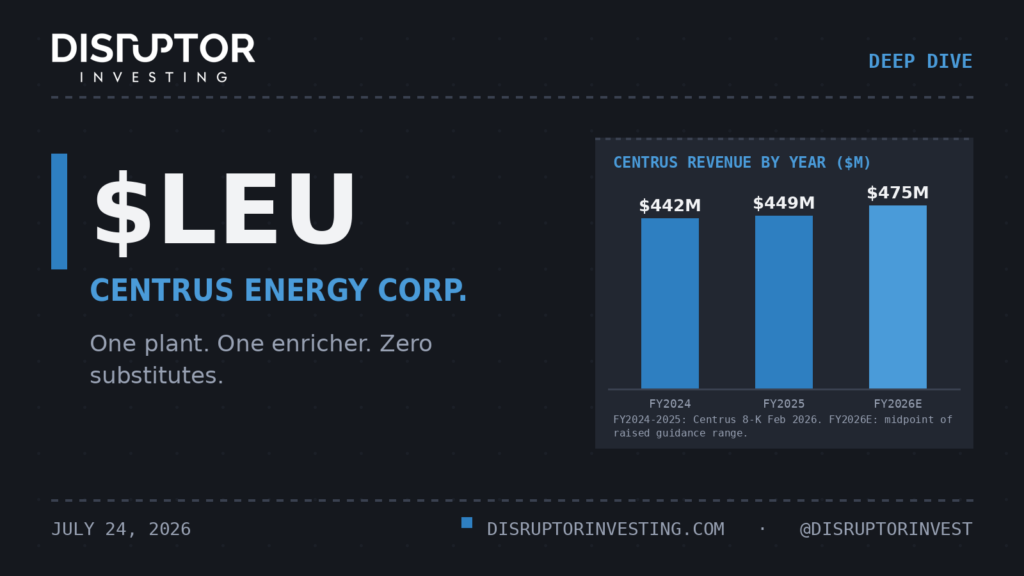
For full year 2025, Centrus reported revenue of $448.7 million and gross profit of $117.5 million, net income of $77.8 million, and strengthened its balance sheet with unrestricted cash of $2.0 billion. This is not a pre revenue story. Centrus is making real money from the existing LEU business while it builds the next chapter. Over the trailing twelve months Centrus generated $448.7 million in revenue, retaining a 26.2% gross margin, with operating income of $50.2 million and net income of $78.0 million, reflecting a 17.4% net profit margin.
Centrus generated total Q1 2026 revenue of $76.7 million versus $73.1 million in the same period the prior year, a 5% increase. Q1 net income came in at $10 million, down from $27.2 million a year earlier, largely because advanced technology costs rose as the company accelerated its expansion work. That earnings decline is not a warning sign. It is what investment in scale looks like before revenue catches up. Centrus ended Q1 with $1.87 billion in cash and long term debt of $1.21 billion, mainly from convertible notes.
The backlog is what ties this together. Centrus cited a $3.9 billion order backlog through 2040 and ongoing expansion at its Piketon facility to increase production of LEU and HALEU. Centrus reported Q1 2026 revenue that was 5% higher year over year, supported by growth in its Technical Solutions segment. The company now expects full year 2026 revenue in a higher range of $450 million to $500 million. They raised guidance after the first quarter. That does not happen at companies struggling to execute.
The $900 million DOE contract establishes a firm fixed price, to be paid incrementally as performance based milestone payments, to deploy a specified amount of enrichment capacity and deliver, by March 2032, one metric ton of uranium enriched as HALEU. The award also includes options at the Department’s discretion for up to $170 million to produce and deliver HALEU, so the total task order contract value with all options is $1.07 billion. Milestone based payment structures mean Centrus collects cash as it builds, which reduces the financing risk of a multi year capital project. One important verification note: the market cap figures I have found range from roughly $2.9 billion to $3.1 billion across different data sources as of mid July 2026, so I am treating $3 billion as a reasonable working number rather than a precise figure.
Why it wins
The moat here is physical and regulatory, not just commercial. Centrus is the only production ready option for national security missions and was recently notified by the National Nuclear Security Administration of its intent to sole source certain uranium enrichment activities from Centrus. Sole source. The NNSA is telling you in plain language that there is no one else to call. That is not a competitive advantage that a startup can replicate in two years by raising venture capital.
The centrifuge technology itself took decades to develop. Under a contract initiated in 2019, Centrus constructed a cascade of its AC-100M advanced centrifuges to demonstrate production of HALEU. The AC-100M design is American owned intellectual property. The manufacturing line in Oak Ridge is now running. Centrus expects the initial build out to allow it to achieve nth of a kind centrifuge manufacturing costs. Nth of a kind means the per unit cost falls as you build more, which is the same cost curve dynamic that has driven every successful manufacturing scale up in history.
The customer side is equally reinforcing. The company has already secured $2.3 billion in LEU purchase commitments from utilities, including both domestic and export customers, contingent upon securing the necessary financing to build the new capacity. Those commitments are contingent, which I will come back to in the risk section. But they indicate that utilities are actively trying to secure Centrus as a supplier, not the other way around. The company is rationing access to future capacity, not chasing buyers.
The government relationship is a structural advantage that commercial competitors cannot easily replicate. Centrus has been working with the DOE since 2019 under a classified adjacent relationship involving both civilian and national security enrichment work. That relationship is sticky. The NNSA sole source notification and the $900 million competitively awarded contract both signal that policymakers across two administrations have concluded that Centrus is the horse to back. Political winds shift, but the 2028 deadline does not.
What could go wrong
The $2.3 billion LEU backlog and the $1.6 billion HALEU related backlog are largely contingent on Centrus securing financing for the Piketon expansion. The company has secured $2.3 billion in LEU purchase commitments from utilities contingent upon securing the necessary financing to build the new capacity. If debt markets tighten or the government funding gets delayed through appropriations fights, those contingent commitments do not automatically convert into revenue. The expansion is a multi billion dollar capital project with real execution risk.
Timeline slippage is the second risk. The first new enrichment capacity is expected to come online in 2029. That means Centrus needs to execute a complex nuclear construction project on time during a period when nuclear construction globally has a poor track record. The Fluor partnership helps, but Fluor has had its own large project challenges. If first cascades slip from 2029 to 2031, the financial model changes materially and competitors have more time to close the gap.
The convertible notes on the balance sheet deserve attention. Centrus has raised over $1.2 billion in convertible note transactions in the past year. Long term debt stands at $1.21 billion, mainly from 2.25% and 0% convertible notes. Convertibles convert into equity at some point, which dilutes existing shareholders. The cash position of nearly $1.9 billion more than covers the debt, but the dilution math matters when you are trying to value a company on a per share basis.
Political risk is real even with bipartisan support. The DOE contract is a federal contract, which means appropriations risk every fiscal year. A government shutdown, a shift in budget priorities, or a political fight over nuclear policy could slow payment timelines. The contract structure requires Centrus to deploy capacity and hit milestones before it gets paid, which means any disruption on the government side creates cash flow timing problems even if the overall contract is intact. What would change my mind: if Congress fails to appropriate funding under the enrichment program in a continuing resolution environment, and the DOE begins exercising stop work clauses, that would be a serious red flag requiring a hard reassessment of the timeline thesis.
What I am watching
Centrus is preparing for its Q2 2026 earnings release on August 5, 2026. That is twelve days away as I write this. The number I care about most is the Technical Solutions segment revenue, because that is where HALEU related government spending shows up. If it continues the 47% year over year growth rate from Q1, that tells me the government spending is real and accelerating. I also want to hear management commentary on the Oklo letter of intent and whether any prepayment terms have been discussed.
The Piketon construction progress is the medium term catalyst. In February 2026, Centrus entered into an EPC contract with Fluor Federal Services for the commercial expansion and deployment of LEU and HALEU production capability at the American Centrifuge Plant in Piketon, Ohio. The first major engineering milestones under that contract should become visible in Centrus filings over the next two quarters. Any indication that the 2029 timeline for first new capacity is holding or slipping will be the single most important piece of operational news for the rest of this year.
The DOE options under the $900 million contract matter too. The contract includes first and second options, exercisable at the Department’s sole discretion, each for delivery of five metric tons of HALEU at $17 million per metric ton. If the DOE exercises those options ahead of the base contract completion, it signals that demand is running ahead of the supply build and that the government is willing to pay commercial prices to accelerate delivery. Watch for any 8-K filings from Centrus between now and year end that reference option exercises under the new contract.
I am also watching whether the Oklo letter of intent converts to a binding supply agreement. Oklo’s Aurora powerhouse needs HALEU starting in 2029, which aligns exactly with Centrus’s first new capacity target. If other advanced reactor developers, including X energy or TerraPower, announce similar offtake letters with Centrus, that would confirm that the commercial HALEU market is forming faster than most people expect and that Centrus is the gravitational center of it.
The bottom line
The advanced nuclear wave is not a prediction. It is a construction site. Reactors are being permitted and built across North America and Europe right now, and every one of them that runs on HALEU needs fuel that currently comes from exactly one Western owned facility. Centrus signed the contract to expand that facility three weeks ago. It has a $3.9 billion backlog, a profitable existing business generating nearly $80 million in annual net income, and a cash position that dwarfs its debt. The government has told it in writing that it is the only option for certain national security enrichment missions.
The risks are real: contingent commitments that require financing to activate, construction execution on a complex nuclear project, convertible note dilution, and the ever present possibility that government appropriations do not flow on schedule. I am not glossing over any of that. But the structure of the opportunity is unusual. Centrus is not racing to win a market. It is the market. The question is whether the build executes on time, not whether demand exists. Demand is legally mandated by the January 2028 import ban and commercially driven by every data center contract signed with a nuclear power developer. I will be watching the August 5 earnings call very closely.
Not financial advice.