
In the spring of 2024, every major hyperscaler announced SMR deals. Microsoft, Amazon, Google, and Meta collectively committed to gigawatts of advanced nuclear capacity by the early 2030s. The presentations were full of renderings. None of them mentioned the fuel problem.
HALEU is high assay low enriched uranium, enriched to between 5% and 20% U-235. It is the cornerstone fuel for virtually every small modular reactor design now in development. And as of today, the United States has exactly one operating HALEU production cascade. One. It sits in Piketon, Ohio and it belongs to $LEU, Centrus Energy Corp. That is not a competitive advantage I am reading into the story. It is a physical fact.
On June 30, 2026, Centrus signed a $900 million fixed price contract with the Department of Energy to deploy commercial scale HALEU enrichment capacity at Piketon, with options that lift the total to $1.07 billion. The stock was already down roughly 28% year to date when the announcement hit. Centrus was also added to the S&P SmallCap 600 on July 14, 2026. Q2 earnings come August 11. Three things converging in a single quarter for a company sitting on the only HALEU infrastructure in the country. That is the setup.
The curve
The nuclear sector sits in early deployment. Not installation, which was the frantic policy and capital formation phase of 2023 and 2024. Actual early deployment, where the first commercial contracts are being inked, the first physical sites are breaking ground, and the market is starting to figure out which companies are real. Microsoft signed a 20-year PPA to restart Three Mile Island Unit 1; Amazon, Google, and Meta have collectively committed to multi gigawatt SMR capacity over the next decade. That demand is not speculative. It is contracted.
The binding constraint holding this entire curve back is fuel supply, specifically HALEU. The US has essentially no domestic HALEU enrichment capacity, ISR uranium production runs at a fraction of 1980s levels, and the SMR licensing pathway under NRC Part 53 is still being walked for the first time. You can license a reactor. You can build a reactor. You cannot run it without the fuel. That sequencing problem is what makes LEU the constraint, not just a participant.
HALEU is nuclear fuel enriched with 5% to 20% of the fissile isotope U-235. It is the cornerstone of next generation nuclear power, offering greater energy density and longer operating cycles for small modular reactors than traditional 5% enriched LEU fuels. Most reactor developers have been designing around the assumption that HALEU supply will be available when they need it. That assumption is still being tested.
According to data from the Energy Information Administration, Russia supplies roughly 24% to 27% of the LEU, or enrichment services, for US nuclear power plants. The political pressure to break that dependency has been building for years. The Prohibiting Russian Uranium Imports Act, signed into law in 2024, formalized it. The strict January 1, 2027, defense procurement deadline makes it urgent. Washington needs domestic enrichment capacity and it needs it on a specific timeline.
The inflection point is first commercial HALEU delivery. Not a demonstration, not a pilot cascade, but product flowing to reactor developers under a real commercial agreement. The first new capacity is expected to come online by 2029. In the interim, Centrus intends to privately operate the existing HALEU cascade on a commercial basis to begin supplying the near term needs of its customers. That interim period is now. The cascade is running. The question is whether the expansion executes on schedule.
The market has not repriced this. Utilities are still using Russian enrichment services where contracts allow. Index funds do not own HALEU infrastructure companies because the sector has no index weight. And the story is genuinely hard to explain in a paragraph, which keeps generalist capital on the sidelines. That gap between what is happening operationally and what the market is pricing is exactly the kind of situation this platform looks for.
I think the market is wrong about the timing here. The DOE contract signed June 30 is not a letter of intent. It establishes a firm fixed price of $900 million, to be paid incrementally as performance based milestone payments, to deploy a specified amount of enrichment capacity and deliver, by March 2032, one metric ton of uranium enriched as HALEU UF6 to a nominal 19.75 weight percent. The revenue recognition cadence is milestone based. That means the story starts flowing into the income statement in measured steps, which actually reduces the lumpiness risk that has historically whipsawed the stock.
The company
Centrus is not a startup. The company was formerly known as USEC Inc. and changed its name to Centrus Energy Corp. in September 2014. USEC was the privatized successor to the US government’s enrichment program, which gives Centrus a lineage going back to the Manhattan Project era infrastructure at Paducah and Portsmouth. That history is both an asset and a liability. The asset is decades of enrichment expertise and an existing relationship with the DOE that no competitor can replicate overnight. The liability is a legacy balance sheet and a shareholder base that has been burned before.
The company operates through two segments: Low Enriched Uranium and Technical Solutions. The LEU segment sells separative work units, natural uranium hexafluoride, uranium concentrates, and uranium conversion to utilities that operate nuclear power plants. The Technical Solutions segment offers technical, manufacturing, engineering, and operations services to public and private sector customers. The LEU segment is the recurring revenue base. Technical Solutions is where the HALEU work currently lives, and where the growth is.
The company’s Q4 2025 announcement officially launched its centrifuge buildout, and the government’s selection of Centrus for a $900 million HALEU enrichment award was cited as the punctuation mark on a milestone year. What changed between that announcement and today is that the contract is now signed. The 8-K filed on June 30, 2026 is not a press release about a selection. It is a legal obligation with a payment schedule.
The initial build out will include 12 metric tons of annual HALEU production capacity, along with new LEU capacity earmarked to work down a commercial LEU backlog Centrus pegged at more than $2.4 billion. The centrifuge technology itself is American Centrifuge, a gas centrifuge design that Centrus has been developing for two decades. It is more energy efficient than the gaseous diffusion technology it replaces. Getting to nth of a kind cost, meaning the point where the enrichment cost curve flattens out as you scale, is the internal milestone management keeps referencing. The language appeared four times in the Q4 2025 earnings call transcript. That tells you what they are measuring themselves against.
The Oklo partnership is worth flagging. Oklo and Centrus Energy signed an agreement to power five Aurora nuclear power plants with domestic fuel. Oklo is the most advanced microreactor developer in the US, backed by Sam Altman and moving through NRC licensing at a faster pace than most SMR developers. If Oklo’s Aurora reactors come online, Centrus supplies the fuel. That is a downstream commercial relationship that does not show up in the backlog yet but shapes the medium term story.
The Technical Solutions segment grew 47% year over year in Q1 2026, driven almost entirely by increased activity on the HALEU Operation Contract. That segment now generates roughly $32 million per quarter. It is not the main event, but it is growing and it is profitable. Gross margin in Technical Solutions ran at about 11% in Q1, compared to 63% in the LEU segment. The mix matters for margin watchers.
The numbers
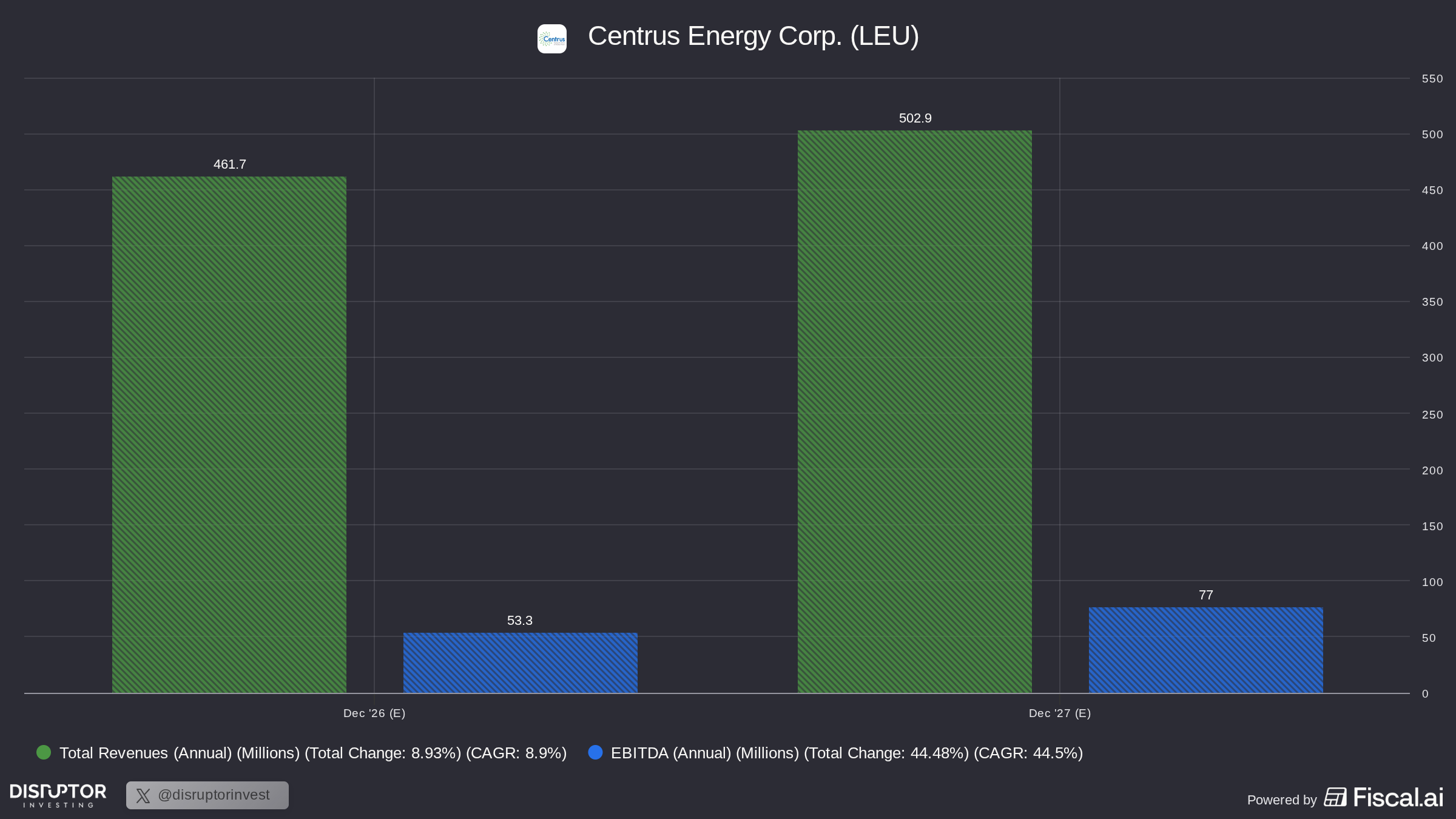
In 2025, Centrus Energy’s revenue was $448.70 million, an increase of 1.52% compared to the previous year’s $442.00 million. Earnings were $77.80 million, an increase of 6.28%. Flat growth at the top line, which is the honest answer to the growth profile question. The LEU business is lumpy by design. Utility customers carry annual purchase commitments, not quarterly ones, so you cannot read the quarterly progression linearly. Centrus raised its full year 2026 revenue guidance to a range of $450 to $500 million from the prior range of $425 to $475 million. The midpoint of that range would represent roughly 11% growth over 2025, which is a step up, though not the acceleration story I would usually want here.
The backlog is the real number. As of March 31, 2026, the total company backlog was $3.9 billion, which extends to 2040. The LEU backlog is at $3.1 billion, which includes roughly $2.4 billion of contingent contracts and commitments, with most already under definitive agreements. The Technical Solutions segment backlog was approximately $0.8 billion. A $3.9 billion backlog on a $3.06 billion market cap is a number worth sitting with.
Balance sheet is a genuine strength here. Cash and cash equivalents totaled $1.9 billion at quarter end. That cash pile exists because Centrus had been accumulating uranium inventory and collecting advances under long term contracts. It also means the company does not need to raise equity to fund the Piketon expansion in the near term. Existing cash, borrowing capacity, and proceeds are expected to cover liquidity needs for at least the next 12 months, that principle applies here too, on an even stronger footing given the $1.9 billion cash position relative to the market cap. No dilution pressure in the next two quarters is the clean read.
The dilution history is a flag I am not going to bury. The number of shares has increased by 27.71% in one year. Some of that is the centrifuge buildout and compensation, but it is a real number and it has weighed on per share earnings metrics. Q1 2026 adjusted EPS came in at $1.05, down 37.5% from $1.68 a year earlier, largely because of higher advanced technology costs and share count. That is the kind of thing that rattles momentum traders and gives short sellers their narrative.
The technical setup is mixed, and I will be straight about it. Centrus Energy faces challenges despite a promising uranium market, with a 28.2% decline year to date. The stock was above $290 in late 2025. It hit the low $150s in mid July 2026. Short interest currently stands at 4.4 million shares, up 3.7% from the previous reporting period, representing 24.1% of the float. Over the past 12 months, short interest has increased by 56.7%. That is a crowded short. High short interest is not inherently bullish, but when a catalyst arrives and the short thesis gets punctured, the unwinding can move the stock hard. The S&P SmallCap 600 addition on July 14 forced passive index buying into a lightly traded float. Volume should have expanded around that event. The August 11 earnings print is the next hard test for the shorts.
Why it wins
The moat is regulatory, physical, and temporal all at once. You cannot build a HALEU enrichment cascade in the United States without NRC licensing, DOE facility access, and enrichment technology. Centrus has all three. Centrus Energy signed a $900 million contract with the DOE to support deployment of large scale HALEU production capacity at its enrichment facility in Piketon, Ohio. The Piketon facility is leased from the DOE. No competitor is walking into the same building and standing up a competing cascade.
Production of the final 900 kilograms of HALEU UF6 required under the demonstration contract was completed in mid June, two weeks ahead of schedule, with a cumulative total of more than 1,900 kilograms produced over the life of the contract. Producing ahead of schedule is a specific detail from the 8-K that matters operationally. The knock on Centrus historically was execution. Delivering early on the demo contract before transitioning to the commercial contract is a data point that undercuts that narrative.
The commercial backlog structure is also a moat. Utility customers sign multi year contracts with delivery schedules extending out a decade. With a growing contingent LEU sales backlog of $2.3 billion, a HALEU mandate from the government, and a potential sole source award from the NNSA, Centrus is uniquely positioned to meet the commercial and national security market needs. A sole source NNSA award would be additional contract value on top of the $1.07 billion DOE deal already signed. That is the option value the market is currently pricing at zero.
The moment the constraint breaks, meaning the moment the first commercial scale HALEU deliveries start flowing to reactor developers, Centrus is the company receiving the check. No other publicly traded US company is positioned that way. The SMR developers need the fuel. The utilities need the fuel. The defense contractors need the fuel. Centrus is the toll booth.
What could go wrong
The milestone based payment structure cuts both ways. The $900 million base award will be paid incrementally as performance based milestone payments. If Centrus misses a construction milestone at Piketon, the revenue does not flow on schedule. The centrifuge buildout is the first large scale commercial deployment of this technology. First of a kind engineering projects have a well documented tendency to run late and over budget. That is not a theory, that is industrial history.
The short interest at 24% of float is a double edged fact. I said it could fuel a squeeze. It can also signal that sophisticated investors who have done the work think the stock is overvalued relative to near term earnings power. The Q1 earnings miss was real. Operating income fell sharply to $0.8 million from $20.5 million a year ago. The decline was largely driven by a sizable step up in advanced technology costs to $18.9 million as the company ramped up expansion related work. If Q2 shows a similar pattern, the stock could break lower before it breaks higher.
Customer concentration is a risk that does not get enough attention. The LEU business sells to nuclear utilities, of which there are maybe thirty in the US. Lose one or two major customers to a contract dispute or a plant retirement and the revenue profile changes materially. Revenue from the LEU segment declined 13% year over year in Q1 2026. SWU revenue decreased by $9.7 million as a result of a 47% decrease in the volume of SWU sold, partially offset by a 52% increase in the average price of SWU sold. The volume decline is not alarming given the lumpy contract structure, but it is a reminder that the quarterly numbers can look ugly even when the annual story is intact.
Dilution risk is real over a longer horizon. The centrifuge buildout will consume capital. Centrus said its enrichment capacity build out will proceed based on customer demand and capital resources. The cash position covers the near term. But if milestones slip or customer demand takes longer to materialize, the company may need to raise equity at some point in 2027 or 2028. At a $3 billion market cap with a $1.9 billion cash hoard, the math is not alarming yet. But it is worth watching.
What I am watching
Centrus Energy will release its next earnings report on August 11, 2026. The revenue forecast is $146.34 million. That forecast implies a roughly 90% jump from Q1’s $76.7 million, reflecting the highly back weighted delivery schedule in the LEU business. The key number I want to see is Technical Solutions segment revenue, because that is where the HALEU contract activity shows up and where the growth narrative lives quarter to quarter. If that segment continues the 47% year over year trajectory, the operating loss story starts to improve even if total GAAP earnings are messy.
The NNSA potential sole source award is the catalyst that is not yet on most people’s radar. With a potential sole source award from the NNSA, Centrus is uniquely positioned to meet the commercial and national security market needs. The NNSA supplies enriched uranium for the US nuclear weapons complex and naval reactors. A sole source contract there would add hundreds of millions in long term backlog to a company already sitting on $3.9 billion. Any announcement on that front before the end of Q3 2026 would be a meaningful positive surprise.
I am watching the short interest data on the next FINRA reporting cycle, which would cover the July 15 and July 31 periods. The S&P 600 inclusion on July 14 should have generated forced buying. If short interest did not decline meaningfully in that window, the shorts are not covering on good news, which raises the question of what they know that the bulls do not. Conversely, if the position starts unwinding into the August 11 print, that tells you the short thesis is weakening on the ground.
The Oklo licensing timeline is a secondary watch item. Oklo and Centrus signed an agreement to power five Aurora nuclear power plants with domestic fuel. Oklo expects NRC review completion later in 2026. An Oklo license approval would crystallize the downstream demand picture and could attract incremental investor attention to the Centrus relationship. Not a primary catalyst, but the kind of news that keeps the story in the conversation.
The bottom line
The nuclear sector is in early deployment, and HALEU fuel supply is the single binding constraint on when the first advanced reactors light up. Centrus does not just sit near that constraint. It is the constraint. The $900 million DOE contract signed June 30 converted a competitive selection into a legal obligation with a milestone payment schedule. Centrus secured the $900 million DOE contract to deploy commercial HALEU capacity in Ohio, with options lifting total value to about $1.07 billion. Having completed its HALEU demonstration output ahead of schedule, Centrus is shifting to large scale HALEU and LEU production in a multi billion expansion supporting thousands of U.S. jobs. That transition is the story, and it is measurable in concrete deliverables.
The stock is down 28% year to date, carries 24% short interest, and reports Q2 results on August 11 with a revenue consensus that implies the back half loading of the LEU contract calendar is finally showing up in the numbers. According to 17 analysts, the average rating for LEU stock is “Buy.” The 12-month stock price target is $264.73, which is an increase of 57.53% from the latest price. I am not endorsing that target, and the earnings history here is volatile enough that one bad print can hurt badly. The balance sheet is strong enough to survive that. What I know is that the constraint is identifiable, the moat is physical and regulatory, and the catalyst is on the calendar. Three things you can actually track.
Not financial advice.
The setup
LEU closed at 175.98, sitting just 2.6% above its 50 day average but 25.2% below its 200 day average, which means the intermediate trend is still pointed down. The stock is near the bottom of its 52 week range, at roughly 10% of that range, and is 59.6% off its 52 week high. That is a hard decline. Three month return is negative 14.4% and six month return is negative 40.6%. Against the market, LEU has lost 17.7 points of relative strength over the past three months. Volume is running modestly above its 50 day average at 1.11 times, and the average true range sits at 6% of price, so daily swings are wide. The one month return of positive 3.3% offers a small stabilizing data point, but it does not change the fact that the prevailing trend has been sharply negative.
The historical base rate on this ticker is striking but the sample is thin. On 34 prior days when LEU sat in a comparable technical position, it was higher a month later 91% of the time and higher a quarter later in all 34 cases, with quarterly gains ranging from 46% to nearly 130% and a median quarterly move of 86.3%. A sample of 34 observations on a single ticker is not a large dataset, and a 100% hit rate on a small sample should not be treated as a reliable law. What happened before on one stock is not an obligation the future has to honor. The base rate is worth knowing, but it should carry limited weight on its own.