
The 30 second version
- Hudson Technologies buys used refrigerant back from contractors, purifies it to industry standard and sells it again into commercial air conditioning and refrigeration service.
- Reclaimed gas sits outside the federal cap on new HFC supply. We put Hudson’s reclaim business at Liftoff, with the shrinking pool of virgin gas as the constraint that is easing.
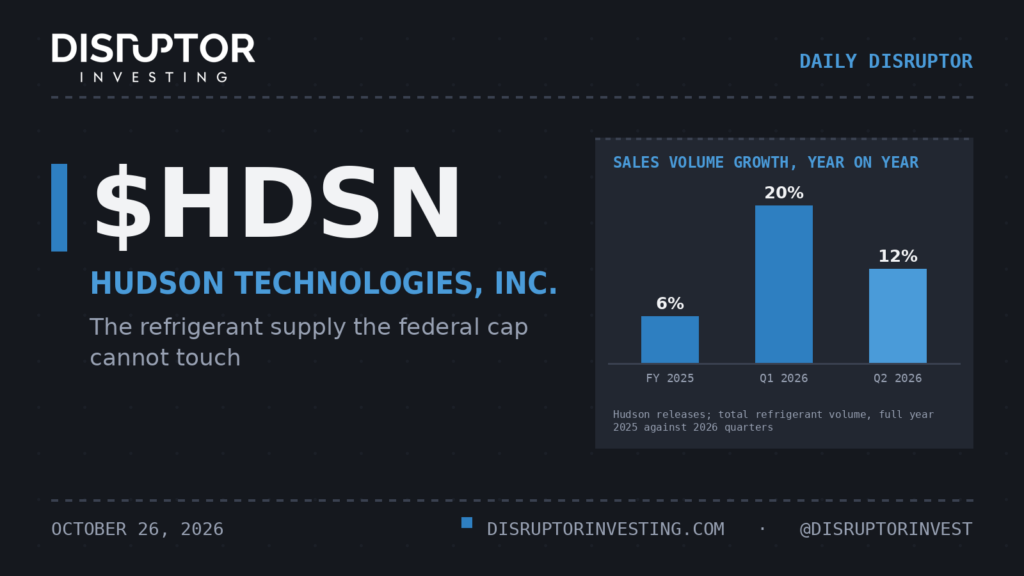
- The evidence: reclamation volume up 18% in 2025 for a second straight year, sales volume up 20% and 12% in the first two quarters of 2026, and the military supply contract awarded again in August.
- The test lands Wednesday, October 28, after the close: third quarter results against last year’s 32% gross margin.
- The thesis breaks if third quarter volume grows less than 5% or gross margin falls below 22%.
The federal cap on new HFC refrigerant has a gap in it, put there on purpose. Gas that has been recovered and reclaimed does not count against the allowances, and Hudson Technologies, one of the largest reclaimers in the country, says its reclamation volume grew 18% in 2025, the same rate as the year before.
The market is looking at a different set of numbers. Second quarter gross margin fell from 31% to 26% because HFC prices are in a trough, and net income halved. Both readings fit the reported totals.
Wednesday’s results are the first look at the business after the summer selling season, against the hardest comparison of the year. On our Disruption Map the refrigerant transition sits among the sectors still early on the curve, which is why we care about volumes now, before the next step down in virgin supply makes them obvious.
What just happened
On October 14 Hudson set its third quarter call for Wednesday, October 28, at 5:00 p.m. Eastern. The quarter it reports covers July through September, the back half of the season when contractors recharge air conditioners and supermarket racks.
Two things changed since the last report. On August 4 the Defense Logistics Agency awarded Hudson its refrigerant and industrial gas supply contract again, after a competitor’s protest had forced the agency to rescind the October 2025 award and rebid it. The new term runs to August 4, 2031, with an option to 2036. When first announced, the company valued the five year base period at $210 million, and the agency accounted for $15.8 million of revenue in the first half alone.
Then on September 17 Hudson signed a joint development agreement with Icorium, a Kansas company founded in 2022 that separates mixed refrigerants by extractive distillation. The deal gives Hudson dedicated engineering help, access to Icorium’s patents, and exclusivity during the first commercial period. It follows a preliminary agreement announced in July.
The business
Hudson sells refrigerant by the pound to wholesalers, contractors and building owners, mostly for servicing equipment already installed. It also buys virgin HFC and the newer HFO gases, offers reclamation as a service, and sends crews to clean systems on site under its RefrigerantSide brand. The company reports one segment. Most orders are single purchase orders at a fixed price, delivered within the year.
The economics run on the spread between what Hudson pays a contractor for a cylinder of dirty gas and what it gets for the cleaned product. In May the company said HFC prices had firmed above $6 a pound. Gross margin was 27.7% in 2024 and 25.2% in 2025. The costs that arrive with the next pound are the buyback payment, distillation, cylinders and freight, and freight is the cost management keeps naming as the drag on margin this year.
Competition comes from two directions: chemical makers selling virgin gas under their allowances, and other EPA certified reclaimers. Hudson’s edge is breadth of product and a recovery network it keeps buying into, through USA Refrigerants in 2024 and Refrigerants Inc. in December 2025, the second for $2.2 million in cash plus up to $2.0 million more if earned.
A detail from the quarterly filing: Hudson received allowances equal to only about 1% of total national HFC consumption allowances for 2024 and 2025. Its access to new virgin gas is small by design. The company also signed a license with Solstice Advanced Materials in the first quarter to reclaim and resell certain patented HFO refrigerants, so the business does not end when HFCs do.
Where it sits on our curve
Hudson has reclaimed refrigerant for nearly thirty years, so the process is old; what is new is the role the product now plays. With virgin HFC allowances cut 40% below baseline since 2024, and a deeper cut of 70% scheduled for 2029, reclaimed gas is moving from a side supply to the main supply for the installed base. That is a Liftoff product. Customers pay for it and come back, and it is starting to outgrow the market it serves.
The binding constraint is on the intake side. Contractors have to bother to recover gas and send it back, and mixed blends have to be separable into saleable product. The buyer’s threshold on the selling side is simple: reclaimed gas certified to the same standard as virgin, at a price no higher. Hudson already meets it for common gases, and the Icorium technology is aimed at the blends it cannot yet convert efficiently.
On the evidence sequence the furthest step is renewal: customers coming back at ordinary prices through two seasons, and the government’s own supply contract won again after a competitive rebid. On the August call, management said reclamation volume rose again in the second quarter, though it gave no figure.
The strongest alternative explanation is less flattering. Hudson may simply be buying share with lower prices in a trough, helped by weather; the company itself credited unusually warm temperatures in the West for part of the first quarter. If volume growth fades to low single digits once prices stop falling, that was the story.
The numbers
Revenue over the last five quarters reads $72.8 million, $74.0 million, $44.4 million, $60.2 million and $78.3 million, with growth of 8% in each of the two 2026 quarters. Underneath, volume grew 20% in the first quarter and 12% in the second, while average selling price fell 6% in the second quarter. For 2025 as a whole, volume grew 6%.
Gross margin is the weak line: 31% and 32% in the middle of 2025, 8% in the fourth quarter after $4.2 million of inventory charges, then 20% and 26% this year. One thing a skimmer would miss. The first half cash flow statement carries a $5.0 million release of the inventory valuation reserve, so some of this year’s margin was really last winter’s inventory charge coming back. SG&A rose to $12.4 million in the second quarter from $9.3 million, on the new ERP system, legal work on the DLA contract and new hires.
The balance sheet has no debt. Cash was $25.6 million at June 30, low because receivables had swelled seasonally to $43.3 million and operating cash flow was negative $6.0 million in the half, while inventory stood at $128.1 million. Cash had been $90 million at the end of September 2025, and the drop came from restocking inventory, $14 million of buybacks in the fourth quarter and the Refrigerants Inc. purchase. An undrawn revolver of up to $75 million sits behind it.
Diluted shares were 42.2 million in the second quarter against 45.2 million a year earlier, down about 7%; basic shares were down about 4%. Hudson bought 416,480 shares at $5.98 in the first quarter and none in the second, while option exercises added shares back. For the full year, management cut its gross margin target in August to the low to mid twenties. It gave no third quarter revenue range.
What the price already requires
At about $5.30 a share, a market quote rather than a figure from a filing, and 42.1 million shares, Hudson is worth roughly $223 million, or about $197 million net of June cash. On our arithmetic from the filings, trailing twelve month operating income was about $11.7 million; add back depreciation, amortization and last year’s $4.0 million of executive severance and EBITDA comes to roughly $22 million. The price asks for about nine times that, and for that $22 million to be a floor rather than a peak.
Our downside case has prices falling another 10% with flat volume: revenue near $235 million, gross margin near 21%, EBITDA near $9 million. That does not support today’s price. Our central case is volume up about 8% at flat prices, revenue near $280 million in 2027 and a 25% margin with SG&A held at this year’s run rate, giving EBITDA near $29 million, under seven times the current value. The upside, prices recovering toward 2025 levels ahead of the 2029 step, gives EBITDA above $40 million.
The gap is in what the reported total hides. The market prices Hudson as a refrigerant distributor whose profits follow the HFC price, and right now that price is down. Inside the total, the part of supply that the federal cap cannot touch has grown 18% a year for two years, and the government just signed on for five more years. Tangible book is about $168 million, much of it gas in tanks, so the market pays only about $55 million for a recovery network that is getting harder to replicate every year the cap tightens.
What breaks it
Written now, before Wednesday: the thesis breaks if third quarter volume grows less than 5% year over year, if gross margin comes in below 22% against last year’s 32%, or if revenue falls below last year’s $74.0 million. Any of those would say the first half volume was bought with price or borrowed from the weather, and that the reclaim shift is too slow to carry the stock through the trough.
The next most likely failure is a slow bleed. SG&A keeps rising, prices stay low and Hudson writes down its $128 million of inventory again in the winter, as it did last year. Financing is not the risk. The company earns money across a full year, carries no debt and should collect most of its June receivables in the third quarter; drawing on the revolver at September 30 would be the warning sign.
What we are watching
- October 28, 2026, third quarter results. Strengthens: volume up 10% or more, revenue of $78 million or more, gross margin of 26% or better, cash above $40 million with the revolver undrawn. Breaks: volume up less than 5%, margin under 22%, or revenue below $74.0 million.
- Same call: a named plant and a start date for the first Icorium unit. Strengthens: installation scheduled within the first half of 2027. Breaks: no timeline by the full year report.
- Early March 2027, full year results. Strengthens: reclamation volume growth of 15% or more for a third year and full year gross margin of 23% or more. Breaks: reclaim growth in single digits or a fourth quarter inventory charge larger than last year’s $4.2 million.
- Early May 2027, first quarter results. Strengthens: volume still growing against the 20% comparison, which would point away from weather. Breaks: volume down year over year.
Not financial advice.
References
- Hudson Technologies, Inc. Hudson Technologies Reports Fourth Quarter and Year End 2025 Results (Form 8-K, Exhibit 99.1). US Securities and Exchange Commission. Published March 4, 2026. Accessed October 25, 2026. https://www.sec.gov/Archives/edgar/data/925528/000110465926023461/tm267768d1_ex99-1.htm
- Hudson Technologies, Inc. Hudson Technologies Reports First Quarter 2026 Results (Form 8-K, Exhibit 99.1). US Securities and Exchange Commission. Published May 6, 2026. Accessed October 25, 2026. https://www.sec.gov/Archives/edgar/data/925528/000110465926056260/tm2613612d1_ex99-1.htm
- Hudson Technologies, Inc. Hudson Technologies Reports Second Quarter 2026 Results (Form 8-K, Exhibit 99.1). US Securities and Exchange Commission. Published August 5, 2026. Accessed October 25, 2026. https://www.sec.gov/Archives/edgar/data/925528/000110465926091092/tm2622080d1_ex99-1.htm
- Hudson Technologies, Inc. Form 10-Q for the quarterly period ended June 30, 2026. US Securities and Exchange Commission. Published August 7, 2026. Accessed October 25, 2026. https://www.sec.gov/Archives/edgar/data/925528/000110465926092682/hdsn-20260630x10q.htm
- Hudson Technologies, Inc. Hudson Technologies Reports Third Quarter 2025 Results (Form 8-K, Exhibit 99.1). US Securities and Exchange Commission. Published November 5, 2025. Accessed October 25, 2026. https://www.sec.gov/Archives/edgar/data/925528/000110465925107007/tm2530368d1_ex99-1.htm
- Hudson Technologies, Inc. Hudson Technologies to Host Conference Call to Discuss Third Quarter 2026 Results. Published October 14, 2026. Accessed October 25, 2026. https://www.hudsontech.com/company-news-and-financial-results/hudson-technologies-to-host-conference-call-to-discuss-third-quarter-2026-results/
- Hudson Technologies, Inc. Hudson Technologies Signs Joint Development Agreement with Icorium; Expands Commitment to Commercialize and Scale Patented Extractive Distillation Technology. Published September 17, 2026. Accessed October 25, 2026. https://www.hudsontech.com/company-news-and-financial-results/hudson-technologies-signs-joint-development-agreement-with-icorium/
- Hudson Technologies, Inc. Hudson Technologies and Icorium Reach Preliminary Agreement to Establish a Commercialization Partnership for Novel Extractive Distillation Technology. Published July 2026. Accessed October 25, 2026. https://www.hudsontech.com/company-news-and-financial-results/hudson-technologies-and-icorium-reach-preliminary-agreement-to-establish-a-commercialization-partnership-for-novel-extractive-distillation-technology/
- Carbon Connector. EPA’s AIM Act Revolution: HFC Rules. Carbon Connector. Published May 2026. Accessed October 25, 2026. https://carbonconnector.com/blog/epa-aim-act-revolution-hfc-rules/
- The Motley Fool. Hudson Technologies (HDSN) Q2 2026 Earnings Call Transcript. The Motley Fool. Published August 12, 2026. Accessed October 25, 2026. https://www.fool.com/earnings/call-transcripts/2026/08/12/hudson-technologies-hdsn-q2-2026-earnings-call-transcript/