
The 30 second version
- Fluence Energy designs and sells grid batteries (Gridstack Pro, Smartstack) to utilities, developers and now hyperscalers, then services and trades them for years.
- The product sits in Flight: demand is proven, and the binding constraint is getting new US contract factories, Houston above all, to build at the rate customers ordered.
- Buyers keep signing anyway: a record $1.44B of orders in the June quarter, about $850M of data center awards and a record $6.4B backlog.
- The test is the fiscal 2026 report and first fiscal 2027 plan, due late November.
- It breaks if fiscal 2027 revenue guidance comes in below $2.6B, EBITDA guidance stays negative, or the plan needs outside equity.
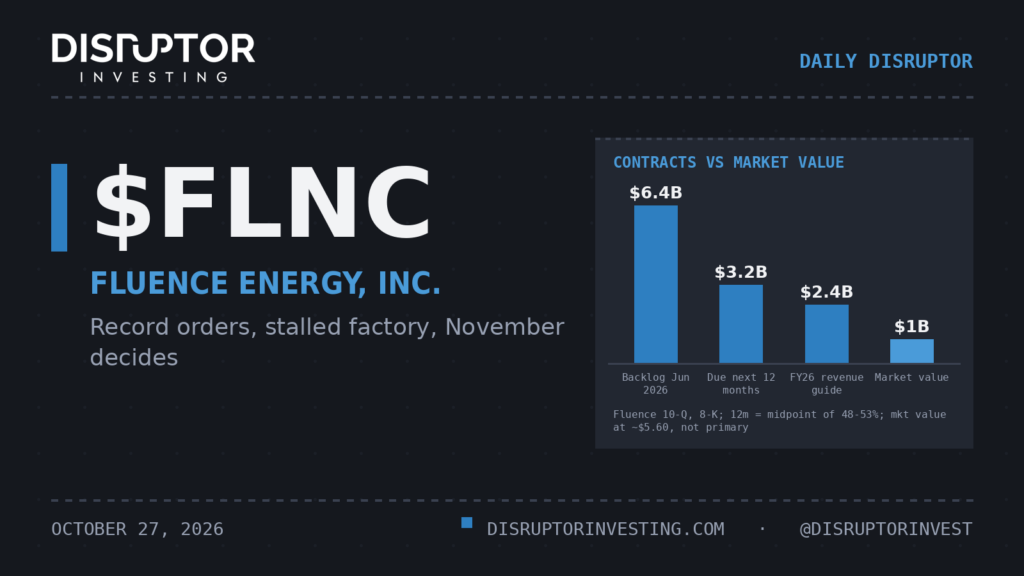
At the end of June, Fluence held $6.4 billion of signed contracts it had not yet turned into revenue. On Monday the entire company was valued at roughly $1.0 billion, with the shares near $5.60, a whisker above their 52 week low and about 72% lower than where they started the year.
The reason is simple and ugly. Fluence could not build what it sold. Two guidance cuts six weeks apart took fiscal 2026 revenue from a $3.4 billion midpoint to about $2.4 billion and turned a small expected EBITDA profit into a loss of about $200 million.
This is the morning to look, because the verdict is close. Management has promised a detailed fiscal 2027 business plan with its year end results, and last year that report landed on November 24. Within about four weeks we learn whether the factory fix is real.
What just happened
On September 16, Fluence cut fiscal 2026 guidance for the second time. Chief executive Julian Nebreda put the blame on a slow ramp at its contract manufacturing facility in Houston, said operations would be restructured, and said corrective steps at the manufacturer had already lifted daily output. Chief financial officer Ahmed Pasha set the bar for next year: “our objective is to generate neutral to positive operating cash flow to support our backlog without external capital.”
The first cut came on August 5. Fluence pushed $400 million of deliveries into fiscal 2027, citing production problems at a new international contract manufacturer and construction delays at a new US plant. That same release carried the best commercial quarter in company history: order intake above $1.44 billion, nearly triple the year before, plus about $850 million of data center business through July. That included its first large behind the meter order and about $550 million of awards from a hyperscaler in July.
Orders have kept coming since. On October 14, Vattenfall picked Fluence for a 1 GWh battery at Brunsbüttel in Germany, built on the Gridstack Pro 5000 platform, with Fluence delivering it turnkey and servicing it afterwards. The project should run by the end of 2028.
The business
Fluence started life as a joint venture of Siemens and AES, and it still sells what that pairing was built for. A customer buys a storage project: battery cells from outside suppliers, packed into enclosures by contract manufacturers, wrapped in Fluence’s design, controls and often installation. Revenue is booked as projects are fulfilled. Customers pay ahead, and deferred revenue rose from about $720 million last September to just over $1.0 billion in June.
The economics are thin per unit and depend on volume. Fiscal 2025 gross margin was 13.1%, so a $100 million project leaves roughly $13 million to cover engineering, sales and overhead. Lateness costs money directly: contracts give customers liquidated damages for missed milestones, which come straight off recognised revenue, and the 10-Q says those damages partly offset this year’s volume gains. On top of hardware, Fluence sells long term service and trading software, which it counts as annual recurring revenue: $148 million at the end of fiscal 2025, with $180 million targeted for this September.
One detail from the filing explains why the ramp matters so much. Fluence has committed to minimum purchases, mostly cells and modules, of about $1.10 billion in fiscal 2027, with roughly $112 million of penalties if it falls short. Supply is locked in. The bottleneck is assembly.
The competition is Tesla’s Megapack and large Chinese integrators. US buyers choose Fluence largely because of where things are made. Its 10-Q states that its US domestic suppliers comply with the foreign entity restrictions in last year’s tax law, which decides whether a project keeps its tax credit. Which is exactly why the US factories were opened, and why their stumble hurt so much.
Where it sits on our curve
Grid scale storage sits in Flight on our Disruption Map, which matters now because Flight is where execution and cash decide the outcome, and Fluence’s product fits that stage on its own evidence. It has 19.3 GWh deployed, contracted backlog of 12.6 GW, up 38% since September 2025, and customers who come back: LEAG is building a second project with it in Germany, and after Fluence signed supply agreements with two hyperscalers in the spring, a hyperscaler awarded about $550 million of work in July. The furthest step on our evidence sequence is expansion, backed by prepaid cash.
Flight risks are about service cost, working capital and cash consumed by growth, and that is precisely what broke. The buyer’s threshold is delivery on the contracted date with compliant domestic content. Fluence’s own number for clearing it: the 10-Q expects 48% to 53% of the $6.4 billion backlog, about $3.1 to $3.4 billion, to become revenue in the twelve months to June 2027, and management says targeted production arrives early in fiscal 2027.
Underneath sits a younger curve. Data center business, about $850 million through July, is equal to roughly an eighth of June backlog and invisible in reported revenue so far. It is a different buyer with a different need, power quality for AI loads, and we would place it at Liftoff.
The strongest alternative: Fluence carries a structural cost and execution gap against Tesla and Chinese rivals, won its orders on price, and the factory trouble is only the symptom. The observation that separates the two is fiscal 2027 gross margin guidance. Back near 10% or better means execution. Stuck in single digits means structure.
The numbers
Quarterly revenue shows the stall. It ran $602.5 million in the June 2025 quarter and about $1.0 billion in September 2025, then fell to about $475 million and $464.9 million in the next two quarters before recovering to $649.8 million in June 2026. The new guidance implies about $810 million for the September quarter, below a year earlier. Backlog moved the other way: $4.9 billion in March 2025, $5.6 billion in March 2026, $6.4 billion in June.
Margins took the hit. GAAP gross margin was 14.8% in the June 2025 quarter, 13.7% in September, 10.0% in March 2026 and 5.1% in June. That last figure includes about $15 million of upfront cost on a long term cell supply deal and the start up costs of new platforms. Full year guidance of a $200 million EBITDA loss, against $90.8 million lost in the first nine months, implies roughly $109 million lost in the September quarter alone.
Cash is the pressure point. Operations used $366.5 million in the nine months, partly because inventory swelled from $455 million to $783 million as units waited for assembly. At June 30 Fluence held $365 million of cash and $863 million of total liquidity, including $307 million of revolver availability with a $150 million cash draw limit. Debt is $400 million of convertible notes due 2030. Share count is flat, about 184.6 million Class A and B shares against 182.7 million last September.
Fiscal 2027 guidance does not exist yet. We could not confirm from a primary source what the street carries, so the November plan is the first hard number.
What the price already requires
At about $5.60, the equity is worth roughly $1.03 billion, and enterprise value is near $1.07 billion using June cash and the converts. Put a plain ten times multiple on a hardware integrator’s EBITDA and today’s price needs about $105 million of sustainable adjusted EBITDA. Fluence earned $78 million in fiscal 2024 on $2.7 billion of revenue, so the price asks for a return to fiscal 2024 profitability at somewhat higher volume, sometime in fiscal 2028.
Our downside: Houston stays slow, fiscal 2027 revenue lands near $2.3 billion, EBITDA stays negative and cash forces a raise. That does not support the price. Our central case: production normalises by spring, fiscal 2027 revenue reaches about $3.0 billion, below the 10-Q’s own twelve month conversion range, with gross margin back near 11% and EBITDA of $60 to $90 million, then $110 million or more in fiscal 2028 as service revenue compounds. That supports today’s price with modest room. Our upside, $3.4 billion at a 5% margin, is worth well over the current value.
The gap is in what the price ignores. A recurring service and software book heading to $180 million a year, valued at the low multiples such books carry, would explain most of the market value alone. That leaves the hardware business, with its $6.4 billion of contracts and a hyperscaler customer list, priced as if the backlog never ships profitably.
What breaks it
Written now, before the November report: fiscal 2027 revenue guidance with a midpoint below $2.6 billion, or adjusted EBITDA guidance below zero, breaks the thesis. So does a September quarter that misses even the cut guidance, revenue under $750 million, because that would mean the September fix did not take. A third deadline that moves is a forecast that cannot fail, and we will treat it as failed.
The next most likely failure is cash. Fluence enters November with liquidity that covers roughly seven quarters at this year’s burn, but cash alone covers about three, and the revolver limits cash draws. If the plan needs equity, or total liquidity falls below $500 million, the upside belongs to new holders and we are out. A securities class action filed this month adds cost and distraction but does not change the arithmetic.
What we are watching
- Late November 2026, fiscal 2026 results and fiscal 2027 plan: strengthen on a revenue midpoint of $3.0 billion or more, positive EBITDA and neutral operating cash flow without equity; break on a midpoint below $2.6 billion, negative EBITDA guidance or a raise.
- Same report, September quarter: strengthen on revenue of at least $800 million and orders above the $1.44 billion record management expects to beat; break on revenue under $750 million.
- Early February 2027, December quarter: strengthen on production at target, revenue above $600 million against about $475 million a year earlier, and gross margin back above 10%; break on another delivery slip.
- By May 2027: strengthen if the second hyperscaler supply agreement converts into a firm order; break if data center awards stall at the July level.
Not financial advice.
References
- Fluence Energy, Inc. Fluence Energy, Inc. Reports Third Fiscal Quarter 2026 Results (Form 8-K, Exhibit 99.1). US Securities and Exchange Commission. Published August 5, 2026. Accessed October 26, 2026. https://www.sec.gov/Archives/edgar/data/0001868941/000186894126000028/flncq3fy26earningspressrel.htm
- Investing.com. UBS cuts Fluence Energy stock price target on production delays. Investing.com. Published October 26, 2026. Accessed October 26, 2026. Used only for the share price and 52 week low. https://ca.investing.com/news/stock-market-news/ubs-cuts-fluence-energy-stock-price-target-on-production-delays-93CH-4902347
- Fluence Energy, Inc. Fluence Energy Announces Revised Guidance for Fiscal Year 2026 (Form 8-K, Exhibit 99.1). US Securities and Exchange Commission. Published September 16, 2026. Accessed October 26, 2026. https://www.sec.gov/Archives/edgar/data/0001868941/000110465926108270/tm2625477d1_ex99-1.htm
- Fluence Energy, Inc. Fluence Energy, Inc. Reports Second Quarter 2026 Results; Reaffirms Fiscal Year 2026 Guidance. Published May 6, 2026. Accessed October 26, 2026. https://ir.fluenceenergy.com/news-releases/news-release-details/fluence-energy-inc-reports-second-quarter-2026-results-reaffirms
- Fluence Energy, Inc. Fluence Energy, Inc. Announces Fourth Quarter and Year End 2025 Earnings Release Date, Conference Call and Webcast. Published October 29, 2025. Accessed October 26, 2026. https://ir.fluenceenergy.com/news-releases/news-release-details/fluence-energy-inc-announces-fourth-quarter-and-year-end-2025
- Fluence Energy, Inc. News and Events: Vattenfall Awards 1 GWh Brunsbüttel Battery Storage Project to Fluence (October 14, 2026); Fluence and LEAG Clean Power start construction of second battery storage project. Accessed October 26, 2026. https://ir.fluenceenergy.com/news-events
- Power Technology. Vattenfall selects Fluence for 1GWh Brunsbüttel battery storage project. Power Technology, syndicated on Yahoo Finance. Published October 2026. Accessed October 26, 2026. https://finance.yahoo.com/news/vattenfall-selects-fluence-1gwh-brunsb-084850394.html
- Fluence Energy, Inc. Form 10-Q for the quarterly period ended June 30, 2026. US Securities and Exchange Commission. Published August 2026. Accessed October 26, 2026. https://www.sec.gov/Archives/edgar/data/0001868941/000186894126000029/flnc-20260630.htm
- Fluence Energy, Inc. Fluence Energy, Inc. Reports 2025 Financial Results and Initiates 2026 Guidance (Form 8-K, Exhibit 99.1). US Securities and Exchange Commission. Published November 24, 2025. Accessed October 26, 2026. https://www.sec.gov/Archives/edgar/data/1868941/000186894125000079/flncq4andfullfy25earningsp.htm
- DCD. Energy storage firm Fluence signs deals with two hyperscale data centers. Data Center Dynamics. Published 2026. Accessed October 26, 2026. https://www.datacenterdynamics.com/en/news/energy-storage-firm-fluence-signs-deals-with-two-hyperscale-data-centers/
- Fluence Energy, Inc. Fluence Energy, Inc. Reports Second Quarter 2025 Results; Lowers Full Year 2025 Guidance (Form 8-K, Exhibit 99.1). US Securities and Exchange Commission. Published May 7, 2025. Accessed October 26, 2026. https://www.sec.gov/Archives/edgar/data/1868941/000186894125000055/flncq2fy25earningspressrel.htm
- Hagens Berman. Fluence Energy (NASDAQ: FLNC) Faces Securities Class Action Amid Inability to Ramp Houston Facility. PR Newswire via Morningstar. Published October 7, 2026. Accessed October 26, 2026. https://www.morningstar.com/news/pr-newswire/20261007sf65607/fluence-energy-nasdaq-flnc-faces-securities-class-action-amid-inability-to-ramp-houston-facility-hbss
- Fluence Energy, Inc. Fluence Energy (FLNC) Q3 2026 Earnings Call Transcript. The Globe and Mail. Published August 2026. Accessed October 26, 2026. https://www.theglobeandmail.com/investing/markets/stocks/FLNC-Q/pressreleases/3818171/fluence-energy-flnc-q3-2026-earnings-call-transcript/