
The 30 second version
- Cohu is a San Diego company that makes chip test handlers. Its Eclipse machine holds power hungry AI processors at a steady temperature while they are tested.
- The company as a whole sits at Orbit. Eclipse is a new curve inside it at Liftoff: thermal control at final test is the constraint that is easing, and Cohu’s own factory now sets how much it can ship this year.
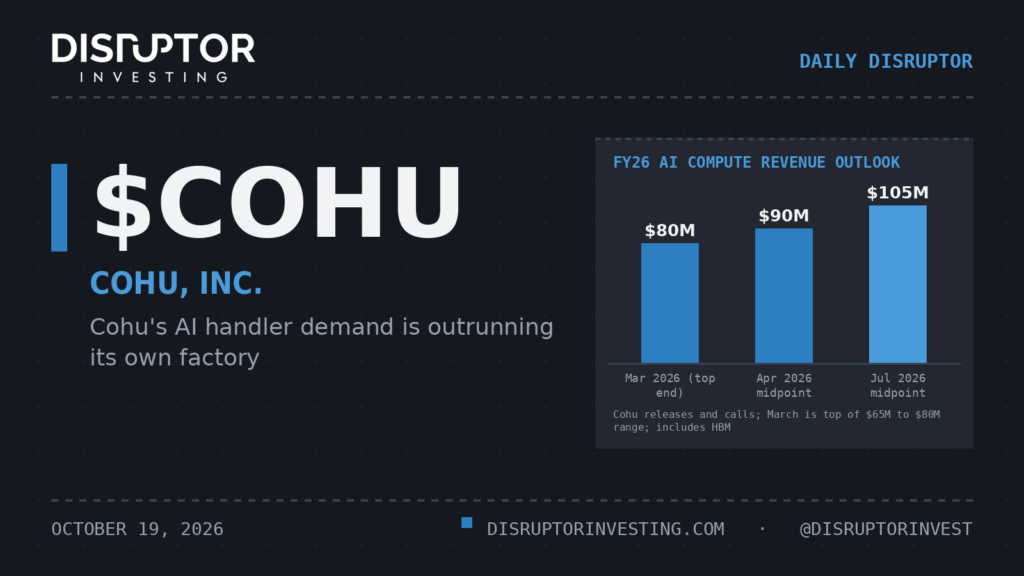
- Evidence: the 2026 AI compute revenue outlook rose from about $80 million in March to $100 to $110 million in July, and one customer placed a $26 million Eclipse order in early July.
- Next test: third quarter results on Wednesday, October 28, against guidance of $170 million plus or minus $7 million. An investor day follows on November 10.
- What breaks it: third quarter sales under $163 million, an AI compute outlook below $100 million, or fourth quarter guidance under $155 million.
Cohu cannot ship more of its AI test handlers this year. Buyers are not the problem. In July, management said the Eclipse line is essentially full through the fourth quarter. It also said qualified customers represent about $190 million a year of demand, against the $100 to $110 million it expects to deliver in 2026.
The reason is the factory.
That shapes the next ten days. Results come out after the close on October 28. In July, management said it would set out a long term financial framework at an investor day in New York on November 10. The shares have fallen through October to around $55, so the stock goes into the report with less excitement behind it than in the summer. Our map puts semiconductors and equipment at Flight, where proven processes scale up. Cohu is an old business with a young product inside it, and the young product is the reason to read on.
What just happened
On July 30, Cohu reported second quarter sales of $149.0 million, up 38% on a year earlier. It estimated that test cells at its customers were 80% utilized at the end of June. It guided the third quarter to $170 million, plus or minus $7 million, and raised its full year growth outlook from about 25% to about 35%. The CFO said that works out to $610 to $615 million for 2026, with the fourth quarter roughly level with the third.
The bigger change was inside that total. The 2026 estimate for high performance computing revenue went up to $100 to $110 million from $80 to $100 million. CEO Luis Müller said the entire increase came from Eclipse. This was the second raise in under three months. In March, when it announced a second Eclipse customer, the company pointed to the top of an internal range of $65 to $80 million. Then in early July, one customer ordered $26 million of Eclipse systems, described on the call as tens of machines, most of them shipping in the fourth quarter.
Management also raised the HPC pipeline to about $850 million of annual customer spending, from $750 million in April. Müller made clear that this is spending per year, not a total over several years. About $190 million of it sits with four qualified customers: three in processors and one in HBM memory. Another $250 million sits with five customers still in qualification.
The business
Cohu makes equipment for the very last step of chip manufacturing. A test handler picks up a packaged chip, presses it into a socket at a controlled temperature, and holds it there while the tester decides whether it can ship. Cohu also sells the contactors and interface boards that touch the chip, inspection systems, the Diamondx tester and analytics software. Interface products alone made up about 19% of second quarter revenue.
The economics work like a razor with expensive blades. The handler is sold once. After that come device kits for each new chip (management says a device usually stays in production for about 18 months), larger thermal heads as dies grow, spares, and now software. One HPC customer signed a software subscription of about $330,000 a year alongside its system orders. Recurring revenue was about 60% of sales in the first quarter and 53% in the second. The share fell only because system sales grew faster.
Management puts each AI customer at $30 to $60 million of annual opportunity. On the April call it said its first win, a US fabless designer of server and inference chips, was worth about $100 million of extra revenue at that one account over three years. Lead time is 13 to 14 weeks from purchase order to first shipment. By our arithmetic, a $26 million order for tens of systems means each handler sells for about a million dollars or less.
There are few competitors. Müller named Hon Precision of Taiwan as the main rival, the long time supplier at outsourced test houses. Cohu’s pitch is closed loop control of junction temperature, meaning the temperature inside the die itself. It runs on a platform that is upgraded in the field as the customer’s chips change, so the customer does not buy new capital equipment for every chip generation. According to Müller, one large Bay Area chip company called Cohu’s thermal technology the best in the market.
Where it sits on our curve
Cohu as a whole is Orbit: established, cyclical and familiar to anyone who follows chip equipment. (It was founded in 1947, when Truman was president, which is an odd line to write about an AI supplier.) Eclipse is a new curve inside it at Liftoff, and it is now large enough to matter: about 17% of 2026 revenue at the midpoint of guidance. That HPC figure also includes Neon HBM inspection, which management forecast in April at about $20 million for the year, so Eclipse alone is somewhat smaller.
The constraint is heat. AI processors draw so much power during test that keeping the die at a stable temperature at production speed decides the yield. What buyers need, as they have described it to Cohu, is a handler that can do this for several chip generations on one platform, so each new chip carries less capital risk. Several buyers have crossed that line: three processor customers have qualified, orders are repeating and getting larger, and a software subscription now comes attached. On our evidence sequence that counts as expansion, and the $26 million order is the commitment behind it.
The strongest alternative explanation is an ordinary cyclical recovery. The CFO said about half of the third quarter’s sequential growth comes from HPC and half from the core business, roughly $10 million each, and most of the full year raise came from the core, led by industrial. He also said customers usually keep adding capacity for about six quarters once utilization passes 80%. If HPC revenue stalls near $100 million while recurring kits carry the growth, the alternative is right. If HPC keeps growing as a share of sales and customers move from qualification to production orders, the curve is real. For it to steepen, the customer described in July as weeks away from qualification has to convert, and the expansion in Malaysia has to arrive on time.
The numbers
The turn shows up over six quarters. Sales were $107.7 million in the second quarter of 2025, $126.2 million in the third and $122.2 million in the fourth. In 2026 they were $125.1 million in the first quarter and $149.0 million in the second, with $170 million guided for the third. Adjusted operating income rose from $0.1 million a year ago to $3.2 million in the first quarter and $15.1 million in the second. Under GAAP, the second quarter loss shrank to $0.2 million.
Adjusted gross margin was 44.4% a year ago, 46.5% in the first quarter and 45.5% in the second, with about 45% guided for the third. The dip comes from mix, because systems earn lower margins than kits. The CFO also flagged rising memory chip costs. Cohu is buying ahead to secure supply and has only started talking to customers about passing those costs on. Quarterly operating expenses stay in the low $50 millions, about $54 million in the third quarter, and management expects about 40% of sequential revenue growth to turn into operating profit.
The balance sheet is strong. Cash and investments were $498.2 million on June 27, against about $296 million of debt, nearly all of it convertible notes issued in late 2025. Operating cash flow was $10 million in the second quarter, while receivables and inventory both grew during the half, which is the cost of growing. Diluted shares used for adjusted earnings rose about 14% on a year earlier, to 53.4 million. Most of that increase is the convertible’s shares now counted in the total. The basic share count rose about 1%, and a capped call offsets 2.4 million of the 5.8 million convertible shares in the third quarter projection.
Guidance is $170 million for the third quarter and about 35% growth for the year, on 2025 revenue of $453.0 million. We have not verified what analysts expect for 2027, so the 2027 figures below are our own.
What the price already requires
At about $55 a share and 47.3 million basic shares, Cohu is worth about $2.6 billion, or about $2.4 billion after subtracting roughly $200 million of net cash. At 25 times adjusted earnings, the price needs about $2.20 a share, close to $115 million of net income on about 52.6 million shares after the capped call. With a 45% gross margin and operating costs near $57 million a quarter, that takes revenue of about $205 million a quarter, roughly 20% above the third quarter guide.
In our downside case, HPC stalls near $110 million, the core cycle turns down in late 2027, and 2027 revenue stays flat at about $600 million. Adjusted EPS falls to about $0.90 and the shares are worth $25 to $30. In our central case, HPC roughly doubles to $200 million in 2027, in line with the capacity management says it will have, and the core grows about 11% to around $565 million. That gives 2027 revenue near $765 million, adjusted EPS near $1.85, and about $205 million a quarter by late 2027, which is what the price needs. In the upside case, HPC wins about a third of the $850 million pipeline, revenue reaches $870 million and EPS is about $2.60.
So our central case supports today’s price, with little to spare. The gap is that the 2026 HPC figure measures capacity, not demand. Management said in July there is little room to grow HPC this year because output is full. Qualified demand of $190 million a year is already well above the $105 million midpoint, and that is before any of the five customers in qualification converts. Someone reading the consolidated total sees a recovering handler company with an AI segment worth 17% of sales. We see a product whose 2026 revenue was capped by a factory in Malaysia that management plans to double by early 2027.
What breaks it
We are writing this before October 28. Third quarter sales below $163 million (the bottom of the range), an HPC outlook cut below $100 million, or fourth quarter guidance under $155 million would each break the thesis, because each would mean the AI orders were a one time burst. The calendar can break it too. If the customer management called about a month from qualification in July is still not qualified at the February report, the pipeline is converting more slowly than the price needs, and we will treat that as a failure, not a delay.
The next most likely failure is supply. Doubling output depends on suppliers, which management called the hardest part, and component costs that cannot be passed on would eat into the 45% margin our cases depend on. Financing is not a risk. With nearly $500 million of cash and positive operating cash flow, Cohu reaches every test on this calendar with money it already has, and the convertible’s dilution is already in our share counts.
What we are watching
- October 28, 2026, third quarter results. Strengthens: sales of $170 million or more, an HPC outlook above $110 million, fourth quarter guidance of $170 million or more, and a fourth processor customer qualified. Breaks: sales under $163 million, HPC under $100 million, or fourth quarter guidance under $155 million.
- November 10, 2026, investor day in New York. Strengthens: a 2027 HPC capacity of at least $200 million, backed by orders. Breaks: the Malaysia doubling slips past mid 2027.
- February 2027, fourth quarter results. Strengthens: 2026 HPC revenue of $100 million or more, and the last of the five qualification customers, expected around mid first quarter, converted to orders. Breaks: HPC falls as a share of sales while utilization holds.
Not financial advice.
References
- Motley Fool Transcribing. Cohu (COHU) Q2 2026 Earnings Call Transcript. The Motley Fool. Published July 30, 2026. Accessed October 19, 2026. https://www.fool.com/earnings/call-transcripts/2026/07/30/cohu-cohu-q2-2026-earnings-call-transcript/
- Cohu, Inc. Cohu to Announce Third Quarter Financial Results on October 28. Stockhouse. Published October 14, 2026. Accessed October 19, 2026. https://stockhouse.com/news/press-releases/2026/10/14/cohu-to-announce-third-quarter-financial-results-on-october-28
- Cohu, Inc. Form 4, Statement of Changes in Beneficial Ownership, Christopher Bohrson, period of report October 15, 2026. US Securities and Exchange Commission. Published October 2026. Accessed October 19, 2026. https://www.sec.gov/Archives/edgar/data/0000021535/000143774926032849/rdgdoc.xml
- Cohu, Inc. Form 8-K, Exhibit 99.1: Cohu Reports Second Quarter 2026 Results. US Securities and Exchange Commission. Published July 30, 2026. Accessed October 19, 2026. https://www.sec.gov/Archives/edgar/data/0000021535/000143774926025053/ex_994647.htm
- Cohu, Inc. Cohu Receives Second Multi Unit Order for Testing Next Generation AI Datacenter Processors, Increasing Confidence on 2026 HPC Revenue Growth. Published March 17, 2026. Accessed October 19, 2026. https://ir.cohu.com/node/19506/pdf
- Alpha Spread. Cohu Q1 2026 Earnings Call. Alpha Spread. Published April 30, 2026. Accessed October 19, 2026. https://www.alphaspread.com/security/nasdaq/cohu/investor-relations/earnings-call/q1-2026
- Cohu, Inc. Form 8-K, Exhibit 99.1: Cohu Reports Fourth Quarter 2025 Results. US Securities and Exchange Commission. Published February 12, 2026. Accessed October 19, 2026. https://www.sec.gov/Archives/edgar/data/21535/000143774926003937/ex_919868.htm
- Cohu, Inc. Form 8-K, Exhibit 99.1: Cohu Reports First Quarter 2026 Results. US Securities and Exchange Commission. Published April 30, 2026. Accessed October 19, 2026. https://www.sec.gov/Archives/edgar/data/0000021535/000143774926014188/ex_952461.htm