
The 60 second version
- BlackSky Technology ($BKSY) flies small imaging satellites and sells reserved access to their pictures and AI analysis, mostly to defence and intelligence agencies.
- The shift: tactical satellite intelligence is moving from one off purchases to standing subscriptions, because militaries find renting a constellation cheaper than building one.
- Gen 3 services sit at Liftoff on our curve. The easing constraint is scarce 35cm capacity that can be tasked within minutes, now flying on five satellites.
- The evidence: one international customer went from pilot to nearly $30M a year, a second converted in Q2, and services revenue hit a record $25M.
- Next test: Q3 2026 results in early November, which must show the second half ramp that $130M to $150M guidance implies.
- The thesis breaks if guidance falls below $130M, Q3 revenue lands under $32M, or services revenue slips below $25M.
In the second quarter of 2026 BlackSky sold about 3.6 million new shares through its at the market programme and collected $150M. Divide one by the other and the average price comes out near $41.70. On October 15 the stock trades at $18.45.
Over those same months the business did the thing we wait years to see from a small space company. Customers who had been trialling its newest satellites started paying for them on contract. Second quarter revenue was $33.3M, up 50% from a year earlier, and services revenue reached a record $25M, half again what it was in the first quarter. In September the company was named the exclusive very high resolution imagery supplier for a planned 50 satellite constellation for France and the United Arab Emirates, a project reported at $1B.
Our view in one sentence: the market is pricing BlackSky as a lumpy defence contractor whose good quarter will fade, while the evidence says Gen 3 has become a subscription product that buyers renew and expand, and at about five times guided 2026 sales the price asks for roughly the 30% growth the signed contracts already point to.
We should say up front that the balance sheet is mixed. BlackSky carries $210.8M of debt, its weighted share count rose 18.3% in a year, and its 2026 guidance leans hard on the back half. Anyone holding this takes real risk, and we will show where it sits.
The shift
Commercial satellite imagery began as an archive business. A buyer picked a place, ordered a picture, and often waited days for it. That suited mapmakers and crop analysts. It never suited a military planner who needs to know what moved at a port in the last hour.
The binding constraint was physics meeting money. Big, expensive satellites could resolve fine detail but passed over any given spot rarely, while swarms of cheap ones revisited daily at resolutions too coarse to tell a truck from a launcher. Sharp imagery with frequent revisits, tasked within minutes, was something only a handful of governments could get, by building and running their own spacecraft.
Two things eased that, and both arrived in roughly the last eighteen months. Small satellites reached 35cm resolution at a unit cost that lets one operator fly enough of them for frequent passes, and tasking and analysis moved into software, so a customer can order a collection and get a flagged answer back without a room full of image analysts. Defence ministries outside the US also seem to want their own tasking rights instead of waiting on whatever allies choose to share. That last point is our own reading of the order book rather than anything the company has said, but international revenue up 200% year on year is hard to explain another way.
Space based earth observation as a whole is further along than this. Medium resolution data is close to a commodity. Tactical subscription imagery for defence buyers is much younger, and that is the curve that matters here.
The company
BlackSky flies a constellation of low orbit imaging satellites and sells what they see. Gen 3, the newest generation, resolves objects down to 35cm, and five of those satellites are now in orbit. Around the hardware sits Spectra, the company’s software for ordering collections and running AI analytics on the results.
Customers buy in two ways. Assured access reserves capacity over their areas of interest on an annual or multiyear contract, and On Demand access buys collections as needed. A smaller slice of revenue comes from building satellites for governments that want their own, and from mission and research contracts. The largest of those is an Air Force Research Laboratory IDIQ worth up to $99M.
Chief executive Brian O’Toole leads the company, and its story over the last two years has been a long, expensive bet on Gen 3 that is now flying and earning. The fifth Gen 3 satellite returned its first image within hours on September 14, 2026. Commissioning new spacecraft in under a week is something the company now does routinely.
One line in the second quarter release caught our eye. The pilot that converted in Q2 became a subscription covering both Gen 3 and Gen 2 imagery. The older fleet is still earning alongside the new one. That matters for the economics, because Gen 2 capacity is already built and launched, so every dollar it pulls into a new contract carries little extra cost.
Where it sits on our curve
We place Gen 3 intelligence services at Liftoff, and we judge that on the product’s own record, separate from the sector’s. Launch Pad would mean demonstrations and pilots. Flight would mean dozens of paying customers and positive cash. Gen 3 sits between: paying customers on contract, early expansion and renewals, but no cash generation yet, with first half operating cash flow an outflow of $5.9M.
The buyer’s threshold is unusually clear. A defence ministry can rent reserved access for roughly $25M to $30M a year, or spend hundreds of millions building its own constellation and wait years for it. Our test is whether a pilot converts to a paid subscription within one budget cycle.
Two unrelated international customers have now done it.
The furthest step on the evidence sequence is expansion. In its first quarter release the company said a major international defence customer had scaled from a Gen 3 pilot to a subscription worth nearly $30M a year. It also booked a $25M multiyear Ministry of Defense subscription and seven figure renewals with NGA Luno, a US government customer and an international Assured customer. The second quarter brought the next conversion, smaller at seven figures, from a different buyer.
Repeatable or a surge? Two conversions is a small sample, and we would not call it proven. What tips us toward repeatable is the mix: renewals from existing buyers, conversions from new ones, and a fleet that keeps growing, so there is more capacity to sell each quarter.
The numbers and what the street expects
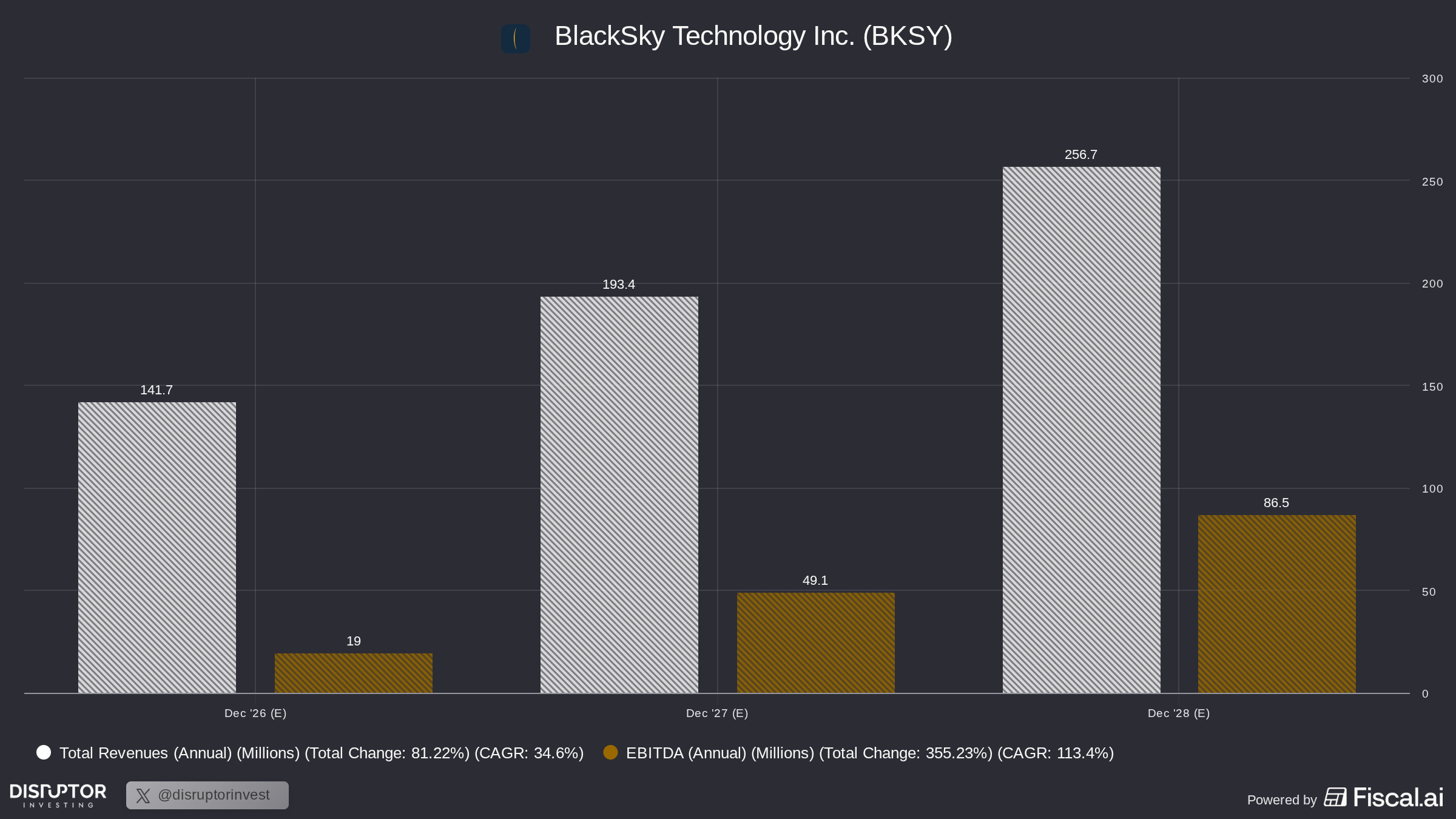
Start with the headline, because it misleads in both directions. Full year 2025 revenue was $106.6M, up only 4%. The first quarter of 2026 came in at $20.8M, down 29%, which looked awful until you notice the prior year quarter held a one time $9.0M milestone. Then the second quarter printed $33.3M, up 50%.
The line we care about is services, the recurring imagery and analytics revenue. It reached $25M in the second quarter, up 50% from the first, and international revenue tripled year on year. Satellite sales and mission milestones will always make the total jumpy, so we treat services as the signal and the rest as weather.
Margins moved the right way. Cost of sales fell to 27% of revenue from 28%, and cash operating expenses held flat at $20.0M while revenue rose by half. Adjusted EBITDA swung to a $4.7M profit, a 14.2% margin, from a $2.8M loss a year earlier. Flat costs against rising subscription revenue is how this model should behave.
Backlog stood at $345M at the end of 2025, up 32%, built on $240M of bookings that year. The first quarter of 2026 added new contracts worth up to $160M. We could not find a June 30 backlog figure in the material we reviewed, so we do not know how much has already turned into revenue.
Cash, restricted cash and short term investments totalled $244.1M at June 30. Against that sits $210.8M of debt, $11.7M of it due within a year, plus $39.2M of warrant and derivative liabilities. First half operating outflow of $5.9M and $31.2M of satellite and equipment spending add up to about $18.5M a quarter, roughly thirteen quarters of runway without new money.
Dilution is the price of that runway. The company raised $160.2M of equity in the first half, shares outstanding went from 35.9M to 40.6M, and weighted shares were up 18.3% year on year. A brief digression, because the timing is unusual. Most small space companies sell stock when they must, at whatever price is on offer, and BlackSky sold near $41.70, more than twice today’s quote, which bought far more runway per share than a holder buying now would fear. None of that makes the dilution free, though it does make it less damaging than the share count alone suggests.
On the forward picture we have to be blunt. We could not confirm consensus estimates for the third quarter or for 2026 and 2027, the number of analysts covering the stock, the spread between the high and low forecasts, or the direction of revisions over the last ninety days. We will not guess. What we can measure is management’s own guidance.
That guidance, raised on May 7 and reaffirmed on August 6, calls for 2026 revenue of $130M to $150M, adjusted EBITDA of $12M to $24M and capital spending of $50M to $60M. First half revenue was $54.1M, so the second half needs $76M to $96M, or $38M to $48M a quarter. Even the low end is a step up from $33.3M. One offset: with $31.2M of capex already spent, the remaining $19M to $29M points to a lighter second half burn.
Why it wins
Follow the money in. The customer pays a subscription for reserved or on demand Gen 3 tasking plus analytics, usually annual or multiyear. Serving the next customer means building another Gen 3 satellite, paying for a launch on a small rocket such as Rocket Lab’s Electron, and running ground stations and processing, with cost of sales near 27% of revenue.
Who keeps the benefit? For now BlackSky does, because sharp imagery that revisits often is scarce, and scarce things hold their price. Supply is coming, though. Planet ($PL) is adding its Pelican satellites, Maxar, now operating as Vantor, runs its own sharp fleet, and government constellations built on SpaceX hardware are adding capacity aimed at the same buyers. When supply catches up, the benefit moves to customers through lower prices.
Now the question we ask of every company in an AI wave. Would a much better, much cheaper base model make BlackSky more useful or easier to replace? Some of each. The imagery gets more valuable, because better models pull more answers from every picture and the picture is the scarce input, while the analytics layer gets easier to copy, since a customer with a strong model and raw pixels can do some of Spectra’s work in house.
So the moat is the constellation plus the speed of turning it into a product. BlackSky owns both the Gen 3 satellites and the Spectra stack, commissions spacecraft in days, and builds satellites ahead of sovereign orders so delivery is shorter. It is an incumbent supplier to the NRO and NGA and now holds the exclusive very high resolution role in the France and UAE project. Rivals mostly offer scale at lower resolution, or sharpness with less frequent revisits.
We would call that a real moat with a clock on it. Orbits and customer relationships buy years of advantage, probably not decades, and the moat is only as good as the next satellite launching on time.
What could go wrong
The strongest alternative explanation is simple, and we take it seriously. This growth may be wartime spending by a few governments, plus satellite sales and milestones that look like momentum but book once and vanish. Defence budgets surge, then normalise. If that is what we are seeing, second half revenue will lean on milestones while services flattens, and 2027 will look like 2025’s 4%.
The bear case in its strongest form adds the calendar. Guidance needs $38M to $48M a quarter, and government contracts, launches and commissioning all tend to arrive late. If one slips, the company misses, the stock falls further, and BlackSky goes back to its at the market programme at $18 instead of $41. Weighted dilution could pass 20%, and with $211M of debt ahead of it, the equity absorbs every disappointment first.
Competition is the slower risk. A sovereign buyer paying $30M a year will ask for a discount at renewal once Planet, Vantor and SpaceX based alternatives exist. The France and UAE deal could disappoint too: we saw it only in a secondary report and a release headline, the constellation is planned rather than built, and we do not know BlackSky’s share of the $1B or when any of it lands. We give it no weight in our numbers.
Then there is the 64% fall from the high. Headlines point to money rotating toward other space names, but we could not confirm that, and the market may know something about contract timing that we do not.
Financing is the kinder part of the calendar. With $244M of cash against about $18.5M a quarter of burn, BlackSky reaches the November results, the full year report and well beyond without raising. Positive free cash flow is another matter, since guided adjusted EBITDA of $12M to $24M sits below capex of $50M to $60M, and management has not told us when that crosses.
The investment thesis
Our thesis: Gen 3 has crossed from pilot to paid subscription with more than one unrelated defence buyer, BlackSky is keeping the value at flat operating costs, and its cash covers the build, so a price of about five times guided sales asks for roughly 30% growth next year that the evidence already supports.
The chain runs like this. The constraint was scarce, sharp, fast imagery, and five Gen 3 satellites in orbit, each commissioned in under a week, are easing it. Adoption is responding, with a conversion worth nearly $30M a year, a second from a different buyer, renewals with NGA Luno and others, and services up 50% in a quarter. The company keeps the value, with cost of sales at 27%, cash opex flat and adjusted EBITDA positive, and equity raised at more than double today’s price covers about thirteen quarters.
Now reverse the price. At $18.45 and 40.6M shares the market value is about $750M; add $211M of debt, subtract $244M of cash, and enterprise value is near $717M, about 5.1 times the $140M guidance midpoint. If a business like this deserves about four times sales once growth settles, today’s price needs roughly $180M of revenue in 2027, up about 29%.
Three cases. In the downside, 2026 lands at $125M, below guidance, and 2027 reaches $145M, leaving the price at about 4.9 times 2027 sales, which it does not support. Our central case is more cautious than management at $135M this year and $175M next, up 30%, which puts the price near 4.1 times 2027 sales, close enough to our yardstick that we think today’s price is supported. The upside, $150M and $210M, takes the multiple to about 3.4 times.
The gap is this. The evidence says Gen 3 is a subscription product with expanding customers and a $345M backlog worth about two and a half years of guided revenue, while the price treats 30% growth as something still to be proven. We think it is half proven already.
November will tell us which half.
Our discipline is to stay with a thesis while it holds and walk away when it breaks. The next test is the third quarter report, expected in early November 2026. It strengthens the thesis if revenue is $38M or more, services reach $27M or more, guidance holds or rises, adjusted EBITDA stays positive, and at least one more pilot converts or a new seven figure subscription arrives. It breaks if guidance is cut below $130M, revenue comes in under $32M, services falls below $25M, or a launch or on orbit failure pushes reserved capacity into 2027.
What we are watching
- Early November 2026, Q3 results: revenue of $38M or more with services at $27M or more strengthens the thesis; revenue under $32M, services below $25M or guidance cut below $130M breaks it.
- November 2026, Q3 quarterly filing: the share count and any at the market sales after June 30. Weighted dilution above 20% year on year with no matching services growth weakens the case.
- By December 31, 2026: another pilot conversion or new seven figure subscription strengthens the thesis; none, while competitors announce sovereign wins, weakens it.
- Through Q1 2027, Gen 3 launches and commissioning: on time additions strengthen it; a launch or on orbit failure that pushes committed reserved capacity into 2027 breaks it.
- Late 2026 or early 2027, France and UAE contract terms: disclosed value, timing and BlackSky’s share would let us count the deal; silence keeps it at zero in our numbers.
- Early 2027, full year 2026 results: revenue inside $130M to $150M, adjusted EBITDA inside $12M to $24M, backlog above $345M and 2027 guidance near $175M or higher support our central case.
The bottom line
Satellite intelligence is moving from buying pictures to renting a constellation, and BlackSky’s Gen 3 service is one of the first places we can watch that happen in signed contracts rather than slides. Two unrelated defence buyers converted from pilots to paying subscriptions, services revenue rose by half in a quarter, and costs held flat. The price asks for about 30% growth that we think the order book already backs.
We are less comfortable with the debt, the dilution and a guidance year that leans on its back half. Those risks are real, and readers should weigh them for themselves.
What would change our mind is specific. If the November report shows services revenue below $25M while the total leans on milestones, then the subscription story is wrong and the lumpy contractor story is right, whatever the France and UAE headline says.
References
- BlackSky Technology Inc. BlackSky Reports First Quarter 2026 Results. Exhibit 99.1 to current report. US Securities and Exchange Commission. Published May 7, 2026. Accessed October 15, 2026. https://www.sec.gov/Archives/edgar/data/0001753539/000175353926000057/exhibit991-blackskyq12026e.htm
- BlackSky Technology Inc. BlackSky Reports Second Quarter 2026 Results. Exhibit 99.1 to current report. US Securities and Exchange Commission. Published August 6, 2026. Accessed October 15, 2026. https://www.sec.gov/Archives/edgar/data/0001753539/000175353926000118/exhibit991-blackskyq22026e.htm
- BlackSky says Gen 3 satellites will provide exclusive high resolution imagery for $1 billion France UAE AI constellation in orbit. Defence Industry Europe. Published September 10, 2026. Accessed October 15, 2026. https://defence-industry.eu/blacksky-says-gen-3-satellites-will-provide-exclusive-high-resolution-imagery-for-1-billion-france-uae-ai-constellation-in-orbit/
- Planet Labs PBC. Planet Reports Financial Results for Second Quarter of Fiscal Year 2027. Exhibit 99.1 to current report. US Securities and Exchange Commission. Published September 3, 2026. Accessed October 15, 2026. https://www.sec.gov/Archives/edgar/data/0001836833/000119312526381874/pl-ex99_1.htm
Not financial advice.