
The 30 second version
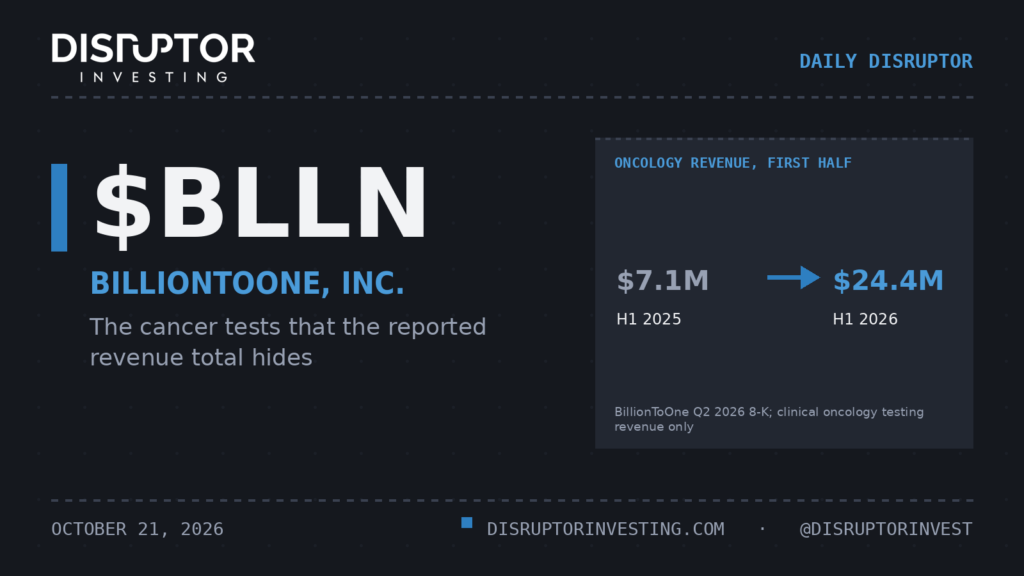
- BillionToOne sells blood tests. Most of the money comes from prenatal screening, and a smaller cancer line, Northstar, is growing far faster inside it.
- Northstar is at Liftoff. Oncologists pay for blood tests that pick a therapy and track response without a tissue sample, and cancer revenue rose 176% to $13.7M in Q2.
- The reported total hides this. Q2 revenue was flat on Q1 because Q1 included $9.2M of catch up payments on older claims.
- The test is Q3 results on November 4. Oncology at $16M or more with the $450M to $465M guide intact strengthens the case.
- The thesis breaks if oncology falls below $13.7M, the guide drops under $450M, or gross margin slips below 65%.
On August 5, BillionToOne reported 64% revenue growth, a GAAP profit and positive free cash flow. That evening the stock lost about 30% after hours, dropping from close to its high of $150 to roughly $105. It is now trading around $100.
The sell off was a reaction to a flat quarter. Revenue was $109.4M in Q2 against $108.4M in Q1. But Q1 included a one time catch up on claims from earlier periods. Strip that out and revenue from tests actually run in each quarter rose about 7.5% in three months, while cancer testing revenue rose 28%.
Q3 results are due in two weeks, on November 4. They will be the first clean quarter since the drop, and they decide which reading holds.
What just happened
In Q1, BillionToOne signed new contracts with insurers. Those contracts let it reprocess claims it had already submitted, some of them from 2025, at the new rates. The 10-Q puts revenue from work done in earlier periods at $12.0M for the first half. Only $2.8M of that fell in Q2, so the remaining $9.2M landed in Q1. Nearly half of the total related to tests performed in 2025.
The company’s slides told the same story per test. The true up added $49 to the average price in Q1 and only $14 in Q2. Without it, the average price rose $15 a test from Q1 to Q2, helped by a record number of insurer contracts. Management also said more than $10M of Q2 claims were on hold until national payers finish setting the company up as in network. That money has not been booked yet.
The oncology news has kept coming since then. On September 1, the therapy selection test was expanded to 102 genes and Northstar Origin launched, an add on that helps locate where a cancer started. On October 7, a peer reviewed study found that Northstar Response, which works without tissue, monitored treatment as well as or better than a tumour informed assay, the kind that has to start from a tissue sample. One week later the company set the Q3 date.
The business
BillionToOne’s core technology counts individual DNA molecules in a blood sample. In pregnancy, its Unity tests screen for chromosomal and recessive conditions using the mother’s blood. In cancer, Northstar Select reads a patient’s tumour mutations from blood to guide the choice of therapy, and the company says it finds over 50% more actionable mutations than conventional liquid biopsies. Northstar Response tracks how much tumour is left during treatment. It uses methylation, a chemical pattern on DNA, so it needs no tissue biopsy.
The company earns money each time it delivers a result. Insurers, Medicaid and Medicare paid for more than 90% of first half revenue. Revenue is booked when the result reaches the doctor, at the amount the company expects to collect. That is an estimate, and it gets adjusted later as claims settle. Q1 showed the adjustment can go up. It can also go down.
Across all products in Q2, the average price was $551 a test and the cost was about $161. Cancer tests cost more to run than prenatal ones, which is why the overall cost per test rose slightly even though oncology’s own cost of goods fell more than 10% in a quarter. Here is a detail you only get from the filings: the company reports oncology revenue but not oncology volume or oncology price per test. Investors therefore cannot yet see what an insurer pays for one Northstar test.
In therapy selection, the competition is Guardant Health and Foundation Medicine. In monitoring, it is tumour informed tests that first need a tissue sample. Doctors choose Northstar for one blood draw, no tissue and higher sensitivity. Add ons for chemotherapy safety (PGx) and for blood cell mutations that can distort results (Select CH) launched in January and February. A tissue free test for residual disease after surgery is expected to be commercially available in Q4 2026.
Where it sits on our curve
Our Disruption Map puts precision oncology at Flight. Blood based therapy selection is reimbursed and routine at the large labs. Response monitoring without tissue is earlier, and that is where Northstar is growing. We place the product at Liftoff. Doctors use it in ordinary practice and pay for it, and the binding constraint for the oncologist is easing. That constraint is a blood result reliable enough to skip a repeat biopsy and to show treatment failing before a scan does.
The evidence is building. In the Allegheny Health Network study of 142 patients on immunotherapy, molecular progression on Northstar Response predicted worse outcomes, with hazard ratios of 5.8 for progression free survival and 4.1 for overall survival. The October study added a head to head comparison. Furthest along the evidence sequence is paid deployment at scale. Monitoring comes with repeat orders built in, because each patient is tested again and again. What is missing is the payer threshold. We do not know the in network price insurers will settle on, and the company has not disclosed one.
The strongest alternative explanation is that BillionToOne added roughly 70 sales reps in the first half, and early adopting oncologists are ordering tests at a price nobody has proven yet. Two observations separate the two readings. Real adoption shows up as sequential oncology growth with gross margin holding at 70% or more. The other story shows up as growth that stalls once the new reps have worked their territories, or as receivables piling up. One side note: the company launched on Epic’s Aura ordering platform in record time, though hospital IT teams still take two to four quarters to fit each integration into their own schedules.
The numbers
Quarterly revenue went from $66.6M in Q2 2025 to $83.5M, $96.1M, $108.4M and $109.4M. Year on year growth slid from 117% in Q3 2025 to 64% in Q2 2026. Oncology went from $4.9M in Q2 2025 to $8.7M in Q3, $10.7M in Q1 2026 and $13.7M in Q2 2026. We could not confirm the Q4 2025 oncology figure in a filing, so it is not in that series.
Gross margin went from 65% a year earlier to 70%, after 73% in Q1, which the true ups helped. Operating income dropped from $17.8M in Q1 to $5.5M in Q2 because operating expenses grew 59% year on year with the new hires. Management says profit will stay around current levels while it keeps investing. Stock compensation was $8.2M in the quarter, three times the level a year earlier.
The balance sheet takes financing off the table. Cash was $548.6M against $91.0M of debt, and $80M of principal is not due until 2031. First half free cash flow was $16.0M. The weak spot is receivables, which rose from $41.6M at year end to $74.9M, or about 62 days of revenue against roughly 40. Basic shares grew 3.0% between December 31 and August 3, to 47.2M. Diluted shares were 54.46M.
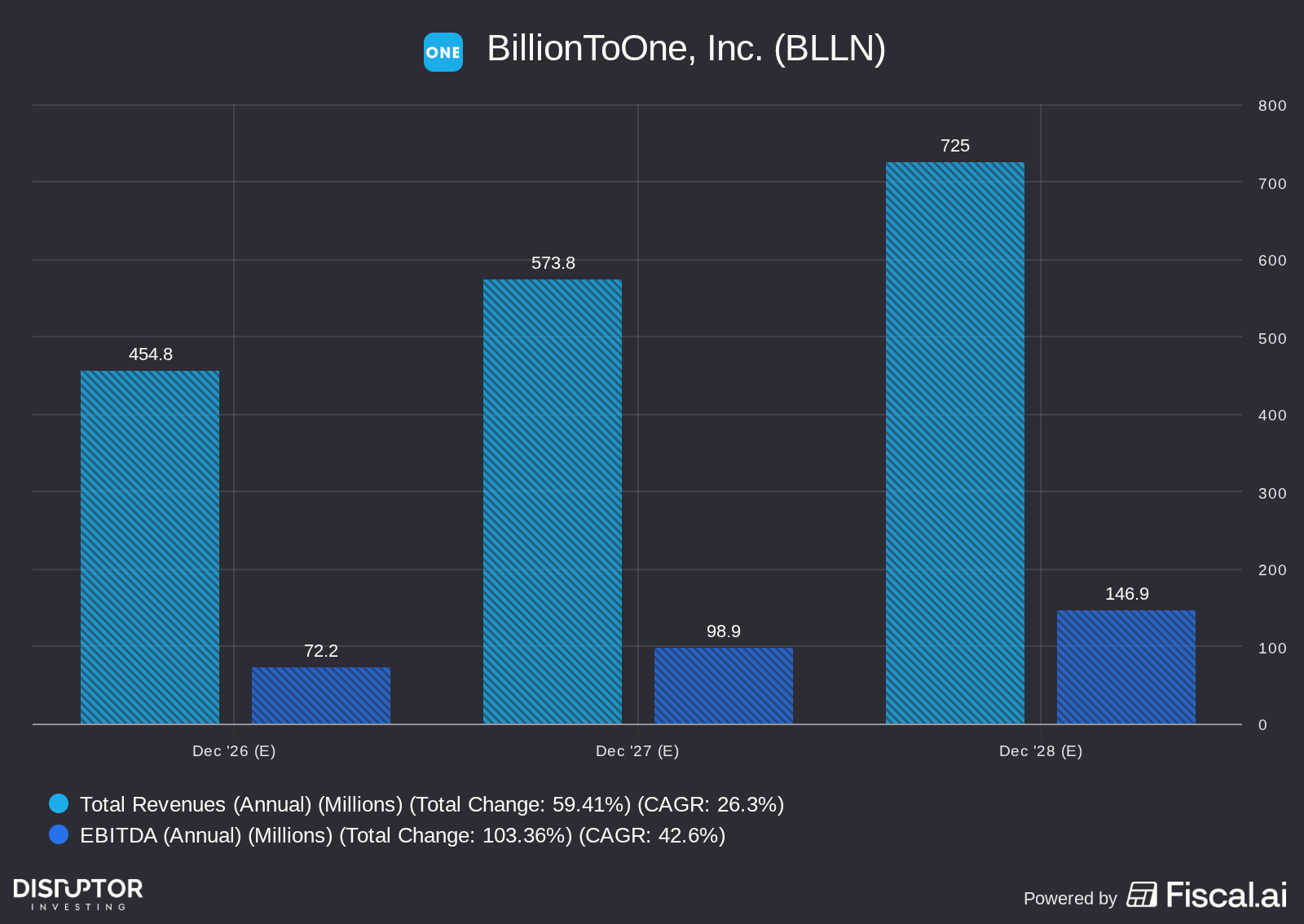
The company’s guidance for 2026 is $450M to $465M, which requires $232M to $247M in the second half. That is about 33% above the second half of 2025, half the growth rate investors are used to, and the reported slowdown is coming. Aggregator consensus for 2027 is about $577M, a figure we could not verify. Our own estimate is near $570M.
What the price already requires
At about $101 and 54.46M diluted shares, the equity is worth roughly $5.5B. Net of $457.6M of net cash, the business is valued at about $5.0B. For that to hold, we think revenue needs to reach about $700M in 2028, valued at 7 to 7.5 times sales, with margins rising as the sales hires mature.
Downside: prenatal growth slows to the mid teens and oncology flattens, giving about $600M in 2028 at 5 times sales, or around $64 a share. Central: prenatal grows in the high teens and oncology grows about 15% a quarter, half its recent pace, reaching roughly $100M in 2027 and $700M of total revenue in 2028. That works out to $99 to $106 a share. Upside: oncology passes $150M in 2028 and the total reaches about $780M at 8 times sales, around $124. Our central case supports today’s price but leaves little cushion.
The gap is in the oncology line. At 15% sequential growth, which is roughly half the Q1 to Q2 pace, Northstar adds about $45M of revenue in 2027. That is a large share of all the growth the company needs next year, and it comes from a product the reported total treats as a rounding error. The market priced the Q2 print as a prenatal lab slowing down. The evidence says a second business is compounding inside it, with its costs coming down.
What breaks it
We will treat any of these on November 4 as breaking the thesis: Q3 oncology revenue below $13.7M, the 2026 guide cut below $450M, or gross margin under 65%. A sequential drop in oncology would mean the sales force growth has run its course before payers have committed. A missed guide less than two months before year end would undercut what management says about the underlying growth.
The next most likely way it fails is collection rather than demand. Revenue is booked on estimates, and receivables grew far faster than sales in the first half. If they grow faster than revenue again in Q3 and operating cash flow turns negative, the profit is accrual, not cash. Financing is not the risk. The company reaches every test on this calendar with cash it already has.
What we are watching
- November 4, 2026, Q3 results. Strengthens: oncology at $16M or more, total revenue at $117M or more, guide held or raised, gross margin at 70% or more. Breaks: oncology below $13.7M, guide below $450M, or gross margin below 65%.
- November 4, 2026, cash and claims. Strengthens: positive operating cash flow, receivables rising more slowly than revenue, and some of the $10M of held claims released. Breaks: receivables growing faster than revenue for a second quarter.
- By December 31, 2026, launch of the residual disease test. Strengthens: commercially available in Q4 as promised. Breaks: slips into 2027 without a stated reason.
- Around early March 2027, full year results and 2027 guidance. Strengthens: 2026 revenue at $450M or more and 2027 guidance implying at least 20% growth. Breaks: 2027 guidance below 15%.
Not financial advice.
References
- BillionToOne, Inc. BillionToOne Reports Second Quarter 2026 Results and Reiterates 2026 Revenue Guidance (Form 8-K, Exhibit 99.1). US Securities and Exchange Commission. Published August 5, 2026. Accessed October 20, 2026. https://www.sec.gov/Archives/edgar/data/0002070849/000207084926000048/a991blln-earningspressrele.htm
- Investing.com. BillionToOne Q2 2026 slides: 64% revenue growth, shares plunge 30%. Investing.com. Published August 5, 2026. Accessed October 20, 2026. https://www.investing.com/news/company-news/billiontoone-q2-2026-slides-64-revenue-growth-shares-plunge-30-93CH-4839599
- BillionToOne, Inc. BillionToOne to Report Third Quarter 2026 Financial Results on November 4, 2026. Published October 14, 2026. Accessed October 20, 2026. https://www.globenewswire.com/news-release/2026/10/14/3380697/0/en/billiontoone-to-report-third-quarter-2026-financial-results-on-november-4-2026.html
- BillionToOne, Inc. Form 10-Q for the quarterly period ended June 30, 2026. US Securities and Exchange Commission. Published August 2026. Accessed October 20, 2026. https://www.sec.gov/Archives/edgar/data/0002070849/000207084926000050/blln-20260630.htm
- BillionToOne, Inc. BillionToOne’s Tissue Free Northstar Response Demonstrates On Par to Superior Cancer Treatment Monitoring vs. Tumor Informed Assay, New Peer Reviewed Study Finds. Published October 7, 2026. Accessed October 20, 2026. https://investors.billiontoone.com/news-releases/news-release-details/billiontoones-tissue-free-northstar-responser-demonstrates-par
- BillionToOne, Inc. BillionToOne Expands Northstar Platform with Launch of Two New Add On Liquid Biopsy Applications for Northstar Select. Published February 10, 2026. Accessed October 20, 2026. https://investors.billiontoone.com/news-releases/news-release-details/billiontoone-expands-northstar-platform-launch-two-new-add
- BillionToOne, Inc. BillionToOne Reports Third Quarter 2025 Results. Published December 9, 2025. Accessed October 20, 2026. https://www.globenewswire.com/news-release/2025/12/09/3202778/0/en/BillionToOne-Reports-Third-Quarter-2025-Results.html
- BillionToOne, Inc. BillionToOne Reports Fourth Quarter and Full Year 2025 Results and Raises 2026 Revenue Guidance (Form 8-K, Exhibit 99.1). US Securities and Exchange Commission. Published March 4, 2026. Accessed October 20, 2026. https://www.sec.gov/Archives/edgar/data/2070849/000207084926000013/a991blln-earningspressrele.htm
- BillionToOne, Inc. BillionToOne Reports First Quarter 2026 Results and Raises 2026 Revenue Guidance (Form 8-K, Exhibit 99.1). US Securities and Exchange Commission. Published May 6, 2026. Accessed October 20, 2026. https://www.sec.gov/Archives/edgar/data/0002070849/000207084926000029/a991blln-earningspressrele.htm