
While the tape fixates on chip sell-offs and Brent crude yo-yoing around $100, $RGNX is quietly running out the clock on what may be the most catalyst-dense quarter in its history — and the market hasn’t fully repriced it.
Here is the setup. REGENXBIO entered July expecting its Type A meeting with the FDA on NAVSUNLI (RGX-121), its one-time AAV gene therapy for Hunter syndrome (MPS II). That meeting, now imminent this week or next, is the gateway to a BLA resubmission targeted for Q3 2026. The FDA already acknowledged in June that existing NAVSUNLI clinical data is sufficient for the accelerated approval pathway — no new studies, no new patients, no placebo arm — a reversal from the February Complete Response Letter. Once RGNX resubmits, the FDA has signaled it will review on an expedited basis, with labeling talks beginning shortly after filing. A two-month review clock would put a potential PDUFA in the Q4–Q1 window.
That is only catalyst one. Simultaneously, RGX-202 for Duchenne muscular dystrophy completed dosing in its confirmatory study — 63 patients across pivotal and confirmatory cohorts — and RGNX plans to initiate a second BLA under accelerated approval, also in Q3 2026. The Phase III AFFINITY DUCHENNE pivotal met its primary endpoint with p<0.0001, with 93% of participants hitting at least 10% microdystrophin expression at Week 12. Duchenne affects roughly 1 in 3,500 to 5,000 boys born each year worldwide; an accelerated approval here, targeting 2H 2027, would address one of the largest unmet needs in rare pediatric disease.
The constraint on this sector has been FDA risk tolerance for small, uncontrolled rare-disease trials. That constraint is easing under the current FDA leadership, which has explicitly signaled a commitment to using the accelerated approval pathway for ultra-rare diseases with genuine unmet need — the very language CEO Curran Simpson cited when the NAVSUNLI reversal was announced.
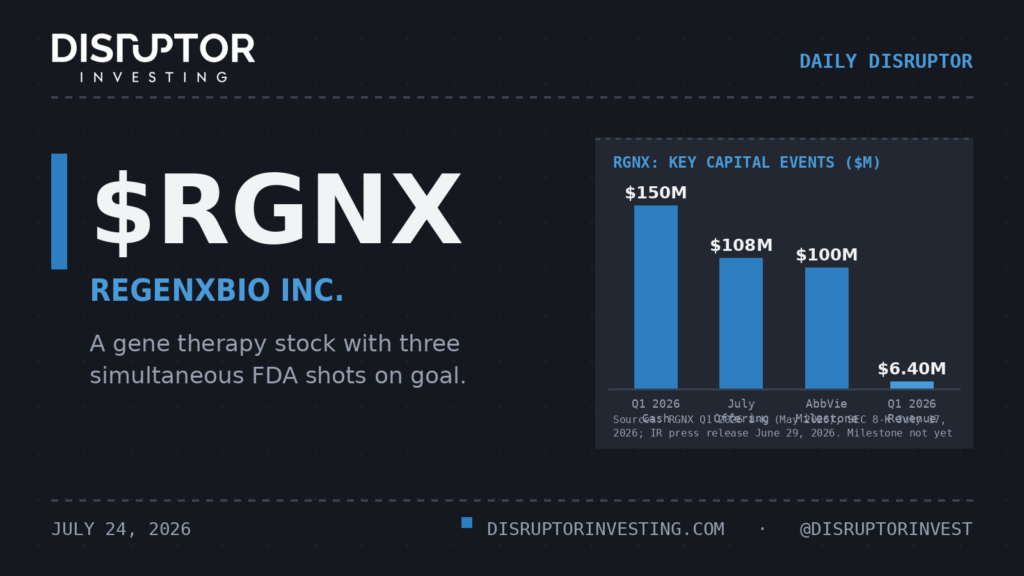
The balance sheet got a critical refresh. On July 17–20, $RGNX priced and closed a public offering of roughly 10 million shares at $9.00, plus pre-funded warrants, generating approximately $107.8 million in net proceeds after the underwriter greenshoe was exercised in full. Combined with its Q1 cash of $150.5 million, RGNX now enters a BLA-heavy second half with a materially extended runway — and a pending $100 million AbbVie milestone tied to first patient dosing in the NAAVIGATE diabetic retinopathy trial, which was completed in Q2. Three independent cash events in a single quarter. A fourth front, pivotal wet AMD data from partner $ABBV on the ATMOSPHERE/ASCENT programs, is on deck for Q4 2026.
The market cap sits near ~$650 million, pricing in significant execution risk. Watch the Type A meeting outcome this month, the NAVSUNLI BLA resubmission filing date, and any Q2 earnings guidance update in August. Metrics to monitor: whether the AbbVie $100M milestone posts to cash in Q2 results, microdystrophin expression durability data at 12 months in the RGX-202 confirmatory cohort, and FDA acknowledgment of the resubmission receipt letter.
Risk: This is still a pre-revenue clinical-stage company. Short interest stands at 22.3% of float, up 90.7% over twelve months — a crowded short that could squeeze on good news, or accelerate a sell-off on any regulatory stumble. The February CRL wasn’t RGNX’s first rodeo with the FDA reversing course. Denali Therapeutics ($DNLI) already received accelerated approval for Avlayah in Hunter syndrome in March 2026, creating a market entry competitor. Cash runway extends only into early 2027 even with the new raise if the AbbVie milestone is delayed. And the July offering at $9.00 — well below the 52-week high of $16.19 — signals dilution risk at inopportune times.
Not financial advice.